The traditional Independence Day parade in Washington D.C. was canceled this morning. It wasn't because of security threats or sudden political protests. It was the heat. A suffocating heat wave has parked itself over the East Coast, pushing temperatures to 38°C with a heat index making it feel closer to 43°C. For a moment, the vast green lawns of the National Mall stood empty, shimmering in the haze.
But the weather didn't stop the main event. Don't forget to check out our earlier post on this related article.
On July 4, 2026, the United States marks exactly two and a half centuries since fifty-six men signed their names to a document rejecting the absolute authority of a British king. It should be a moment of universal national reflection, a milestone that brings a fractured populace together. Instead, America's 250th birthday has been thoroughly re-engineered into a massive, highly synchronized political rally for Donald Trump.
If you look at how the government is marking this milestone, the shift is staggering. The official federal bipartisan planning group, the U.S. Semiquincentennial Commission, was quietly systematically reshaped. Early in his second term, Trump filled the board with loyalists. The original public-facing brand, America250, was pushed aside. National Park Service employees received internal memos telling them to scrub the old logos and replace them with "Freedom 250" insignias. What started as a nationwide historical commemoration morphed into a campaign known as "Rededicate 250," pitched as a national jubilee of prayer, praise, and thanksgiving. To read more about the background here, NPR offers an excellent summary.
The National Mall Becomes a Personal Playstage
The morning parade might have been canceled to protect spectators from heat stroke, but the evening plans went ahead exactly as the White House demanded. Trump scheduled a massive political gathering right on the National Mall. He openly promised a long speech, military flyovers, and a custom musical selection featuring his personal campaign playlist alongside traditional patriotic anthems.
This isn't how milestones usually work. In 1976, for the Bicentennial, President Gerald Ford gave a speech that focused on national healing after the trauma of the Vietnam War and the Watergate scandal. It was designed to lower the temperature of a divided nation. Today, the strategy is the exact opposite.
Trump hasn't hidden his desire to stand at the center of the nation's timeline. In public remarks leading up to the holiday, he joked about wanting to take personal credit for the 250-year anniversary itself, noting how his second term coincided with the World Cup, the Olympics, and this historic birthday.
While the humor gets laughs from his supporters, critics see something far more ominous. The original designers of the American republic were obsessed with a single fear. They dreaded the rise of an executive who would consolidate total power and treat the state as personal property. Watching a president convert a collective national anniversary into a partisan spectacle feels, to millions of citizens, like watching the ideals of 1776 being inverted in real time.
How the Celebration Splintered the American Identity
Walk through the crowds near the National Mall or listen to people across the country, and you see a profound fracture in how Americans view their own country today. For the MAGA movement, this day is a victory lap. Believers traveled from thousands of miles away, braving dangerous heat to fill the capital. To them, the administration's focus on a specific, traditionalist, faith-forward narrative of American history is a necessary reclamation of a country they felt was slipping away.
But for a massive portion of the population, the trappings of patriotism have become alienating. Many citizens who share a birthday with the nation expressed a deep sense of dislocation this year. They talk about a feeling that the national flag and the anniversary itself have been captured by a single political faction.
Consider the sheer optics of the event. A massive concert series organized under the federal celebration banner collapsed in mid-June after prominent artists, including the Commodores and Bret Michaels, pulled out due to concerns over the heavy political undertones. Rather than scaling back, Trump simply filled the void by transforming the event into a standard, high-octane political rally.
The Corporate Commercialization of 1776
Away from the political stage, corporate America did what it always does during a major milestone. It found a way to monetize the patriotism. This year, the commercial tie-ins reached a fever pitch, blending historic nostalgia with aggressive modern marketing.
Fast-food chains and national brands didn't hesitate to jump on the bandwagon. One major burger chain rolled out a promotional deal offering two grass-fed steakburgers, fries, and a themed milkshake for exactly $17.76 throughout the month of July. Coffee giants introduced limited-edition plastic cups shaped like eagles with sculpted lids, selling them for eleven dollars a pop with the promise of discounted beverage refills.
Even the luxury market found a way to cash in on the historic day. The Kennedy Center in Washington D.C. offered premier viewing packages for the evening fireworks show, with the highest-tier "presidential" package priced at a staggering $25,000 for groups wanting an elite, air-conditioned view of the night sky.
The contrast is stark. On one side, you have working-class families buying eagle-shaped coffee cups and $17.76 burger deals. On the other, wealthy donors paying five-figure sums to watch the sky light up while insulated from the dangerous humidity outside. It reflects the broader economic reality of the country at 250, where the gap between the wealthy and everyone else has never felt wider.
What the Fireworks Reveal About Modern Power
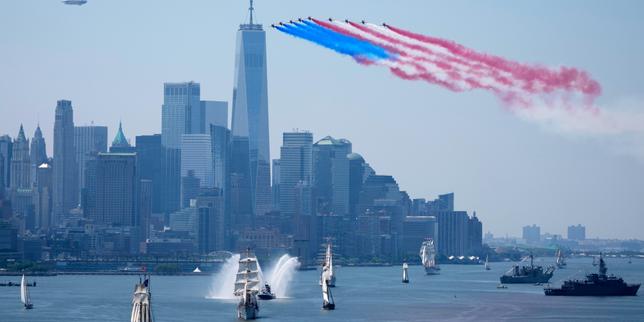
The administration vanted the evening display as the largest fireworks show in human history. The plan called for 850,000 rockets to be fired over a forty-minute period, an enormous escalation from typical annual displays.
It's a classic demonstration of power through sheer scale. The noise, the lights, the military flyovers, and the massive crowds are meant to project an image of absolute strength and unified exceptionalism. During his speeches, Trump repeatedly declared the United States the most exceptional nation on Earth, pointing to the size of the economy, the strength of the military, and the dominance of American technology.
But look beneath the smoke of nearly a million fireworks, and the structural vulnerabilities are hard to ignore. The anniversary arrives at a time defined by deep domestic policy fights, aggressive immigration crackdowns, and a fundamental disagreement over the rule of law. The country is growing faster, its technology is moving quicker, yet its core civic systems are under immense strain.
The Founding Fathers created a system meant to survive bad leaders, political tribalism, and foreign threats. What they didn't explicitly design was a system that could easily withstand a culture where truth itself is factionalized, and where the national story is rewritten by whoever holds the microphone at the White House.
Practical Next Steps for Navigating a Fractured Civic Landscape
If you're feeling disconnected from the national narrative today, or if you're trying to figure out how to engage with American history without the partisan noise, you don't have to just sit back and watch the television broadcast. History doesn't belong to the person currently occupying the Oval Office, no matter how loud the fireworks are.
First, step away from the televised rallies and read the actual source material. Harvard professor Danielle Allen, an expert on the founding era, points out that the Declaration of Independence is only 1,337 words long. It takes less than fifteen minutes to read out loud. Reading it yourself cuts through the modern political commentary and reminds you what the original argument was actually about, human equality and the right to alter a government that fails its people.
Second, support local historical preservation that tells a complete story. The national conversation is heavily focused on top-down narratives, but the real history of the last 250 years lives in state archives, local museums, and community projects. Look into how your own town or city marked previous milestones, or find local volunteer organizations dedicated to civil rights, civic education, and community organizing.
Finally, separate the concept of the nation from the individuals who happen to lead it. Governments change, politicians come and go, and administrations eventually end. The anniversary of a country belongs to the entire citizenry, not to a single political movement or a specific campaign strategy. Claiming ownership over your piece of that history is the most patriotic thing you can do.