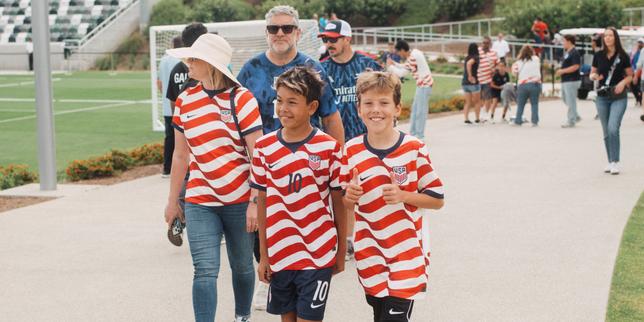
The Death of Just Happy to Be Here
Walk into any sports bar from Manhattan to downtown Los Angeles right now and the vibe hits you instantly. It's loud. It's sweaty. There's a strange, almost intense collective conviction in the air. For decades, American soccer fans approached the World Cup with a sort of polite defensive optimism. We wanted the team to advance past the group stage. We hoped to avoid getting embarrassed by traditional European giants. Surviving was the goal.
That mindset is completely dead. Meanwhile, you can find similar stories here: Why The 2026 World Cup Knockout Stage Is Pure Chaos Already.
As the knockout rounds begin, the conversation across the country has radically shifted. Fans aren't hoping for a deep run anymore. They genuinely expect one. If you talk to the supporters packing out stadiums in Seattle or packing fan zones in Miami, they don't see themselves as underdogs. They see Team USA as a legitimate contender to lift the trophy on home soil. It's not just blind patriotism or classic American bravado. Something fundamental has changed in how the public perceives soccer in the United States, and the current tournament is exposing that cultural shift to the rest of the world.
The Reality Behind the Hype
Belief requires proof. Without it, you're just screaming into the wind. This summer, the US Men's National Team gave their fans plenty of real evidence to fuel the fire during the group stage games. To explore the bigger picture, we recommend the detailed article by ESPN.
The tournament opened with a statement. A clinical 4-1 destruction of Paraguay in Los Angeles proved that the attack had teeth. It wasn't a lucky win built on counter-attacks or defensive desperate blocks. The team controlled the rhythm. They dictated the terms of the game. When they followed that up with a disciplined, suffocating 2-0 victory over Australia in Seattle, the national mood shifted from cautious interest to full-blown obsession.
Even the final group match, a chaotic 3-2 loss against a brilliant Turkish side, didn't break the momentum. Auston Trusty and Sebastian Berhalter found the net, proving the squad can score even when things get messy. They showed resilience after falling behind early to goals from Arda Güler and Barış Alper Yılmaz. Losing sucks, sure. But fighting back from a deficit in a hostile, loud environment showed a mental toughness that previous American generations simply lacked. They qualified comfortably for the knockout rounds. Now, a massive Round of 32 clash with Bosnia and Herzegovina in San Francisco awaits.
Cultivating the Home Advantage
Playing at home changes everything. The crowd isn't just watching the game. They are actively trying to influence it. European and South American commentators used to mock American soccer crowds for being too quiet or treating matches like family picnics.
Good luck finding a picnic atmosphere in the stadiums right now.
The fans in Seattle and Los Angeles have been brutal, loud, and relentless. It's an environment built to grind down visiting teams. Opponents aren't just playing against eleven guys on the pitch. They are dealing with a wall of sound that doesn't stop for ninety minutes. That home advantage gives the players an extra gear when their legs start to give out in the second half.
The Pochettino Factor
You can't talk about this team's absolute confidence without talking about the guy pulling the strings on the sideline. Mauricio Pochettino has brought a cold, calculated European club mentality to the national setup. He doesn't care about marketing campaigns or making everyone feel good. He cares about tactical discipline and winning.
Under his guidance, the team looks organized. The chaotic defensive meltdowns of yesteryear have mostly vanished. He has convinced players like Christian Pulisic, Giovanni Reyna, and Weston McKennie that they belong on the absolute highest stage. When the manager expects perfection, the players start expecting it too. That belief trickles directly down to the stands.
What Traditional Soccer Nations Get Wrong
If you read the international press, there's still a lot of condescension. European journalists look at the soaring American expectations and roll their eyes. They think it's typical American arrogance, a byproduct of a country used to dominating basketball, football, and baseball trying to force its way to the top of the global game.
They are completely misreading the situation.
This obsession isn't born out of ignorance. The average American fan in 2026 is highly educated about the sport. They watch the Premier League every Saturday morning. They follow the Champions League religiously. They know exactly how good France, Brazil, and England are. They aren't underestimating the opposition. Instead, they finally realize that their own player pool is filled with guys starting for top-tier clubs across Europe. The days of relying on a squad entirely comprised of domestic players or benchwarmers are over. This is a roster of hardened professionals who face elite competition every single week.
The Financial and Cultural Engine
Look at the numbers driving the sport right now. Youth participation is at an all-time high. Major League Soccer facilities are world-class. Corporate sponsors are pouring billions into the game because they see where the culture is heading.
Soccer isn't an alternative sport for counter-culture kids anymore. It's mainstream. The kids who grew up playing FIFA on their consoles and watching the 2014 or 2018 World Cups are now adults with disposable income. They are the ones buying out stadium tickets in minutes. They are the ones creating a soccer culture that is uniquely American—fusing traditional supporter group style with the high-energy spectacle of American sports entertainment.
Navigating the Brutal Knockout Road
The group stage was just the warm-up. The tournament changes completely when it becomes a single-elimination bracket. One bad bounce, one controversial VAR decision, or one defensive lapse can send you home.
Bosnia and Herzegovina will not be an easy out in the Round of 32. They are physical, organized, and have absolutely nothing to lose. The pressure is entirely on the host nation. If the US stumbles early, the critics will come out in full force, calling the pre-tournament confidence delusional.
To survive the bracket, the team needs to lean into three distinct tactical priorities.
- Protect the Transition: The loss to Turkey showed vulnerability when possession turns over quickly. The midfield must track back aggressively to avoid exposing the center-backs.
- Feed the Winger Channels: Pulisic and Timothy Weah need early service in space. When they get isolated against fullbacks, good things happen.
- Manage the Emotional Waves: Knockout soccer is emotional. Players can't let a bad referee call or an early conceded goal break their composure.
Your Plan for Following the Knockout Stage
Don't just watch the games passively from your couch. To fully experience what is turning out to be a historic moment in American sports history, you need to get involved.
First, locate your local independent supporter group chapter. Whether it's the American Outlaws or a local club bar, watching these knockout matches surrounded by die-hard fans offers an entirely different perspective than a sterile living room.
Second, follow tactical breakdown channels rather than just mainstream highlight shows. Look at how Pochettino adjustments happen in real-time during the second half. Understanding the subtle shifts in pressing lines will show you exactly why this team is succeeding.
Finally, keep an eye on the bracket layout. Map out the potential quarter-final and semi-final matchups. The road to the final is brutal, but understanding the potential opponents helps you see exactly what kind of tactical challenges this team will face next. The belief is real. Now it's time to see if they can back it up when everything is on the line.