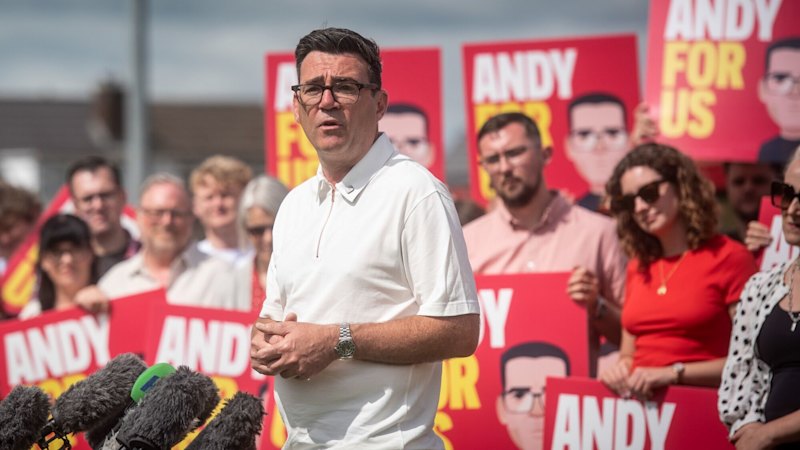
The political chess board in the United Kingdom just blew up. Keir Starmer has officially resigned as Prime Minister, ending months of speculation and internal warfare. The man standing directly in line to take the crown isn't one of the usual Westminster insiders who spent the last few years plotting in London coffee shops. Instead, it's Andy Burnham, the freshly elected Member of Parliament for Makerfield and the long-time Mayor of Greater Manchester.
For years, people called him the King of the North. It wasn't always a compliment. To his enemies in London, it was a subtle dig at his regional exile. But after his crushing by-election victory in Makerfield on Friday, June 19, 2026, where he took almost 55% of the vote and beat back a massive surge from Nigel Farage's Reform UK, Burnham made his return to Parliament. Three days later, Starmer bowed to the pressure and quit.
If you want to understand where British politics goes next, you need to look past the media catchphrases. Burnham isn't just a popular regional leader who got lucky. He's a political survivor who has completely re-engineered how power works outside of London.
The Path From Westminster Rebel to Downing Street Frontrunner
Most people forget that Andy Burnham used to be the ultimate party insider. He didn't start his career as an anti-establishment outsider. He went to Cambridge, worked as a researcher for Tessa Jowell, and became a special adviser in the late 1990s. By 2001, he was the MP for Leigh. Under Tony Blair and Gordon Brown, he climbed the ranks quickly, eventually running the Department for Culture, Media and Sport, and then serving as Health Secretary.
Then came the crashes.
Burnham ran for the Labour leadership twice. He lost in 2010 to Ed Miliband. He lost again in 2015, getting utterly flattened by the grassroots left-wing surge of Jeremy Corbyn. Back then, Burnham was viewed as a political chameleon. He was a man who tried to please every faction of the party and ended up pleasing none. He looked like a relic of a dying New Labour era.
Instead of fading into the backbenches, he did something radical for a British politician. He left Westminster entirely in 2017 to become the first elected Mayor of Greater Manchester. That move changed everything. It gave him space to reinvent himself away from the daily toxic spin of the capital. He traded the sterile green benches of the House of Commons for real-world execution on the streets of the North.
Understanding Manchesterism and the Fight With Boris Johnson
During his nine years in Manchester, Burnham built what political scientists now call Manchesterism. It's a brand of politics built around local pride, public control of services, and a flat rejection of the idea that everything good in Britain has to trickle down from London.
His breakout national moment came in 2020 during the darkest days of the pandemic. The central government under Boris Johnson tried to force Manchester into strict lockdowns without providing financial support for low-paid workers who couldn't work from home. Burnham didn't just disagree in private. He stood on the steps of the Bridgewater Hall, surrounded by local leaders, and gave a furious live television press conference attacking Downing Street.
He looked like a regional governor fighting an imperial capital. That single moment earned him the King of the North title. It proved to voters across the country that he cared more about his people than party lines or Westminster etiquette.
Look at what he actually did with that power over the next few years. He took on the private bus operators and created the Bee Network. He brought public transport back under public control for the first time since Margaret Thatcher deregulated it in the 1980s. He integrated buses, trams, and bikes into a single, cheap system with capped fares. While London crumbled under rail strikes and soaring costs, Manchester showed that local public ownership actually worked.
How He Slipped the Reform UK Trap in Makerfield
The biggest test for the Labour Party over the last year hasn't been the collapsing Conservative Party. It has been the terrifying rise of Reform UK. Nigel Farage's populist machine has been hollowed out traditional working-class seats across the industrial north, winning over voters who feel completely abandoned by the mainstream elite.
When Josh Simons stepped down from the safe Labour seat of Makerfield in May 2026, it triggered a high-stakes by-election. Everyone knew what it really was. It was a calculated gamble to get Burnham back into the House of Commons so he could legally challenge Keir Starmer for the leadership.
Reform UK threw everything they had at the seat. Their candidate, Robert Kenyon, ran a fierce anti-immigration, anti-establishment campaign. If Labour lost, or even if they crawled across the finish line by a few hundred votes, Burnham's momentum would be dead before he even reached London.
He blew them out of the water.
Burnham won 24,927 votes. He beat Kenyon by more than 9,000 votes. He didn't do it by acting like a typical London politician using scripted talking points. He spent five weeks on the ground, talking about the cost of living, regional fairness, and fixing public services. Professor Rob Ford from the University of Manchester pointed out that this victory makes Burnham Labour's single greatest asset. He proved that he knows how to talk to angry, working-class voters without alienating the progressive wing of the party. He showed that Reform UK is completely beatable if you offer people genuine local hope instead of abstract national arguments.
What an Andy Burnham Premiership Will Look Like
With nominations for the Labour leadership contest opening in July 2026, Burnham is the absolute favorite to win the votes of ordinary party members. He has a massive lead in the polls. An Ipsos survey just days before Starmer's resignation showed that 25% of the British public wanted Burnham as Prime Minister, compared to tiny figures for any other senior cabinet minister.
So what happens when he gets to Downing Street?
Expect an immediate shift away from the cautious, managerial style of Keir Starmer. Burnham has already dropped hints about his first 100 days. His team is talking about a temporary one-year rent freeze for private-sector tenants to ease the crushing cost of living crisis. He wants to move aggressively on the failing private water infrastructure, starting with bringing Thames Water back into public hands.
His biggest project will be a massive constitutional overhaul. He wants to take the Manchester model and roll it out across the entire nation. That means giving local mayors real powers to tax, spend, manage schools, and run local healthcare systems. He has also been a vocal supporter of proportional representation, promising a national commission to look into replacing the outdated first-past-the-post voting system.
It won't be an easy ride. The British Treasury hates giving up control of money, and civil servants in London will fight regional devolution every step of the way. He will also face massive internal pressure from Labour MPs who remember his older, shifting political identities and worry that his plans are long on poetry but short on detailed policy.
The Next Moves for British Politics
The transition of power has already started. If you're tracking where the UK goes next, watch these specific dates and events closely over the coming weeks.
- Swearing In: Burnham takes his seat in the House of Commons to officially begin his work as an MP.
- Leadership Nominations: The Labour Party opens formal nominations for MPs to back leadership candidates. A candidate needs support from 20% of Labour lawmakers (81 MPs) to make the ballot.
- The Campaign Trail: Candidates travel the country to pitch directly to hundreds of thousands of individual Labour Party members who cast the final votes.
- The Coronation or Vote: If the party unites behind Burnham to avoid a bloody civil war, he could be crowned leader by the end of summer. If a rival like Wes Streeting runs, a full member vote will wrap up by September.
The winner of this contest automatically becomes Prime Minister without needing a general election, using Labour's historic 2024 parliamentary majority. The era of cautious Westminster management is over. The King of the North is coming to London, and he's bringing the Manchester model with him.