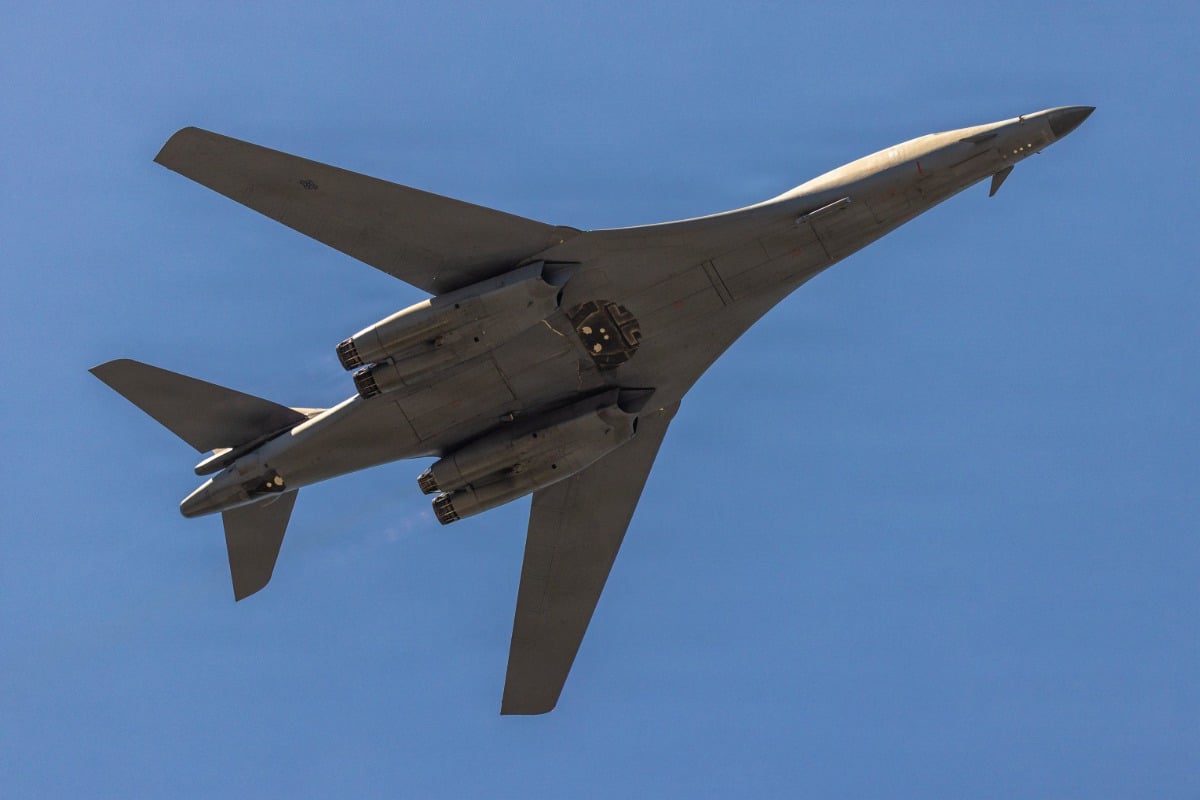
The U.S. Air Force just pulled off an engineering feat on a 40-year-old aircraft that most people figured was ready for the scrap heap. If you follow military aviation, you probably know the B-1B Lancer fleet has been beaten to absolute hell. Decades of flying low-altitude, high-stress missions in the Middle East have left these swing-wing supersonic bombers with severe structural fatigue.
When an aircraft's main spine starts cracking, the typical answer is retirement. Instead, the Air Force Life Cycle Management Center's B-1 Program Office just returned an operational Lancer to active service months ahead of schedule after replacing its entire Forward Intermediate Fuselage (FIF).
This wasn't a standard parts swap. It was massive, invasive structural surgery on a 33-foot component in the upper spine section of the jet. The project, officially dubbed the BackBONE Project, proves that legacy fleet sustainment isn't just about patching holes anymore. It's about completely rebuilding old warplanes using data tech.
What the Competitors Missed About the BackBONE Project
Most defense blogs reported this as a routine maintenance milestone or a simple wing-and-body part delivery contract. They completely missed the real story. The breakthrough here isn't that a factory stamped out a new piece of metal; it's how the Air Force bypassed the traditional, agonizingly slow defense supply chain to build and install it.
When tail number 86-0117 arrived at McConnell Air Force Base in Kansas, engineers expected a grueling 12-month turnaround. The structural repair wrapped up in just eight and a half months.
To understand why a three-and-a-half-month shortcut on a heavy bomber is a big deal, you have to look at how old planes are put together. No two B-1Bs are exactly identical. Hand-built in the 1980s, individual airframes settled, shifted, and warped under decades of G-forces. If you manufacture a 33-foot replacement beam based strictly on 1980s paper blueprints, it won't fit the actual plane sitting in the hangar.
The Air Force solved this by using a high-fidelity digital twin developed by Wichita State University’s National Institute for Aviation Research (NIAR). Since 2020, NIAR technicians have been meticulously laser-scanning disassembled retired bombers from the Arizona Boneyard to map every bolt hole, variance, and structural millimeter.
[Physical Bomber] ---> [Laser Measurement System] ---> [Digital Twin Model]
                                                                |
[Flawless Fitment] <-- [Directly Machined Fixture] <------------+
Before mechanics turned a single physical wrench on the operational jet, they simulated the entire sequence digitally. They used a laser measurement system to map the exact physical dimensions of the active bomber, transferred that data directly to the manufacturing fixture where the new FIF was built, and custom-machined the part to match the specific quirks of that airframe.
Why Bother Saving a Battered Cold War Jet?
Critics will tell you the B-1B is an expensive relic. It's true that the fleet has faced abysmal mission-capable rates over the last decade. The variable-geometry wings require heavy maintenance, the four General Electric F101-GE-102 engines are costly to feed, and the lack of stealth makes it highly vulnerable inside modern contested airspace.
Yet, Global Strike Command keeps pouring money into keeping 45 of these planes airborne. The reason is simple: payload capacity and standoff firepower.
While the stealthy B-2 Spirit and the upcoming B-21 Raider handle the deep-penetration missions against advanced air defenses, the B-1B acts as the ultimate heavy conventional weapons truck. It carries up to 75,000 pounds of internal ordnance—more than any other bomber in the U.S. inventory.
The Air Force is currently reconfiguring the Lancer’s bomb bays and testing external hardpoints to carry oversized, heavy hypersonic weapons that simply won't fit inside a stealth bomber's internal bays. If you want to launch a barrage of massive standoff missiles from hundreds of miles away, the B-1B is your best platform. Keeping it structurally sound means keeping that massive magazine capacity active until the B-21 arrives in sufficient numbers.
Replicating the Digital Twin Blueprint
The true value of this structural surgery goes way beyond a single bomber returning to Dyess Air Force Base in Texas. The BackBONE Project provides a scalable template for every aging asset in the Pentagon’s inventory.
The Air Force faces a massive crisis with long-range strike availability. The B-52 fleet is getting completely new Rolls-Royce engines, but those airframes are from the 1960s. The Navy’s F/A-18 Super Hornets are fighting severe corrosion issues. Fabricating structural parts for aircraft whose original manufacturers went out of business decades ago is usually a nightmare.
By relying on laser scanning and digital twin environments, depot maintenance teams can now:
- Pre-fabricate complex structural parts before an aircraft even arrives at the facility.
- Drastically reduce the number of post-repair structural inspections required, as the digital alignment ensures zero residual stress on adjacent components.
- Train maintenance crews on virtual reality models of the exact airframe configuration before physical installation begins.
The Next Steps for Airframe Sustainment
The Air Force cannot afford to treat heavy depot maintenance as an artisanal craft anymore. If you want to apply these digital engineering lessons to your own fleet or manufacturing processes, start with these actionable steps:
- Stop Relying on Legacy Blueprint Data: Paper schematics do not account for decades of structural warping or field modifications. Transition completely to high-fidelity 3D laser scanning for any hardware older than twenty years.
- Incorporate Prototype Dry Runs: Use decommissioned assets or virtual twins to sequence complex teardowns. Finding out a bolt is inaccessible on a digital model saves weeks of physical engineering delays.
- Integrate Multi-Unit Maintenance Teams Early: The BackBONE project succeeded because the 22nd Maintenance Group at McConnell and the 7th Maintenance Group from Dyess worked alongside NIAR researchers from day one, ensuring the operators who fly the jet knew exactly how it was rebuilt.