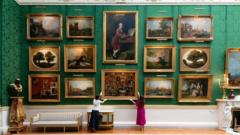
If you think royal art galleries are static spaces where nothing changes for centuries, you're mistaken. Buckingham Palace just proved it. The Buckingham Palace Picture Gallery has undergone a massive, once-in-a-generation transformation just in time for its summer opening. They've almost doubled the number of masterpieces hanging on the walls, jumping from 63 to 120 paintings.
This isn't just a minor shuffle of frames. It's a radical rethink of how the public experiences some of the most valuable art on the planet. For decades, the gallery had a specific, somewhat faded look that defined how millions saw the royal collection. Now, that era is officially over.
Curators spent a staggering 875 hours hanging the new selection. If you visit London between July 9 and September 27, you'll see a room that looks completely unrecognizable compared to last year. Here's exactly why this overhaul is a massive deal for art lovers, historians, and casual tourists alike.
The Death of the Pink Velvet
Let's talk about the walls first. Since 1976, the Buckingham Palace Picture Gallery was defined by its coral pink velvet wall coverings. It was a specific choice that aged into a historical artifact of its own. Over fifty years, that fabric deteriorated, faded, and grew tired.
The curators didn't just patch it up. They ripped it out and replaced it with a vibrant emerald-green silk damask.
This color shift completely alters how your eyes perceive the art. The 47-meter-long gallery, originally designed by architect John Nash in the nineteenth century, has always been a shape-shifter. History shows that royal tastes fluctuate wildly.
In the beginning, the room was a bright golden yellow. Then came the Victorian era, bringing a fashionable, muted lilac. Later, it became a dramatic crimson red, followed by a long stint in olive green for most of the twentieth century.
This new emerald green isn't just decorative. Old Master paintings, with their deep shadows and rich oil glazes, pop against a dark, saturated backdrop. The old pink velvet absorbed too much light and competed with the flesh tones in Renaissance portraits. The green damask recedes, letting the golds, reds, and deep blues of the paintings dominate the space.
The Return of the Rejected Masterpiece
Doubling the number of paintings means digging deep into the royal vaults. Some of these works haven't been seen in this room for nearly two centuries.
The most fascinating addition is Johann Zoffany's massive painting, The Tribuna of the Uffizi. Queen Charlotte originally commissioned this work, expecting a grand, orderly depiction of the famous Florentine gallery. Instead, Zoffany painted a crowded, chaotic scene filled with tech-bro-equivalent connoisseurs of the eighteenth century gawking at classical sculptures and arguing over art.
Queen Charlotte absolutely hated it. She found the composition messy, crowded, and completely unconventional. Because of her dislike, it was banished from her private apartments. It last hung in the Picture Gallery way back in 1841. Bringing it back now is a brilliant, cheeky move that acknowledges the complex history of royal taste.
You'll also get to see how artists interacted with each other across time. The new hang features Peter Paul Rubens's famous Self Portrait. In a stroke of curatorial genius, it has been placed directly facing a newly added portrait that Rubens painted of his close friend and legendary fellow artist, Anthony Van Dyck. Seeing these two artistic titans look at each other across the room gives the space a surprisingly intimate feel. It stops being a cold museum and starts feeling like a room where people actually lived and collected.
Dogs, Doctors, and Dutch Masters
The expanded collection doesn't just stick to solemn portraits of long-dead monarchs. It covers an incredible range of subjects that reveal the personal quirks of past kings and queens.
Take George Stubbs's painting, A Rough Dog. It's widely believed to be a portrait of George IV's actual pet dog. It sits alongside Thomas Gainsborough's magnificent portrait of the musician Johann Christian Fischer. Then you have the heavy hitters. The room currently holds five separate works by Rembrandt, alongside masterpieces by Caravaggio.
Most people don't realize that the royal collection isn't a museum collection built by a committee. It's an accumulation of personal obsessions. King George IV bought roughly half of the paintings in this specific gallery. He had an insatiable appetite for Dutch and Flemish art, which explains why the palace holds such an absurdly dense concentration of world-class seventeenth-century masterpieces.
How to Actually Look at a Double-Stacked Gallery
If you're planning to visit the State Rooms this summer, you need a strategy. Walking into a room with 120 masterpieces can easily trigger visual fatigue. The curators have utilized a classic "double-stacked" hanging method, meaning paintings are arranged in tiers, one above the other.
Don't try to look at everything with equal intensity. You'll leave with a headache.
Start by looking at the lower tier first. This is where you'll find the works with intricate details, like the small Dutch genre scenes or the precise brushwork of Rembrandt's portraits. These were painted to be viewed from a few feet away, at eye level.
Then, step back to the center of the Nash-designed gallery to take in the upper tier. The higher paintings are usually larger, with bolder compositions designed to be read from a distance. Look for the dramatic lighting of Caravaggio or the sweeping brushwork of Rubens.
Pay attention to the lighting, too. John Nash built the gallery with a glass ceiling to flood the space with natural London light. Depending on whether you visit on a bright, sunny afternoon or a gray, overcast morning, the emerald walls and the oil glazes will look completely different.
The Changing Purpose of the Palace
This massive re-display happens at a very specific moment in royal history. It comes right after the announcement that King Charles and Queen Camilla won't be moving into Buckingham Palace as their primary residence.
For generations, this building was a private home first and a public monument second. Now, that balance is shifting. The Picture Gallery is still used for state visits, where foreign presidents and monarchs are escorted through to see special exhibitions. Donald Trump was taken on a tour here during his state visit in 2019.
But with over half a million members of the public walking through these doors every summer, the focus is turning toward public benefit. The Royal Collection Trust stated that this re-hang directly aligns with their charitable aim to share as much of the collection as possible with the public.
It makes you think about the future of these artworks. Unlike the state collections in France, Spain, or Austria, which were handed over to national museums because of revolutions or political agreements, the British royal collection remains held in trust by the Sovereign for the nation. It's one of the last intact royal treasure troves in Europe. Seeing it adapt to the twenty-first century by packing more art onto the walls is a sign that the institution knows it needs to offer more value to the people buying tickets.
Your Next Steps for a Summer Visit
Don't wait until the last minute if you want to see this transformation in person. The summer opening only runs from July 9 to September 27, 2026.
Book your tickets online well in advance through the official Royal Collection Trust website. Morning slots are usually crowded with tour groups, so aim for an afternoon booking when the crowd thins out slightly and you can actually stand in front of the Rubens without getting bumped.
When you get inside, bypass the gift shops initially and head straight for the State Rooms. Spend your energy in the Picture Gallery while your eyes are still fresh. Bring a good pair of glasses if you need them, because looking at the top row of a double-stacked gallery requires some serious squinting. Look for the Zoffany painting and try to spot why Queen Charlotte found it so objectionable. Once you see the sheer density of characters crammed into that frame, you'll understand why she preferred a quieter wall.


