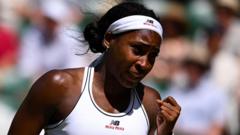
Coco Gauff just did something she has never done before. At 22 years old, she finally broke through the grass-court ceiling to reach her first Wimbledon semifinal. She did it the hard way too. She dropped the opening set against her regular doubles partner and fellow American Jessica Pegula, looked completely out of sorts in the blazing midday heat, and then completely turned the match on its head to win 4-6, 6-3, 6-3.
If you've followed Gauff since she burst onto the scene as a 15-year-old phenom seven years ago, this moment feels different. It feels like a massive shift in how she approaches a surface that has historically made her look mortal.
When she walked off Centre Court on Tuesday, she joked about whether she is officially a veteran now. She might be joking, but the way she survived a brutal, sweltering quarterfinal against the fourth seed showed exactly the kind of maturity you expect from a seasoned tour veteran. This wasn't a win built on youthful exuberance or raw athletic talent alone. It was a tactical, gritty piece of problem-solving.
By surviving this match, Gauff achieved an elite milestone. She is now the youngest woman to reach the semifinals at all four Grand Slams since Maria Sharapova did it back in 2007. Think about that. She has completed the full set of major semifinals before turning 23, and she did it during a tournament where she openly admitted she hadn't won a single match on grass for two full years prior to this fortnight.
The Mental Shift on Centre Court
Wimbledon has always been a complicated place for Gauff. It's where the world first met her when she knocked out Venus Williams in 2019. That fairytale run set expectations impossibly high. For years, every time she stepped onto the grass in London, she looked weighed down by the ghost of her teenage self. The nerves would creep in, her second serve would fall apart, and opponents would exploit her shorter forehand responses.
This year changed everything. Gauff revealed after the match that for the first time in seven years of playing at the All England Club, she walked onto Centre Court without feeling any nerves. That's a massive confession. It shows she's no longer fighting the hype or the past. She's just playing the ball in front of her.
Against Pegula, that lack of panic saved her tournament. Pegula started white-hot, breaking Gauff in the very first game of the match. The older American was striking the ball beautifully from the baseline, refusing to give Gauff any rhythm. In previous years, going down an early break against a top-five player on grass would have triggered an avalanche of double faults and unforced errors from Gauff. Not this time. She stayed within striking distance, took her medicine in the first set, and reset during the changeover.
The heat was a major factor too. Temperatures soared past 84 degrees Fahrenheit, turning Centre Court into a pressure cooker. Both players were visible struggling, with Gauff asking the chair umpire for ice packs to cool down her cheeks and thighs during changeovers. Winning a match like this requires a certain level of physical suffering, and Gauff showed she is more than willing to embrace that grind.
Breaking Down the Tactical Adjustments
To understand why this version of Gauff is so dangerous, you have to look at the adjustments she made after dropping that first set. Pegula was suffocating her with flat, deep groundstrokes that didn't bounce high enough for Gauff to wind up on her forehand wing.
Gauff shifted her position. She stepped up closer to the baseline in the second set, taking away Pegula's time. Instead of engaging in endless crosscourt baseline rallies where Pegula holds the upper hand, Gauff started changing the rhythm. She hit with more heavy topspin to alter the bounce height on the grass, forcing Pegula to strike the ball out of her ideal comfort zone.
Then came the net rushing. Gauff is one of the best doubles players in the world, yet she often hesitates to bring that skill set to her singles matches. In the second and third sets, she abandoned her hesitation. She used her incredible speed to track down short balls and transition forward, putting immense pressure on Pegula's passing shots.
Look at the stats for the longer rallies. Gauff completely dominated the exchanges that went past nine shots, winning roughly 75 percent of those extended points in the final set. She wore Pegula down physically and mentally. Every time Pegula thought she had hit a winner, Gauff's defensive coverage brought the ball back, forcing one extra shot until Pegula finally blinked.
The serving issues haven't completely disappeared. Gauff still hit seven double faults and struggled on her second serve points, winning less than half of them. But great players find ways to win when their primary weapons aren't firing perfectly. She hit a booming 117mph ace to seal the second set, proving that she can still summon the big serve exactly when the pressure peaks.
Surviving the Ultimate Tightrope Walk
This wasn't an isolated survival story. Gauff's entire run through the 2026 Wimbledon draw has been a masterclass in living on the edge. She has played four consecutive three-set matches just to get to this point.
Think back to the second round against Solana Sierra. The young Argentine actually served for the match against Gauff. The tournament was seconds away from becoming another disappointing early exit for the American. Gauff refused to break. She stayed solid, let her opponent feel the pressure of the finish line, and broke back to save her tournament.
Then came the round of 16 against Belinda Bencic, another grueling three-set war where Gauff had to navigate referee interventions and extreme tension to close it out. By the time she faced Pegula, Gauff was entirely comfortable with discomfort. She had spent the last week playing with a metaphorical noose around her neck, so going down a set to the number four seed didn't shock her system.
When you have that level of deep, earned competitive faith, you view a lost set as a minor speed bump rather than a disaster. That psychological edge is what separates Grand Slam champions from the rest of the pack. Pegula, who is 32 and still hunting for her first major title, looked like the player carrying the weight of the world in the final set. Gauff looked like she was just getting started.
What Lies Ahead in the Semifinals
The draw is now wide open for Gauff. As the highest seed remaining in the women's tournament, she carries the mantle of the favorite, whether she likes it or not. Next up is a semifinal clash against either Naomi Osaka or Karolina Muchova.
Both potential matchups present fascinating tactical challenges. A match against Osaka would be a box-office blockbuster featuring two of the biggest brands and hardest hitters in tennis. Muchova, on the other hand, brings a crafty, slice-heavy variety that can disrupt anyone's rhythm on grass.
If Gauff wants to lift the Venus Rosewater Dish on Saturday, she has to clean up the early match sluggishness. She cannot afford to keep giving away opening sets against elite opposition. The double faults need to be minimized, and she must maintain the aggressive net-rushing identity she discovered against Pegula right from the very first point.
Your Next Steps to Follow the Action
The tournament is reaching its absolute peak, and things move fast from here. Here is what you need to do to stay on top of Gauff's historic run:
- Check the Thursday Schedule: The women's semifinals are scheduled for Thursday afternoon. Keep an eye on the official Wimbledon order of play to see the exact court timing for Gauff's match.
- Watch the Serve Metrics: In the opening games of the semifinal, pay close attention to Gauff's second-serve speed and placement. If she is landing them deep and avoiding early double faults, it's a massive indicator of her comfort level.
- Track the Net Points: Watch how early Gauff decides to move forward. If she stays glued to the baseline, she is playing into her opponent's hands. If she attacks the net early, she is in control.