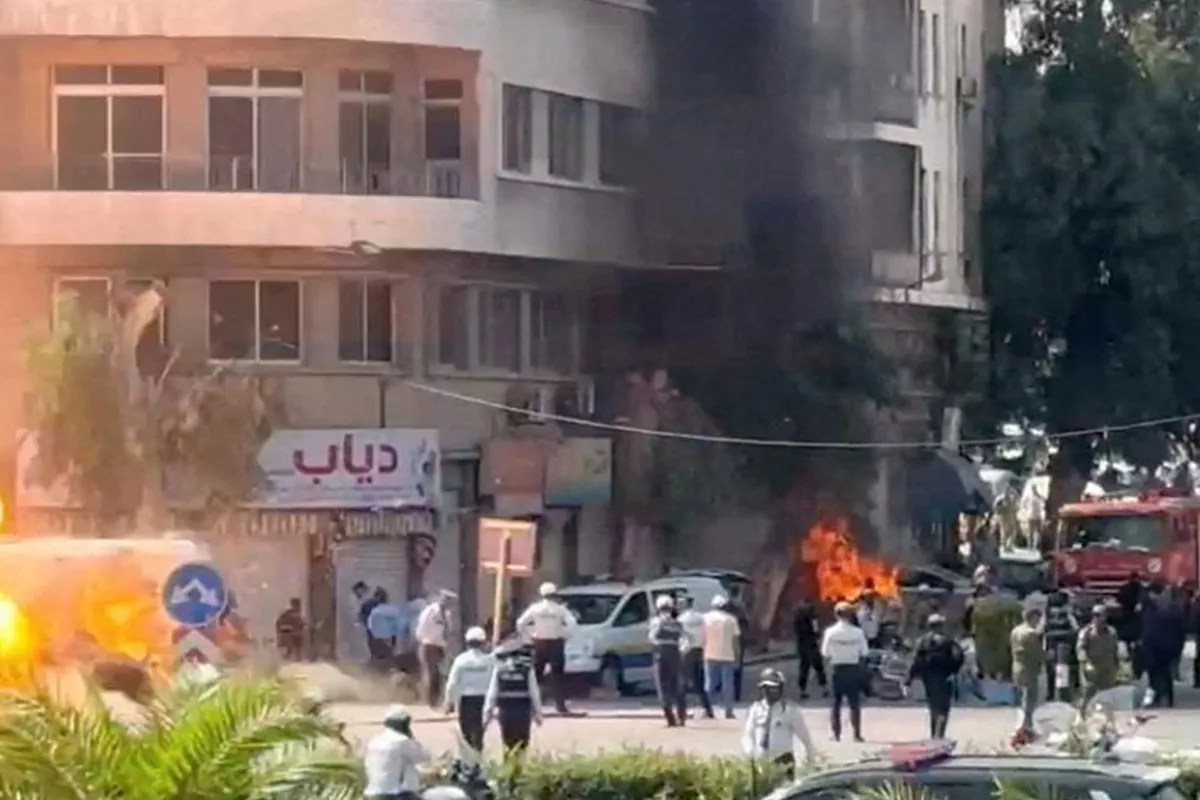
Two crude bombs packed with explosives detonate in the middle of a bustling morning in Damascus. One hides in a trash can; the other rests inside a parked car. The target area isn't random. It’s right outside the security cordon of the luxury Four Seasons Hotel, the exact spot where French President Emmanuel Macron had spent the night.
18 people are left bleeding on the pavement, including four police officers. Thick black smoke blankets the sky, yet Macron’s motorcade is already miles away, speeding toward the presidential palace. He didn't even hear the blast.
If you thought Syria was entirely stable after the shocking overthrow of dictator Bashar al-Assad in late 2024, Tuesday’s attack is a brutal wake-up call. It's the second major bombing in the capital within a single week, following a cafe explosion that killed ten people near the Justice Palace. It shows a fragile, volatile reality that the country's new leadership is desperately trying to mask.
The Reality of Post-Assad Syria
Let’s look at what's actually happening on the ground. Macron is the very first European Union head of state to step foot in Damascus since the regime change. He arrived on a mission to open what he calls a "new page of stability and peace," bringing a heavy delegation of French business executives from corporate giants like TotalEnergies and shipping titan CMA CGM.
But why would the French president risk his personal safety—and his political reputation—to back a new Syrian government?
To understand this, you have to look at the man sitting across from him at the People's Palace: Syrian President Ahmed al-Sharaa.
Al-Sharaa isn’t your typical Western-allied diplomat. He’s a former Islamist insurgent commander who once led the al-Qaeda-linked group Hayat Tahrir al-Sham. Over the last two years, he has pull off one of the most aggressive geopolitical rebranding acts in modern history. He disavowed his extremist past, promised an inclusive democratic transition, protected skeptical religious minorities, and successfully convinced France to champion the lifting of heavy Western economic sanctions.
For Macron, backing al-Sharaa is a massive calculated gamble. France wants to lead the multi-billion-dollar reconstruction effort in a war-torn country that has been shattered by over a decade of conflict. Paris also wants a stable partner in the Middle East to curb migration and maintain counterterrorism cooperation.
What the Competitors Missed About the Security Cordon
Most mainstream news outlets simply reported the explosions as a shocking security failure. They missed the tactical reality of how Damascus is currently policed.
The Syrian Interior Ministry quickly noted that the crude devices went off just outside the primary security perimeter established for the French delegation. Syrian intelligence officers had actually identified the suspicious items and were preparing to defuse them when the wireless triggers were pulled.
This tells us two distinct things. First, the internal security apparatus under al-Sharaa has sharp ears and eyes, but it's dealing with a highly sophisticated network of underground cells that know how to bypass military checkpoints. Second, the attackers weren't necessarily trying to assassinate Macron. They were trying to assassinate the narrative that al-Sharaa has everything under control.
Think about the timing. The bombs shattered the morning peace just as Macron donned his trademark aviator sunglasses to shake hands with al-Sharaa. The goal was to scare off the international investors sitting in Macron's traveling entourage. If a bomb can explode near the Four Seasons while a Western G7 leader is in town, what does that mean for an ordinary foreign engineer or executive trying to rebuild an oil refinery?
Moving Past the Chaos
Despite the blood-stained streets and the burning vehicles captured on local social media feeds, both leaders refused to back down. They went ahead with their scheduled meetings, signed major economic memorandums of understanding, and boldly announced the formal return of their respective ambassadors after more than twelve years of frozen diplomatic ties. France had closed its embassy back in 2012; now, the diplomatic highway between Paris and Damascus is officially open again.
Hours after the incident, Macron took to X to brush off the threat. He stated that nothing could "smother the aspiration of Syrian women and men to live in a fully sovereign, safe, pluralistic, and united Syria."
The French president is playing the long game. Later today, he flies directly to Ankara, Turkey, for a crucial NATO summit where US President Donald Trump and President al-Sharaa are expected to hold high-profile talks.
If you're watching Syria’s reconstruction space, don't let the headlines panic you into thinking the country is sliding back into total civil war. Political risk analyst Aron Lund pointed out that while these attacks dent short-term investor confidence, they pose zero actual threat to the government's centralized control over Damascus.
Your next steps to monitor this developing situation include tracking the upcoming NATO summit outcomes in Ankara to see if the US mirrors France’s aggressive sanction-lifting policies, and keeping a close eye on the stock performance of infrastructure and energy firms eyeing eastern Mediterranean contracts. The corporate rush into the new Syria has begun, and a couple of roadside bombs aren't going to stop it.


