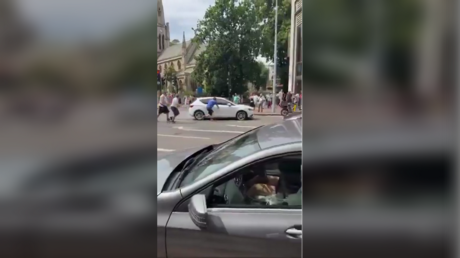
A white car speeds up on a busy Saturday afternoon in west London. Pedestrians scramble. Bystanders run alongside the vehicle, kicking the doors and trying to force their way inside to stop the driver. It sounds like a scene from a thriller, but it happened in broad daylight on Ealing Broadway.
Five people were left injured. The driver sped away from the chaos before police tracked him down minutes later. Whenever a car drives into a crowd in a major Western capital, the public mind immediately jumps to one conclusion. We've seen it too many times before. The internet explodes with speculation, and international headlines lean heavily into the driver's background.
Let's look at what actually happened on June 27, 2026, and why the official response isn't matching the online outrage.
The Chaos on Ealing Broadway
The emergency calls started hitting the London Ambulance Service at 2:29 pm. On a sunny Saturday afternoon, Ealing Broadway was packed with shoppers and families. Out of nowhere, a vehicle struck multiple pedestrians.
The immediate aftermath was pure confusion. Mobile phone footage quickly circulated on social media, showing a chaotic scene where ordinary citizens tried to intervene. In the videos, you can see people chasing a white car, visibly desperate to halt its progress. Instead of stopping, the driver accelerated and hit the gas, leaving injured people on the pavement.
Emergency responders flooded the area. The London Ambulance Service deployed ambulance crews, fast response cars, an incident response officer, and even dispatched London’s Air Ambulance.
Here is how the casualties shook out:
- Five pedestrians total were injured.
- Two people were treated right there at the scene for minor injuries.
- Three people were rushed to the hospital, including one taken to a major trauma centre as a priority.
The good news? None of the injuries are life-threatening or life-changing. It could have been much worse.
Who is the Driver?
The driver didn't hang around to help. He fled the scene in the vehicle, sparking a brief but intense manhunt. Metropolitan Police officers managed to corner and stop the vehicle a short time later in Grange Park, a residential area nearby.
The man behind the wheel is a 34-year-old Somalia-born British citizen. Police arrested him on suspicion of dangerous driving and attempted murder.
Because of the terrifying nature of the crash, local police immediately looped in Counter Terrorism Policing London. That's standard protocol now. When a car plows into a crowd in London, counter-terror investigators conduct the initial inquiries to see if they are dealing with a coordinated attack or an inspired lone wolf.
After looking into it, the Met Police made a definitive statement: the incident is not being treated as terrorism. Investigators are keeping an open mind about why he did it, but they've ruled out a political or ideological motive for now.
Why Headline Framing Matters
If you look at certain international outlets, the framing tells a very specific story. Headlines screaming about a "Somalian migrant" are designed to trigger a specific political reflex. They want you to think of border control, failed integration, and national security threats.
But there's a big difference between an asylum seeker who just crossed the English Channel and a 34-year-old British citizen who happened to be born in Somalia. Nuance gets completely flattened in the rush for clicks.
When people see the phrase "not treated as terrorism," they often get skeptical. They think the government is trying to cover something up to keep the peace. But the legal definition of terrorism in the UK is very precise. It requires proof that the act was designed to influence the government or intimidate the public for a political, religious, racial, or ideological cause.
If a driver is high, having a psychotic episode, experiencing severe road rage, or fleeing a completely unrelated crime, it's a horrific criminal act. It's attempted murder. But it isn't terrorism. Treating every violent crime by a minority background as a terror plot doesn't make anyone safer. It just feeds the panic cycle.
What Happens Next
The area around Ealing Broadway faced heavy road closures while forensic teams gathered evidence from the asphalt. If you're trying to make sense of this or worried about safety in the area, here is what you need to look out for next:
- Watch the formal charges. The suspect was arrested on suspicion of attempted murder. If the Crown Prosecution Service maintains that charge, it means they believe he intentionally tried to kill those pedestrians, regardless of his ideological background.
- Look for mental health evaluations. In many non-terror mass casualty events involving vehicles, court proceedings eventually reveal severe psychiatric distress or substance abuse.
- Check for local security updates. Ealing Council and the Met Police usually step up visible patrols after an incident like this to reassure the public, even when terror is ruled out.
If you witnessed the event or have dashcam footage from Ealing Broadway or Grange Park around 2:30 pm on Saturday, don't just post it on X. Call the police on 101 and give them the reference number 4607/27JUN. The legal system needs clean evidence, not social media speculation, to secure a conviction.