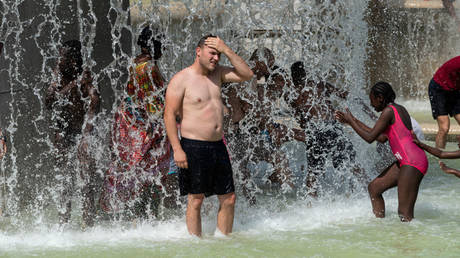
Thermometers across Europe are hitting numbers that look like typos. 40°C in Germany, 43°C in southern Europe, and spots in France crossing 45°C. For millions of people, it feels less like a typical summer and more like an existential structural failure. It is.
If you're wondering why a temperature that is standard for summer in places like India or Texas is currently causing total chaos across Western Europe, the answer is simple. European infrastructure wasn't built for this, and the continent is warming at double the global average speed. Don't forget to check out our previous coverage on this related article.
World Health Organization Director-General Tedros Adhanom Ghebreyesus recently summarized the situation bluntly on the X platform. Over 150 million people are living under extreme heat right now, grids are buckling, schools are shut down, and hundreds have died. In France alone, public health authorities just confirmed more than 1,000 excess deaths over a single three-day peak.
This isn't a random bad week of weather. It is a complete mismatch between a rapidly heating continent and a built environment designed for a world that no longer exists. To read more about the history of this, BBC News offers an informative breakdown.
The Architecture Problem
Walk into almost any apartment in Paris, Berlin, or London, and you'll notice something immediately. There is no air conditioning. Less than 5% of European homes have cooling systems installed. For generations, traditional building design focused on keeping heat in, not letting it out.
Thick stone walls, dense brickwork, and double-glazed windows work beautifully during freezing winters. They trap thermal energy. But when a heat dome settles over a city for a week, those exact same buildings turn into ovens. They absorb solar radiation all day during Europe’s long, 16-hour summer days. Then they radiate that heat inward throughout the night.
Nighttime offers zero relief. The World Weather Attribution group noted that these soaring nighttime temperatures have become 100 times more likely over the last two decades. When your bedroom stays at 32°C all night, your body never gets a chance to recover. Your heart rate stays elevated. Your core temperature stays up.
That is exactly why the death toll spikes. Public Health France reported that 85% of the recent fatalities involved people aged 65 and older. Most didn't pass away on the street; they died in their own living rooms and residential care homes.
Why European Heat Feels Different
People often ask why 43°C in Paris feels deadlier than the same temperature in New Delhi. Geography and atmosphere play a massive role here.
First, Europe sits further north than most people realize. Paris is further north than Toronto. Because of that high latitude, the summer sun hits at a lower angle but stays up for hours longer than it does in tropical regions. Cities have more time to soak up heat.
Second, the air is clearer. Industrial regions in Asia often have significant levels of suspended particulate matter in the air before the monsoon season. These tiny particles scatter and diffuse direct sunlight. Europe has relatively clear skies during these heat domes. The solar radiation hits your skin and the pavement directly, without any atmospheric filter. It feels sharper, harsher, and far more exhausting.
Infrastructure on the Brink of Collapse
The physical systems that keep Europe moving are literally melting. Rail networks are experiencing massive delays because steel tracks are bowing. When steel tracks face direct sunlight in 40°C ambient temperatures, the rail metal can easily reach 50°C or hotter. They expand, warp, and can cause train derailments. Operators like Govia Thameslink in Britain and regional lines in Germany have been forced to introduce severe speed restrictions or cancel trains entirely.
The energy grids are failing for two reasons simultaneously. Demand for power is spiking as people scramble to buy portable AC units and fans, leading to chaotic scenes outside electronics stores. At the exact same time, power generation capacity is dropping.
Nuclear plants in France rely heavily on river water to cool their reactors. But Europe's rivers are running historically low and warm. The Po River in Italy has dwindled so much that saltwater from the sea has pushed 18 kilometers inland, destroying agricultural fields. If power companies pump water that is already too warm back into the rivers after cooling a reactor, they risk killing off entire aquatic ecosystems. So, they have to throttle power production precisely when the public needs electricity most.
The human toll on workers is getting dangerous. In France, a major city bus crashed after the driver fainted at the wheel. The vehicle had no air conditioning. In Berlin, fire departments declared emergency states after answering an extra 500 ambulance calls in a single day for heat stroke and severe dehydration.
How to Protect Yourself Today
If you are trapped in a city during a major European heat dome, relying on old habits won't work. You need to change how you manage your living space immediately.
Shut everything early. Do not leave your windows open during the day to "let a breeze in." If the outside air is 38°C, you are just filling your home with a furnace draft. Close the windows and pull down the external shutters or heavy blinds by 8:00 AM. Only open them after 10:00 PM when the outside temperature finally drops below the indoor temperature.
Ditch the appliances. Incandescent bulbs, ovens, computers, and washing machines generate significant internal heat. Cook outside if you can, or stick to cold meals.
Focus on conduction cooling. Fans just blow hot air around once the room passes 35°C, which can actually dehydrate you faster. Instead, cool your body directly using water. Take cool showers, wrap a damp towel around your neck, or soak your feet in a bucket of cold water.
Check your neighborhood. The elderly and those living alone in top-floor apartments are at the highest risk. Spend five minutes checking on vulnerable neighbors. It saves lives.
Europe will have to spend billions adapting its towns, retrofitting historic buildings, and upgrading grids to handle this new reality. Until then, survival means treating summer like the extreme weather event it actually is.