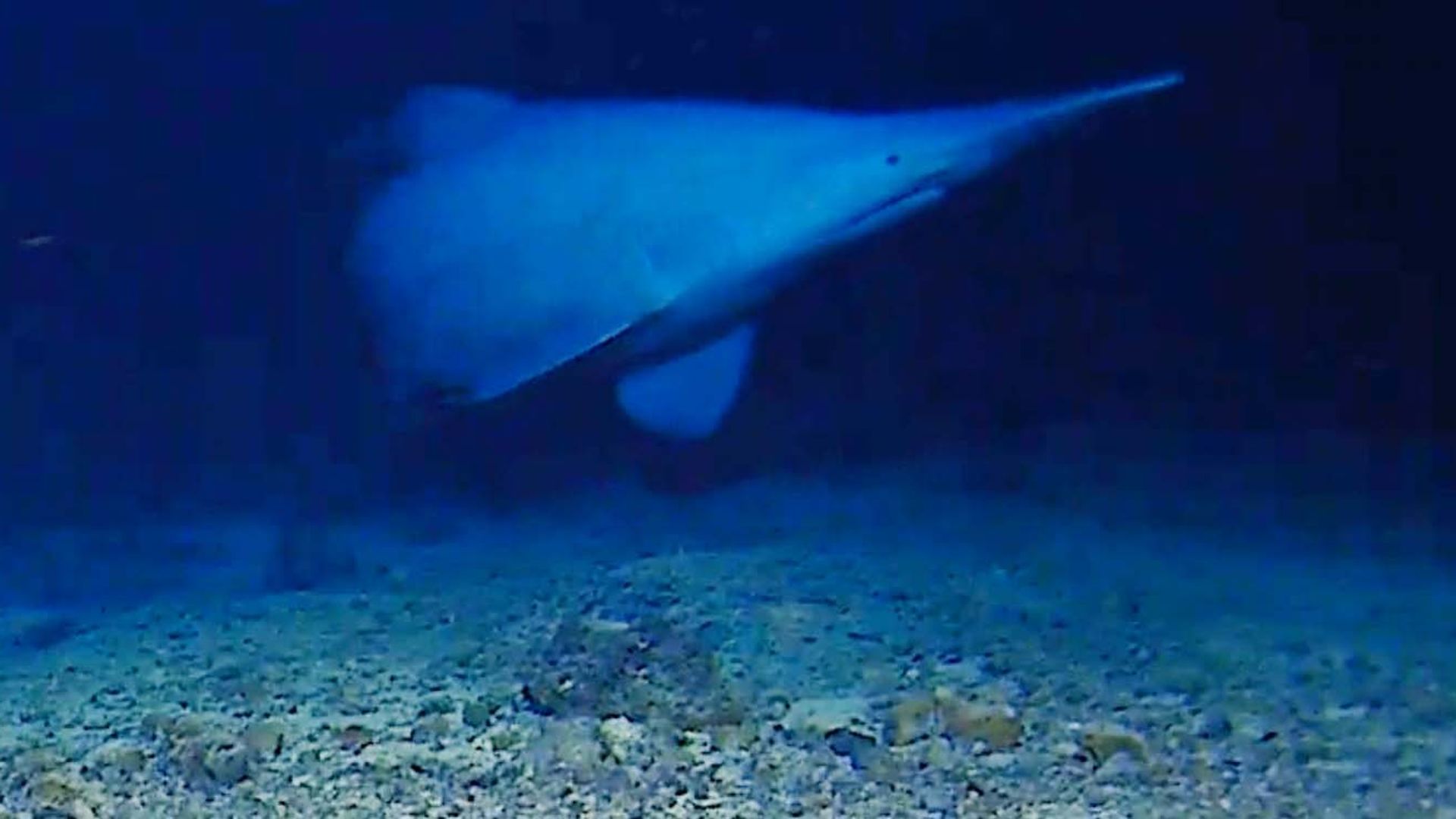
We've been hunting ghost stories in the wrong places. For decades, the goblin shark has been the ultimate marine mystery. It's an animal that looks like a prehistoric fever dream with its pink skin, flabby body, and jaws that spring forward like a sci-fi monster. Until now, almost everything we knew came from dead or dying specimens dragged up from deep-sea fishing lines.
That just changed completely.
Oceanographers have finally observed healthy goblin sharks alive in their actual, undisturbed habitat. The discoveries don't just add a new line to a textbook. They smash our understanding of where these creatures live and how deep they can go. They weren't where we expected. Not even close.
The Pacific Surprises We Didn't See Coming
Marine biologists used to think goblin sharks preferred specific underwater regions, mostly around Japan, New Zealand, and parts of the Atlantic. The Central Pacific wasn't even on the radar.
Aaron Judah, an oceanographer at the University of Hawai'i at Manoa, changed the game by digging into old archives. While chatting with colleagues, he heard a rumor about a weird fish spotted during a 2019 expedition near Jarvis Island. Jarvis Island is a remote, protected wildlife refuge sitting about 1,305 nautical miles south of Honolulu.
Judah went back through the archived livestreamed dive footage from that trip. Sure enough, there it was. A real, living goblin shark swimming calmly northwest of the island. It was shocking because nobody knew the species could exist in the Central Pacific.
But a single video from 2019 could be called a fluke. Then came 2024.
A separate research team was exploring the Tonga Trench. Using a baited camera system, they captured crystal-clear footage of another goblin shark. This second sighting confirmed that the 2019 encounter wasn't an accident. These sharks actually belong in these waters.
Breaking Depth Records in the Tonga Trench
The geographical shift is massive, but the depth data is what really blew scientists away.
Historically, goblin sharks were caught at depths ranging from 100 to 1,200 meters. The Tonga Trench observation happened nearly 700 meters deeper than the absolute maximum depth ever recorded for the species. Think about that for a second. We missed an entire habitat zone by nearly half a mile of vertical ocean space.
Alan Jamieson, a professor and founding director at the Minderoo-UWA Deep-Sea Research Center, worked on the Tonga Trench project. He noted that seeing the most iconic of all deep-sea sharks looking healthy in its natural environment was a unique honor. He admitted he never actually thought he'd see one alive, let alone swimming at depths that completely rewrite the species profile.
Why Our Past Data Was Total Garbage
To understand why this is a massive deal, you have to look at how we used to get deep-sea data.
Most of our knowledge about deep-ocean life comes from commercial fishing bycatch. A longline or a trawl net snags something at 900 meters. By the time the fishermen haul the line to the surface, the extreme pressure change and temperature shift have essentially ruined the animal.
When divers historically tried to swim with goblin sharks hauled to the surface, they were looking at dying animals. A suffocating, stressed shark doesn't behave naturally. It thrashes, its jaw mechanics look distorted, and it dies quickly.
These new observations used remote vehicles and stationary cameras. No hooks. No nets. No stress. For the first time, we saw a calm, healthy animal navigating its actual world. It turns out they aren't sluggish, clumsy monsters. They are highly adapted, efficient predators that are comfortable in environments we thought would crush them.
What This Means for Ocean Conservation
This isn't just cool trivia for marine biologists. It has real legal consequences for the ocean.
If you don't know an animal lives in a specific country's waters, you can't protect it. Now that we know goblin sharks cruise the Central Pacific and the deep trenches of the South Pacific, regional management plans have to change. Nations can officially add the goblin shark to their local biodiversity lists.
This means deep-sea mining proposals, commercial fishing permits, and marine protected area boundaries will have to account for them. You can't protect a habitat if you don't even know who lives there.
Your Next Steps to Follow the Discovery
If you want to stay on top of how this discovery reshapes marine science, stop reading generic news summaries and go straight to the source material.
- Read the peer-reviewed science: Look up the official study published by Aaron Judah and his team in the Journal of Fish Biology. It breaks down the exact coordinates, depth metrics, and behavioral notes from both sightings.
- Watch the ocean research livestreams: Organizations like the NOAA Ocean Exploration and the Schmidt Ocean Institute regularly livestream their deep-sea ROV dives on YouTube. That's exactly how the 2019 Jarvis Island data was caught in the first place. Watching those streams is how you catch the next major discovery in real time.