Five months ago, US special forces executed Operation Absolute Resolve, snatching Nicolas Maduro and his wife, Cilia Flores, straight out of Caracas in the dead of night. Today, the former autocrat is sitting in a New York court facing narco-terrorism charges.
But back home, something stranger is happening. The regime didn't collapse. Instead, his former allies took the wheel, and now they're quietly erasing him from the physical and verbal landscape of the country. Don't miss our previous coverage on this related article.
If you walk through the streets of Caracas, you'll still see giant billboards demanding his release with the hashtag #WeWantThemBackNow. There's even a count-up clock in the historic center tracking the days since his January 3 capture. It looks like a movement fiercely loyal to its fallen leader.
It isn't. It's a facade. If you want more about the context here, USA.gov offers an in-depth summary.
Behind the official propaganda, an aggressive campaign is underway to airbrush Maduro out of Venezuelan history. His face is being painted over. His name is being dropped. The people who once cheered his name are suddenly eager to forget he ever existed.
The Rapid Muting of a Dictator
When the US military operation took Maduro, acting President Delcy Rodriguez went on the defensive. She immediately labeled the raid a "kidnapping" and blasted Maduro's name across every state media channel.
Data shows she mentioned him 86 times in her initial public addresses.
Fast forward to March. That monthly tally dropped to just seven mentions. That's a collapse of over 90% in official rhetoric. By June, as Rodriguez flew to Turkey and India to talk oil and mining with foreign leaders like Recep Tayyip Erdogan, Maduro's name became a ghost.
The political calculus here is simple. The interim regime wants survival. They're realizing that clinging to the legacy of a man who oversaw a 70% economic contraction is a losing strategy.
The US lifted sanctions on Delcy Rodriguez in April, and the US embassy in Caracas reopened. Money is starting to move again. According to US Secretary of Energy Chris Wright, Venezuelan oil exports have already generated over $1 billion since the capture. Another $5 billion is expected in the coming months.
To keep that cash flowing, the new leadership needs to look practical. Maduro is bad for business.
White Paint and Scraped Cement
The erasure isn't just happening in government press releases. It's happening on the concrete walls of neighborhoods that used to be die-hard Chavista strongholds.
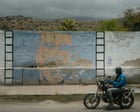
In downtown Caracas housing estates, local residents have watched maintenance crews turn up with rollers of cheap white paint. They aren't fixing the infrastructure. They're covering up massive murals that glorified Maduro's "revolutionary" rule.
On the highway out to Guatire, election hoardings from his stolen 2024 vote have been left to rot, the text fading into complete illegibility under the tropical sun. Further east in Caucagua, someone smeared thick gray cement directly over Maduro’s face on a public playground display.
Even where pro-regime groups try to fight back, public anger ruins the effort. On the main motorway linking Caracas to the international airport, authorities painted a massive blue-and-yellow fresco screaming "Free Maduro." Within weeks, local saboteurs defaced it with splatters of thick black paint.
The reality is that his cult of personality was always hollow. It relied on fear and state funding. Once the fear vanished, the paint started peeling.
Why Nobody is Fighting for Maduro's Legacy
You might wonder why a regime that spent over a decade building a totalitarian grip on power isn't fighting harder to defend its figurehead.
The truth is, Maduro managed to alienate everyone.
Even within the United Socialist Party of Venezuela (PSUV), anger had been boiling for years. He inherited a wealthy, oil-rich nation from Hugo Chavez and completely broke it. Millions of citizens fled the country. Those who stayed faced hyperinflation and hunger.
Worse, his public persona was deeply insulting to a starving population. People haven't forgotten the state television broadcasts where Maduro would dance and sing while the country crumbled. It was tone-deaf. It was infuriating.
His former allies aren't stupid. They know that trying to build a future around a deposed dictator currently wearing an orange jumpsuit in New York is political suicide. They are moving on because they have to.
What Happens Next
The physical erasure of Maduro is a symptom of a deeper political pivot. If you are watching Venezuela for business, geopolitics, or human rights, don't look at the official "Free Maduro" signs. Look at what the interim government does next.
Track the flow of oil wealth. With production ramping up and billions entering the state coffers, see if this money filters down to broken public services or if it just funds a new elite.
Watch the international tours. Delcy Rodriguez’s visits to Turkey and India show Caracas is aggressively courting non-Western partners to cement its legitimacy, independent of Washington or Maduro's old network.
Keep an eye on the courts. While Maduro sits in New York, international pressure is mounting. Just this week, a federal court in Argentina requested the extradition of a former National Guard colonel over crimes against humanity dating back to the 2014 protests. True accountability might finally be catching up with the regime's lower ranks.