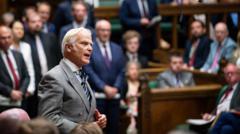
Politics usually looks like a cage match. Modern political theater thrives on pure, unadulterated hostility, where any sign of kindness is branded as weakness. But the final Prime Minister’s Questions for a departing leader always breaks the script. Following Keir Starmer’s sudden resignation announcement on Monday, the atmosphere in Westminster shifted from toxic to surreal. The defining moment of the entire session didn’t involve policy, polling, or economic forecasts. Instead, a bizarre exchange about a predatory big cat, a nanny, and a luxury bottle of bubbly stole the show.
This specific House of Commons lion and champagne story caught everyone off guard. It reveals a hidden layer of British political life that rarely makes the evening broadcast. While the public watches MPs scream at each other on television, a quiet, parallel universe of old-school chivalry exists behind the scenes.
The bizarre interaction started when Conservative veteran Sir Desmond Swayne stood up. He didn't launch into a statistical attack on the economy or hammer Starmer on immigration. Swayne reached back into early twentieth-century literature to make his point. He specifically referenced Hilaire Belloc’s famous 1907 cautionary poem about a boy named Jim, who escaped his caregiver and suffered a gruesome end at the zoo. Swayne asked if the Prime Minister had time to warn his own party about the moral of the tale.
Starmer skipped the bait. He didn't defend his record or counter with a partisan insult. He smiled and shared a private memory. Years ago, while vacationing in Swayne’s gorgeous New Forest West constituency, Starmer received an unexpected knock on the door. It was Swayne. The Tory MP wasn’t there to argue about local planning laws or national tax rates. He had tracked down the leader of the opposition just to hand-deliver a cold bottle of champagne as a gesture of pure hospitality.
The Poetry Behind the Politics
Understanding why Swayne brought up a wild animal requires a quick look at the classic poem itself. Belloc wrote "Jim, Who ran away from his Nurse, and was eaten by a Lion" as a dark comedy for children. In the rhyme, young Jim lets go of his nurse’s hand during a trip to the zoo, gets cornered by a lion named Ponto, and gets eaten piece by piece starting with his toes. The final lines of the poem are famous among a certain generation of traditionalists. They tell the reader to always keep a hold of nurse for fear of finding something worse.
Swayne was using the poem to poke fun at the looming chaos within the Labour party. Starmer is stepping down, leaving a massive power vacuum. Figures like Andy Burnham are already circling the leadership, and the political waters are getting choppy. Swayne's joke was simple. He suggested that by letting go of Starmer's relatively stable leadership, the party might find itself devoured by something far more dangerous.
The humor landed because of who delivered it. Swayne is a legendary figure on the Tory benches, famous for his booming voice, eccentric posture, and fierce loyalty to traditional parliamentary codes. He represents a brand of politics that feels increasingly rare. It is an approach where you can fight someone tooth and nail on the floor of the house, but still treat them with absolute dignity when the cameras turn off.
Breaking the Tribal Divide
Starmer's revelation about the champagne gift completely flipped the energy in the room. It reminded everyone that the fierce tribal warfare we see on social media is often an act. Behind the scenes, these individuals share corridors, tea rooms, and an incredibly stressful lifestyle that very few outsiders truly understand.
The anecdote painted a vivid picture of British governance. Imagine a high-profile politician trying to get away from the stress of London, only for an ideological opponent to show up on his doorstep with a luxury beverage. It sounds like a scene from a political satire. Yet, it happened. That bottle of champagne represents an unwritten rule of the old guard. You respect the office, and you respect the human being holding it, even if you hate their manifesto.
This kind of cross-party warmth used to be the norm rather than the exception. Historical records show that political enemies frequently shared drinks, jokes, and even deep friendships away from the cameras. Former adversaries would regularly dine together at the parliament bar after trading brutal insults during a major debate. The House of Commons lion and champagne story highlighted a traditional camaraderie that many fear is dying out completely.
The Cold Reality of Modern Power
The warm moment between Starmer and Swayne didn't last long. The contrast became glaringly obvious when the focus shifted to the current leadership battle. Kemi Badenoch took a completely different approach. She offered no warm anecdotes, no jokes, and absolutely no sentimental farewells.
Badenoch stayed on the attack, refusing to engage in the traditional pleasantries that usually soften a resignation session. Her team made it clear that she had no intention of apologizing for her aggressive stance or playing along with the cozy atmosphere. For her, politics is a battle of ideas that shouldn't be watered down by fake friendships or champagne deliveries. She viewed the friendly banter as a distraction from the real failures of the government.
This sharp divide shows a massive generational shift in Westminster. The older generation of politicians, represented by Swayne, views parliament as a club with strict codes of conduct and mutual respect. The newer breed views it as a battleground where any compromise or kindness is a liability.
Why This Matters Beyond Westminster
It is easy to dismiss this entire saga as inside-the-beltway gossip. People might wonder why they should care about wealthy politicians sharing high-end wine while the country faces real economic pressure. That skepticism is fair, but it misses the bigger picture.
When political opponents lose the ability to see each other as human beings, governance breaks down entirely. Total polarization creates a system where a good policy from the opposing side must be opposed simply because of the badge they wear. The champagne story matters because it shows that cooperation is possible when individuals refuse to let tribalism dictate their every interaction.
If you want to apply this to your own life, look at how you handle disagreements in your workplace or community. It is entirely possible to disagree deeply with a colleague’s strategy while still respecting their talent and buying them a coffee. Separating professional disagreement from personal respect is a crucial skill that keeps organizations running smoothly.
To dig deeper into the shifting dynamics of modern British leadership, you can watch how the press analyzed the full session. This insightful broadcast covers the fallout of the afternoon exchanges: PMQs Resignation Analysis. The commentary breaks down exactly how the mood changed once the personal stories stopped.
The era of politicians sharing champagne across the partisan divide is drawing to a close. The future looks much louder, much sharper, and far more combative. Whether that shift will actually deliver better results for the public remains to be seen, but the entertainment value of the old chamber is definitely fading away.