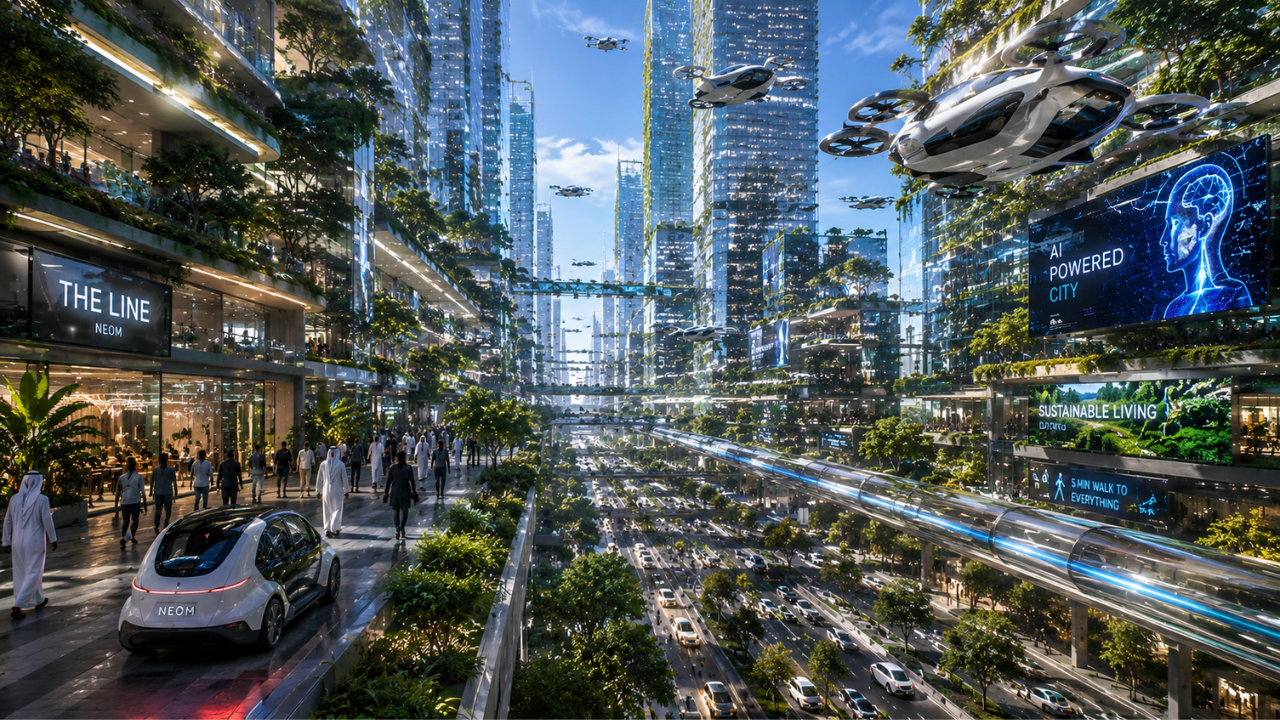
The flashy marketing videos promised a mirror-walled city stretching 170 kilometers across the desert. No cars. No carbon emissions. Just flying taxis, robot maids, and nine million people living in a vertical paradise. It sounded like science fiction because it was.
The reality of Saudi Arabia's flagship project, The Line, has officially collided with economic gravity. Learn more on a connected topic: this related article.
Recent internal shifts and contract cancellations confirm that further construction on the mirrored megacity has been put on hold until at least 2030. The initial dream of housing 1.5 million people by the end of the decade was previously slashed to 300,000, then down to 100,000, and now the brakes are fully locked.
The kingdom is not abandoning its massive economic diversification scheme, known as Vision 2030. They are just quietly shifting their billions away from sci-fi fantasies and toward things that actually make money. More journalism by Forbes delves into comparable views on this issue.
The Math Behind the Mirage
You cannot build a 170-kilometer skyscraper on a whim. The math simply never worked.
While the official budget for the entire NEOM region was initially pegged at $500 billion, internal audits leaked to the press painted a far more terrifying financial picture. The true lifetime cost to fully build out the project was projected at a staggering $8.8 trillion.
To put that into perspective, $8.8 trillion is roughly 25 times the annual budget of Saudi Arabia. It is nine times the country's entire GDP.
No country, no matter how rich in oil, can fund that alone. Saudi Arabia expected foreign investors to flood the project with capital. But global investors looked at the blueprints for a 500-meter-tall, 200-meter-wide mirrored wall and hesitated. Between 2017 and 2022, foreign direct investment into the kingdom averaged only about $17 billion annually. That is barely a drop in the bucket for an $8.8 trillion dream.
With the Saudi Public Investment Fund cash reserves dipping to historic lows at various points during the build, the leadership faced a hard choice. They could keep pouring money into a literal sand trench, or they could fund infrastructure that generates immediate economic value. They chose the latter.
What Went Wrong on the Ground
Money was only part of the problem. The engineering hurdles were immense.
Constructing a continuous linear city requires a mind-boggling amount of raw materials. Industry experts pointed out that building something of this scale within a decade would require concrete and steel at a rate thousands of times faster than standard major infrastructure projects. The global supply chain simply cannot support that.
Then there was the management chaos. Longtime NEOM CEO Nadhmi Al-Nasr departed amid missed milestones and reports of a toxic workplace culture. Contractors started seeing massive shifts, including the cancellation of a $1.6 billion tunnel contract with Hyundai Engineering and Construction. Massive layoffs followed, with workforce cuts hitting roughly 35 percent at the main site.
The project also faced heavy international criticism. Human rights groups flagged the forced eviction of local tribespeople from the Tabuk province to clear land for the development, creating a public relations headache that scared away ethical investment funds.
The Pivots That Are Actually Working
It is easy to look at the suspension of The Line and declare NEOM a total failure. That is a mistake.
NEOM is a massive economic zone the size of Belgium, and while the sci-fi skyscraper is dead for now, other practical sub-projects are making real progress.
The kingdom is doubling down on industrial and commercial clusters that offer clear returns on investment.
Oxagon and the New Trade Routes
Oxagon is NEOM's industrial sub-project, featuring a planned floating port and manufacturing hub on the Red Sea. This is where the real work is happening. The Port of NEOM at Oxagon is actively handling cargo, with Phase 2 dredging well underway. Saudi Arabia is investing billions here to establish critical trade routes and build massive data centers to attract global artificial intelligence firms.
Green Hydrogen Lead
The NEOM Green Hydrogen complex is moving fast. The facility is nearly complete, and the first export shipments of clean fuel are targeted for late 2026. This gives Saudi Arabia a massive foot in the door for the future global clean energy market.
Luxury Tourism
Sindalah, a luxury island resort in the Red Sea, has already opened its doors to invited guests. It provides an immediate playground for ultra-wealthy tourists and generates immediate hospitality revenue.
Other high-profile elements have been paused or reassigned. Trojena, the planned mountain ski resort, lost its bid to host the 2029 Asian Winter Games, and funding there has been heavily restricted during the current cycle. Even the Mukaab, a separate cube-shaped megastructure project in Riyadh, has seen its earthworks paused.
The Blueprint for Future Giga Projects
The lesson here is simple. Pragmatism always beats hype. If you are tracking global infrastructure, real estate development, or Middle Eastern economics, ignore the glossy promotional videos. Look at where the concrete is actually being poured.
If you are looking to invest in or partner with these massive regional shifts, stop looking at residential real estate plays or futuristic transit concepts. Focus your energy and capital on industrial supply chains, renewable energy tech, and data logistics infrastructure. That is where the real money is going, and that is what Saudi Arabia is actually building.