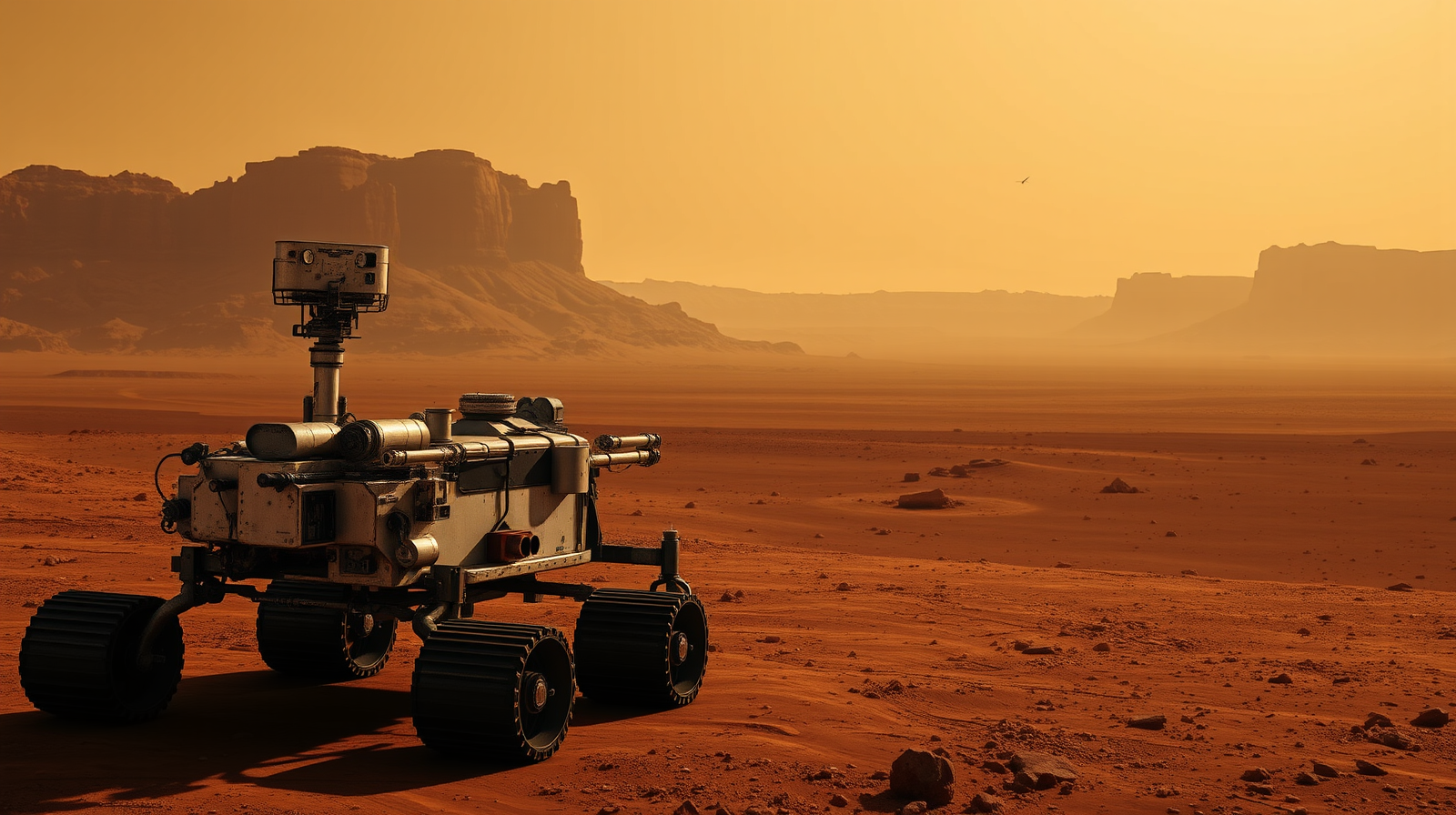
Elon Musk wants you to believe that moving to Mars is just around the corner. He talks about dropping nuclear bombs on the Martian ice caps to melt them, releasing trapped gases, and magically warming up the planet. It sounds like a fantastic science fiction movie.
But science fiction is exactly what it is. For a different look, see: this related article.
If you think we're going to pack our bags and build a new Earth on the Red Planet anytime soon, you're going to be disappointed. A recent study published by scientist Slava Turyshev takes a hard, mathematical look at what it would actually take to terraform Mars. The conclusion? It's not happening. The sheer scale of engineering required is so massive that it borders on the impossible with anything resembling human technology today or even in the next few centuries.
Forget about living in cozy dome cities without a spacesuit anytime soon. Mars is a hostile desert, and it wants to keep it that way. Further coverage on the subject has been shared by Ars Technica.
The Brutal Reality of the Martian Atmosphere
Right now, Mars is a frozen graveyard. The average surface temperature hovers around minus 60 degrees Celsius. Worse, the atmosphere is incredibly thin. It sits at less than 1% of the atmospheric pressure we enjoy on Earth. If you stepped out onto Mars today without a pressurized suit, the lack of air pressure would cause your bodily fluids to boil, and you'd die in minutes.
To turn this nightmare into something humans can live on, scientists look at five major milestones.
First, you have to raise the atmospheric pressure to at least 6.1 millibars. This is the triple point of water—the exact pressure needed so that liquid water can actually exist on the surface without instantly evaporating or freezing solid.
The next step is creating a "shirtsleeve greenhouse" environment. This means building massive pressurized domes over entire regions where crops could grow. You aren't fixing the whole planet yet, but you're making local pockets livable.
To step outside those domes without your blood boiling, the global surface pressure needs to hit 62.7 millibars. Finally, the ultimate dream is a fully breathable atmosphere with a high level of oxygen and an overall pressure of 500 millibars.
Each step sounds logical on paper. But when you look at the raw physical mass needed to make it happen, the whole idea crumbles.
Moving Entire Moons Just to Breathe
To increase the atmospheric pressure of Mars by a single, solitary millibar, you need to inject about 3.89 × 10¹⁵ kilograms of gas into the air.
Let's put that number into perspective. That's the entire mass of Deimos, one of Mars's own moons. To raise the pressure just one notch, you'd basically have to vaporize an entire moon.
If you want to scale that up to a fully breathable, Earth-like atmosphere, you need closer to 10¹⁸ kilograms of gas. That is roughly equal to the mass of Janus, an irregular moon orbiting Saturn.
Sure, the outer solar system is littered with icy, gas-rich rocks of this size. In theory, you could use advanced nuclear or fusion propulsion to hunt down a Saturn-sized moon, drag it across millions of miles of deep space, and crash it into Mars. But the level of industrial capability required to move an object that heavy dwarfs every single thing humanity has built since the dawn of civilization. We can barely manage to launch small rovers without years of planning and billions of dollars.
The Continental-Sized Mirror Problem
Let's say you somehow solve the air pressure issue. You still have to deal with the fact that Mars is freezing. It needs a massive influx of heat.
One of the most popular ideas among space enthusiasts is placing gigantic mirrors into orbit around Mars. These mirrors would catch sunlight and reflect it directly onto the planet, acting like a giant magnifying glass to melt the ice caps and warm the soil.
Turyshev's calculations reveal the absurd reality of this plan. To warm the planet effectively, you would need a mirror system with a surface area of roughly 70 million square kilometers.
That is larger than the entire continent of Asia.
Think about the manufacturing power needed for that. We don't have the factories, the raw materials, or the heavy-lift rockets to launch a mirror the size of a small country into space, let alone an entire continent.
The Hidden Trap: Mars Is Bleeding Gas
Even if some hyper-advanced future civilization manages to drag a moon to Mars and build an Asia-sized space mirror, they'd run into another roadblock: Mars doesn't have a global magnetic field.
Earth's magnetic field acts like a shield, protecting our atmosphere from the solar wind—a stream of charged particles blasting out from the Sun. Because Mars lacks this shield, the solar wind acts like a cosmic sandblaster, slowly stripping gases away into deep space. NASA's MAVEN spacecraft confirmed that Mars used to have a thick atmosphere and liquid water billions of years ago, but the Sun literally stole it.
If you pump a bunch of new gas into the Martian sky, the Sun will just start stripping it away again. You'd be fighting a losing battle against the solar wind unless you also figured out how to build an artificial planetary magnetic shield.
What to Do Instead
If you're fascinated by space exploration, don't waste your time buying real estate plots on Mars or expecting a ticket there in your lifetime. Instead, focus your attention on the practical steps scientists are taking right now.
Track the progress of localized life-support technology. Watch how NASA and other space agencies develop closed-loop oxygen generation systems, like the MOXIE instrument on the Perseverance rover, which successfully extracted oxygen directly from the thin Martian air. Pay attention to advancements in robotic automated construction, because if humans ever survive on Mars, it will be inside heavily shielded, underground habitats built by machines long before we arrive. True space exploration is going to happen in tiny, pressurized bunkers, not on a green, terraformed paradise.