We know shockingly little about Mercury. It's sitting right there in our cosmic backyard, closer to us than Jupiter or Saturn, yet we've barely scratched its surface. Space agencies have sent dozens of rovers and orbiters to Mars, but Mercury has only ever hosted one orbiter in human history.
That changes this November.
After an eight-year trek through the inner solar system, the joint European-Japanese BepiColombo spacecraft is finally entering orbit around the closest planet to the Sun. It didn't take eight years because Mercury is far away. It took eight years because sliding into orbit around this tiny rock requires fighting the most powerful gravitational beast in our local neighborhood: the Sun.
If you think space exploration is just about pointing a rocket and firing the engines, Mercury will shatter your assumptions.
The Solar Gravity Trap
Most people assume reaching an inner planet is simple because you're traveling downhill toward the Sun. That's exactly the problem. As a spacecraft drops closer to the Sun, solar gravity pulls it in and accelerates it to extreme speeds.
By the time a probe reaches Mercury's neighborhood, it's moving way too fast. Mercury is small. Its mass is tiny, and its gravitational grip is incredibly weak compared to the Sun's titanic pull. If you flew straight there, you'd blow right past the planet like a runaway train. To actually stop and circle Mercury, you have to find a way to slam on the brakes in a vacuum.
Conventional rocket fuel weighs too much. If a spacecraft carried enough fuel to blast its thrusters backward and slow down manually, the rocket would be too heavy to ever leave Earth.
Space agencies had to get creative. The late Italian mathematician Giuseppe "Bepi" Colombo cracked the code decades ago. He figured out that you can use the gravity of planets as natural brakes. BepiColombo—named in his honor—has spent nearly a decade doing exactly that.
The spacecraft has executed nine separate planetary flybys since launching in 2018. It swung past Earth once, Venus twice, and Mercury itself six times. Every single pass was designed to steal a little bit of the spacecraft's momentum, slowly dropping its speed relative to Mercury.
The Near Disaster That Delayed The Mission
This wasn't a smooth ride. In early 2024, engineers noticed a terrifying problem. A power glitch, essentially a short circuit, crippled the spacecraft's solar-electric propulsion system. The ion thrusters couldn't deliver full power.
For a minute, the mission looked doomed. If BepiColombo couldn't deliver the right amount of thrust, it would miss its window to get captured by Mercury's gravity.
The engineering teams at the European Space Agency (ESA) and the Japan Aerospace Exploration Agency (JAXA) had to rewrite the flight plan on the fly. They came up with a bold, riskier trajectory. During its fifth flyby, they directed the spacecraft to skim just 35 kilometers closer to Mercury's surface than originally planned. This ultra-close pass used the planet's gravity to make up for the weak thrusters.
It worked, but it cost them time. The maneuver delayed the final orbital insertion by 11 months, pushing the arrival from late 2025 to November 21, 2026.
The heavy lifting from those ion thrusters is officially over. On June 15, 2026, engineers permanently shut down the solar-electric propulsion system, turning off the iconic blue glow of the ion engines. The spacecraft is now on a purely ballistic, free-falling trajectory toward its target.
One Mission Two Independent Spacecraft
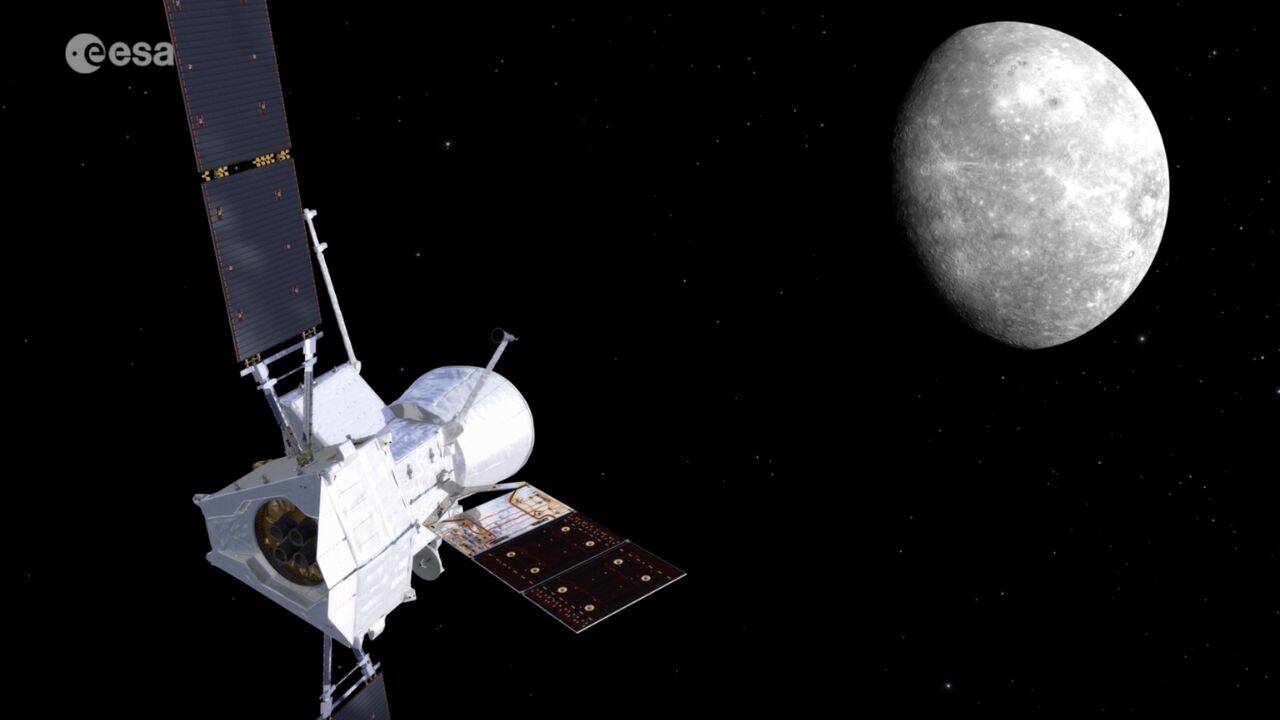
What makes BepiColombo completely different from previous missions is its split personality. It's not just one probe; it's a stacked carrier vehicle holding two separate, highly specialized orbiters.
- The Mercury Planetary Orbiter (MPO): Built by ESA, this heavily insulated spacecraft will sit in a tight polar orbit. Its job is to look straight down, mapping the planet's cratered surface, analyzing its chemical composition, and peering into its interior structure.
- Mio (Mercury Magnetospheric Orbiter): Provided by JAXA, this craft spins like a top to maintain stability. It will sit in a wider, elongated orbit to study Mercury's weird magnetic field and how it interacts with the brutal solar wind.
Right now, they're clamped together on the Mercury Transfer Module, which acts as the cruise ship. On September 3, 2026, the transfer module will detach. From there, the two orbiters will coast toward the planet together until November 21, when Mercury's gravity grabs them. By December, the two scientific craft will separate completely, spent chemical thrusters placing them into their final distinct orbits to begin science operations in early 2027.
Why We Care About A Scorched Desert
Mercury looks like a boring, dead version of our Moon. It's not. It's a bizarre anomaly that challenges everything we think we know about how planets form.
First, it has a magnetic field. Liquid iron cores generate magnetic fields, but small planets are supposed to cool down quickly and solidify. Mars and the Moon lost their global magnetic fields billions of years ago. Mercury shouldn't have one, yet it does. Mio's specific job is to figure out why that core is still churning.
Second, it has an oversized core. Mercury is mostly a giant ball of iron wrapped in a thin crust of rock. Some scientists think a massive ancient collision blasted away the planet's original outer layers. Others think the young Sun simply baked the rocky material away before it could settle. BepiColombo's MERTIS instrument—an infrared spectrometer—is already mapping the mineral layout to settle this debate.
Finally, there's the ice paradox. Mercury is a cosmic broiler, with daytime temperatures soaring over 400°C. Yet, previous radar data and NASA's MESSENGER mission confirmed the presence of pure water ice hiding inside deep craters at the poles. Because Mercury has no axial tilt, the floors of these deep craters never see a single ray of sunlight. They are permanent deep-freezers floating in a hellscape.
What To Watch For Next
The era of long wait times is over. The cruise phase is done, the ion engines are cold, and the ballistic drop has begun.
Keep an eye out for September 3, 2026, when the transfer module drops away, leaving the two main science crafts to make their final approach solo. The ultimate milestone happens on November 21, 2026. If the orbital insertion burn goes correctly, we will double our presence at the inner edge of the solar system and start rewriting the textbooks on how rocky worlds are born.
To track the arrival live and view the latest flyby imagery directly from the spacecraft's monitoring cameras, check out the official ESA BepiColombo Operations Portal.