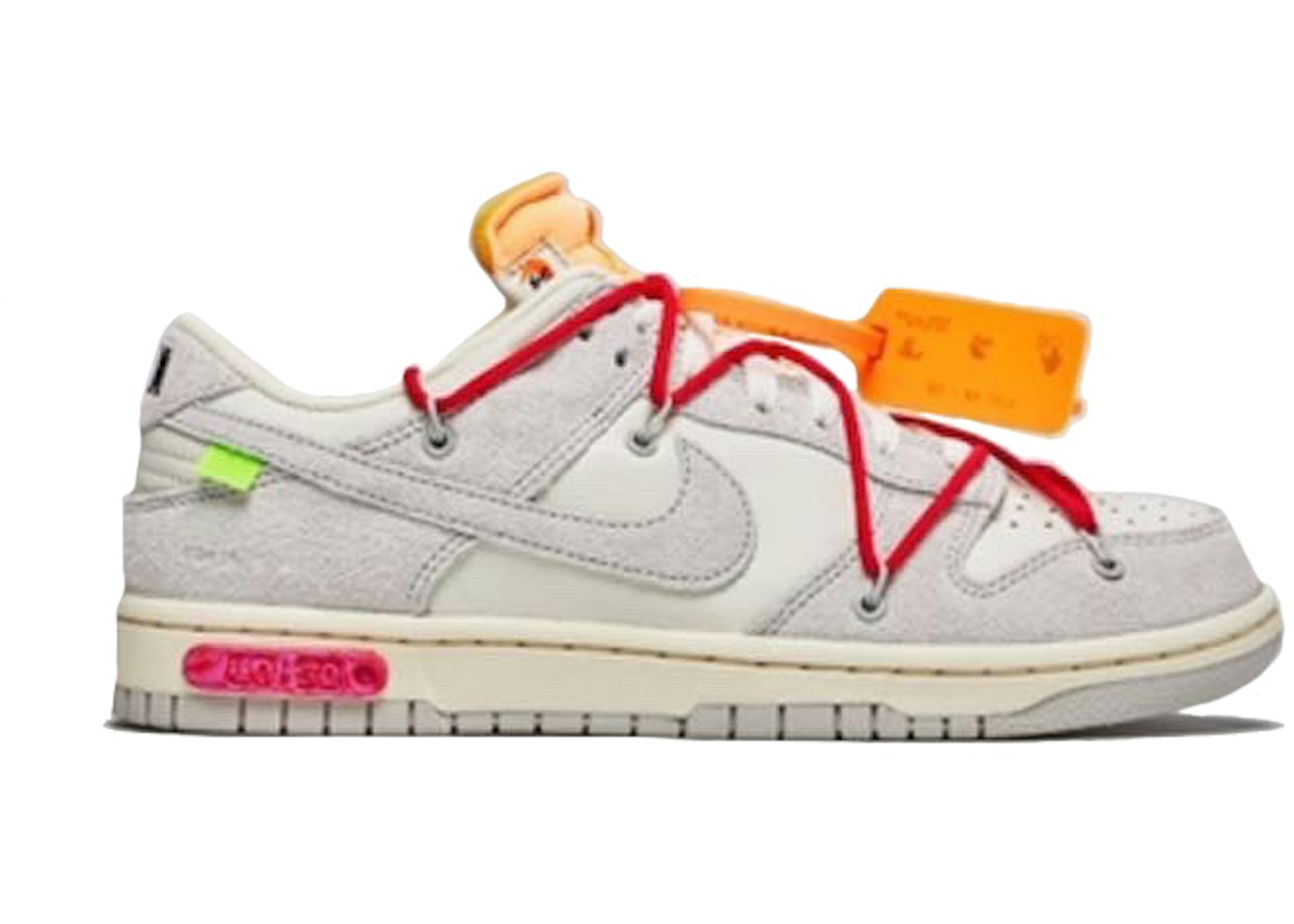
I watched a collector drop five figures on a bulk buy of "The 50" only to lose thirty percent of his expected return because he didn't understand the specific aging mechanics of the canvas and leather mix. He thought he could treat them like standard SB Dunks, tossing them into plastic drop-front boxes in a room with high humidity and direct sunlight. Within eight months, the exposed foam on the tongues had begun to crumble, and the crisp white upper had turned a sickly, uneven yellow that didn't look like intentional "vintage" styling—it looked like neglect. If you're holding an Off White Dunks Lot 1, you're not just holding a sneaker; you're managing a ticking clock of material degradation that most resellers and enthusiasts completely ignore until the resale value craters.
The Oxidation Trap of the Off White Dunks Lot 1
The biggest mistake I see is the assumption that deadstock means immortal. People think if they keep the zip-tie on and the paper in the box, the shoe stays perfect. It doesn't. The "Lot 1" is unique because it relies on a specific white-on-white aesthetic with a yellowish vintage midsole that's supposed to look aged but remains physically structural. When you trap these shoes in their original cardboard boxes for three years, the acidity in the cardboard actually accelerates the yellowing of the white leather and the foam. I've opened boxes from 2021 where the tissue paper had fused to the silver foil-like hangtag because of moisture trapped inside.
The fix is counterintuitive: you have to let them breathe, but you have to control the air. Get rid of the original stuffing paper immediately. It's cheap, acidic, and holds onto moisture like a sponge. Replace it with acid-free tissue paper or, better yet, nothing at all. Use silica packets, but don't overdo it. If you bone-dry the air, the leather will eventually crack. I recommend maintaining a consistent 40% to 50% humidity. If you're in a place like Florida or South East Asia and you don't have a dehumidifier in your storage room, you're essentially watching your investment evaporate.
Stop Treating the Zip Tie as a Structural Component
I've seen so many people try to wear these with the plastic zip tie still cinched tight against the secondary lace loops. This is a fast track to ruining the eyelets. The cable tie on this specific pair is heavy, and the way it sits against the flywire-inspired lacing system puts constant tension on the delicate suede or leather holes. Over time, that tension stretches the hole into an oval shape that can't be fixed.
If you're going to wear them, take the tie off or loop it through the primary laces where the leather is thicker and reinforced. Don't listen to the "keep it original" purists who have never actually walked five miles in these. They'll tell you the dangling plastic is the point, but they won't be the ones paying to repair a snapped lace loop. The "Lot 1" was part of a massive 50-shoe experiment, and the quality control across the different materials varied wildly. On this specific white pair, the secondary lace—that neon or neutral cord that zig-zags across the top—is prone to snagging. If that cord snags on the zip tie, it frays the nylon.
Managing the Secondary Laces
The secondary lace system isn't just for show; it's a friction point. Most people pull them too tight because they like the aggressive look. This compresses the toe box permanently. I’ve seen shoes where the toe box has a permanent "dent" because the owner cranked down the over-laces. Keep them loose. They should have enough slack that you can run a finger under them without effort.
Misunderstanding the Midsole Composition
The "vintage" look of the midsole leads people to believe it's more durable or already "beat," so they don't clean it properly. This is a mistake. The paint used to achieve that specific off-white tint is prone to scuffing and can actually flake off if you use harsh chemicals. I’ve seen people use standard acetone or heavy-duty sneaker cleaners to get a grass stain off, only to realize they’ve stripped the yellowish tint right off, revealing a bright white rubber underneath. Now the shoe looks like a "Lot 2" through "Lot 49" hybrid, and the value is gone.
Use a soft-bristled brush and nothing stronger than a mild dish soap diluted in water. If you get a deep scuff, don't try to buff it out with a magic eraser. Those erasers are essentially micro-sandpaper; they will smooth out the texture of the midsole and leave a shiny spot that stands out like a sore thumb in natural light.
The Myth of the "One Size Fits All" Storage Solution
I've seen collectors spend thousands on those clear plastic stacking crates, thinking they've solved the storage problem. They haven't. Most of those crates aren't UV-protected. If your storage wall is opposite a window, your shoes are getting hit with UV rays every day. On a white shoe like this, UV damage isn't uniform. The plastic swoosh will yellow at a different rate than the leather upper, and the foam tongue will turn a dark orange.
Before I started using UV-blocking film on my windows, I had a pair of shoes where the side facing the room stayed white while the side facing the wall (which caught reflected sunlight) turned beige. It looked ridiculous. If you can't guarantee a dark room, keep them in a dark bin, not a clear one.
Temperature Fluctuations and Glue Failure
It's not just about light. I've seen shoes stored in attics or garages where the temperature swings 30 degrees between day and night. This causes the materials to expand and contract at different rates. Since the "Lot 1" uses a mix of leather, foam, and rubber, those different expansion rates put immense stress on the glue bonds. I’ve seen outsoles start to separate from the midsole on pairs that were supposedly "kept in a climate-controlled environment" that actually just meant "the heater was on in the winter." True climate control means no swings. If you wouldn't sleep in the room because of the temperature, don't put your shoes there.
The Cleaning Before and After Reality
Let's look at how a typical owner handles a dirty pair versus how a professional does it.
The amateur sees a mud stain on the white leather. They grab a generic sneaker wipe and scrub hard in a circular motion. The mud gets pushed into the pores of the leather. They see the stain is still there, so they apply more pressure. By the time they're done, they've rubbed the finish off the leather and left a greyish smudge that is now a permanent part of the shoe's DNA. They figure they'll just "deep clean" it later with a washing machine—a move that eventually destroys the exposed foam on the tongue, causing it to yellow and lose its shape.
The professional approach is different. I start by dry-brushing. I use a horsehair brush to get every single loose particle of dirt off before a drop of water touches the shoe. If you add water to dirt, you make mud, and mud stains. Once it's dry-brushed, I use a damp microfiber cloth to "lift" the stain rather than scrub it. For the exposed foam on the tongue, I don't use liquid at all if I can help it. I use a dry sponge or a specialized suede eraser to gently lift debris. This keeps the foam structure intact and prevents the internal moisture that leads to mold. The difference in the end result is a shoe that still looks 9/10 versus a shoe that looks like it was dragged through a swamp.
Authenticity Markers and the "Languishing" Effect
The market for this specific pair is flooded with high-quality fakes. Because of that, the burden of proof is on you to keep every single piece of the original packaging in pristine condition. A mistake I see often is people throwing away the outer shipping box or the "Dear Summer" insert. In the high-end market, a "Full Set" doesn't just mean shoes and box; it means the tissue, the inserts, and even the original digital receipt.
I’ve seen sales fall through because the owner lost the specific "Lot" sticker that comes on the box. It seems petty, but when you're dealing with a shoe that has 50 different variations, those small markers are what prove you have the actual first lot and not a mismatched pair.
Documenting the Aging Process
I tell people to take high-resolution photos of their Off White Dunks Lot 1 every six months. It sounds paranoid, but it’s the only way to track if your storage Method is failing. If you look at a photo from January and compare it to July and the midsole looks two shades darker, your room is too hot or getting too much light. You can't trust your eyes day-to-day because the change is too slow to notice until it's too late.
A Reality Check on the Long-Term Hold
If you're reading this because you think holding onto these for another five years is a guaranteed "moon mission" for your bank account, you need to hear the truth. This shoe is a nightmare to preserve. Unlike an all-leather Jordan 1 from 1985 that can be restored relatively easily, the Virgil Abloh designs are intentionally "deconstructed." That means they use raw edges, exposed foam, and synthetic plastics that are designed to look cool today but weren't engineered for a forty-year lifespan.
The foam will eventually yellow and crumble. The plastic zip tie will eventually become brittle and snap if handled. The "NIKE" printing on the heels of many of these pairs was notoriously prone to cracking straight out of the box. You aren't managing a piece of fine art; you're managing a chemical compound that is slowly breaking down. Success with this pair isn't about finding a "secret" cleaning trick. It's about damage limitation. You are fighting a losing battle against oxygen and time. If you aren't prepared to check on your storage conditions weekly, or if you aren't willing to invest in a dedicated space with a dehumidifier and UV protection, you're better off selling them now while they're still "white." The most expensive mistake you can make is assuming that doing nothing is the same as keeping them safe. In the world of high-end sneakers, doing nothing is just a slow way to lose money.