Pakistan is playing a familiar game. Every time a major security failure happens on its soil, the political leadership in Islamabad follows a predictable script. They look across the border, point a finger at New Delhi, and claim external forces are trying to destabilize their country.
The recent militant strike on a paramilitary compound in Karachi is the latest example of this routine. Heavily armed militants stormed the regional headquarters of the Sindh Rangers. It caused chaos. It resulted in casualties. Almost immediately, Pakistani officials blamed India. For a closer look into this area, we suggest: this related article.
India's Ministry of External Affairs hit back fast. MEA spokesperson Randhir Jaiswal flatly rejected the claims. He called them completely baseless. He told Islamabad it needs to look inward instead of trying to pass the buck.
This diplomatic back-and-forth isn't just a minor disagreement. It reveals a deeper problem in how Pakistan handles its internal security crisis. Blaming India doesn't solve their domestic terror problem. It just delays the reckoning. For additional context on this development, detailed reporting can be read at The New York Times.
The Anatomy of the Karachi Base Assault
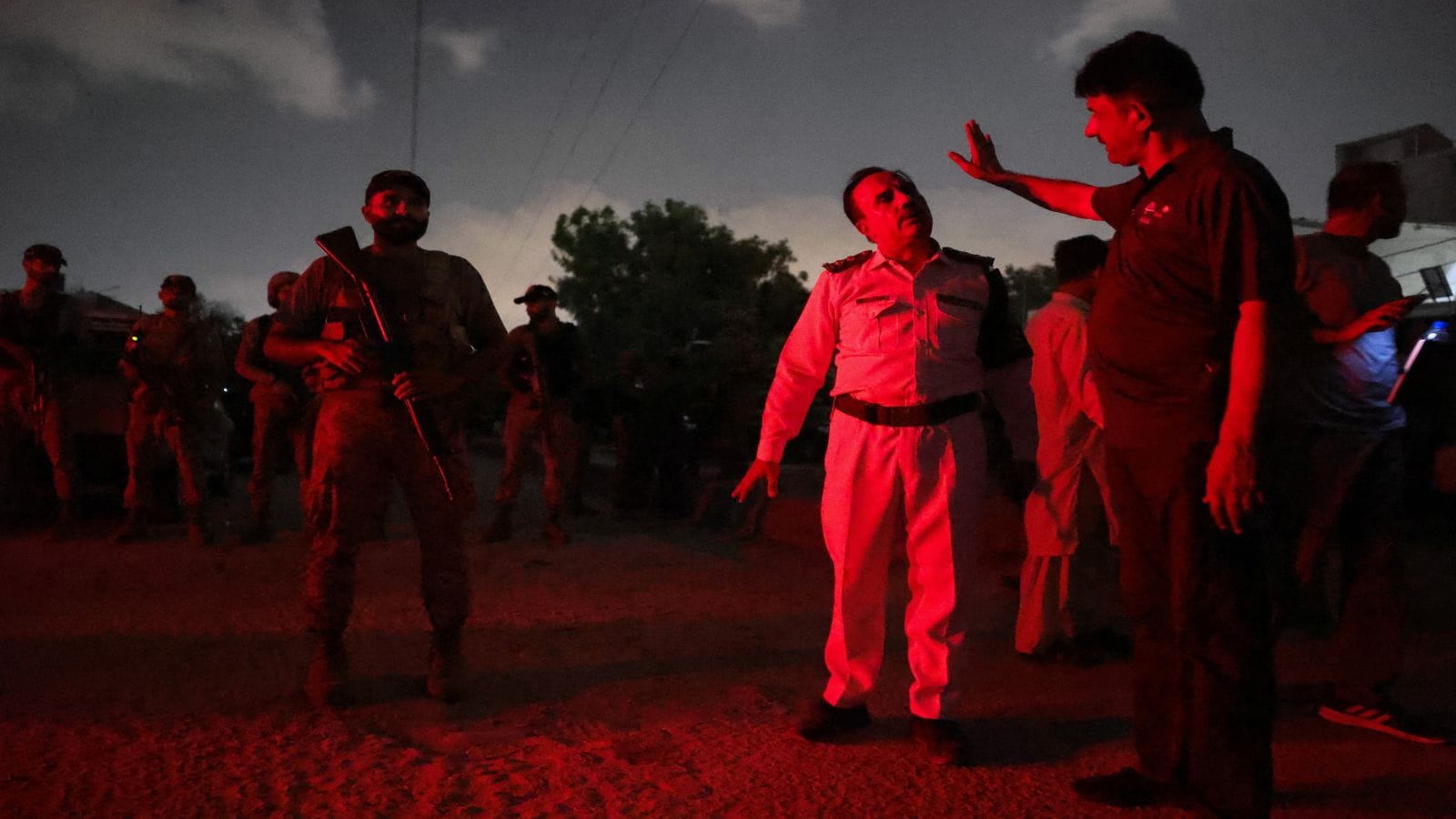
Let's look at what actually happened on the ground before diving into the politics. On a Saturday evening, heavily armed militants launched a coordinated assault on the Sindh Rangers Bhittai Wing headquarters. The facility is located in Karachi's densely populated Gulistan-e-Jauhar area.
The attackers didn't sneak in. They rammed an explosives-laden vehicle straight through the main gate. The initial blast triggered massive explosions and shattered nearby windows. Panic spread fast across the neighborhood, which sits close to several educational institutions and the Pakistan Meteorological Department.
What followed was a fierce 90-minute gun battle. Armed with automatic weapons and hand grenades, the militants tried to take over the compound. The Rangers fought back. Soon, commandos from the Special Security Unit and the Anti-Terrorist Force rushed to the scene to reinforce them.
When the smoke cleared, the toll was heavy. At least three paramilitary soldiers were dead. Several others were wounded. Security forces managed to kill six militants during the firefight. They also captured one injured attacker alive.
The Pakistani military confirmed that the captured suspect is an Afghan national. This detail is incredibly important. It completely undermines the narrative that Islamabad tried to build later that night.
The Immediate Blame Game Without Evidence
Before any real investigation could even begin, Pakistani politicians started spinning a narrative. Pakistan Interior Minister Mohsin Naqvi spoke to local media and alleged an Indian link to the strike. He claimed the assault was carried out by an Indian proxy.
He didn't offer any proof. No documents. No intercepted communications. Nothing.
During a visit to Karachi shortly after the incident, Pakistan Prime Minister Shehbaz Sharif echoed these sentiments. He accused India of using proxies to undermine peace and stability in Pakistan. It was a textbook deflection technique.
The problem with this narrative is that a well-known militant group had already taken responsibility for the operation. Jamaat-ul-Ahrar claimed the attack. They're a violent splinter faction of the banned Tehreek-e-Taliban Pakistan, also known as the Pakistani Taliban or TTP.
Jamaat-ul-Ahrar isn't some mysterious new entity. They've been fighting the Pakistani state for years. They have targeted security forces, government buildings, and religious minorities across the country. They operate from the rugged border regions between Pakistan and Afghanistan. They don't take orders from New Delhi. They want to overthrow the government in Islamabad.
New Delhi Sets a Hard Diplomatic Line
India's response was swift and sharp. Randhir Jaiswal issued a direct statement on social media and through official channels. He made it clear that India has no time for manufactured accusations.
"We have seen Pakistani reports making baseless allegations against India regarding the recent incident in Karachi. We categorically reject them."
Jaiswal didn't stop there. He turned the spotlight back on Pakistan's long history of using militant groups for its own geopolitical goals. He stated that Pakistan would do better to look inwards. He urged them to take credible action against the terror infrastructure operating on their own territory. He explicitly told Islamabad to rid itself of its proclivity to rely on terrorism as an instrument of state policy.
This response highlights a growing frustration in New Delhi. Indian diplomats are tired of the old routine. For decades, Pakistan used a strategy of plausible deniability regarding groups like Lashkar-e-Taiba and Jaish-e-Mohammed. Now, when domestic groups turn against the Pakistani state, Islamabad tries to use that same old playbook in reverse. It isn't working anymore.
Why Islamabad Relies on the Indian Proxy Narrative
Why does Pakistan keep doing this? Why blame India when the evidence points somewhere else entirely?
It comes down to domestic politics and institutional preservation. The Pakistani military and intelligence apparatus have long justified their massive budget and political dominance by framing India as an existential threat. If the public realizes that the biggest threat to Pakistan's stability comes from internal mismanagement and homegrown religious extremism, the military's grip on power weakens.
Admitting that Jamaat-ul-Ahrar can drive a bomb-laden vehicle into a major paramilitary headquarters in Pakistan's largest city is embarrassing. It shows a massive intelligence failure. It proves that the state cannot secure its own critical infrastructure.
Blaming an external intelligence agency changes the conversation. It turns a domestic failure into a patriotic rallying cry. It asks the Pakistani public to unite against a foreign enemy instead of questioning why their own security forces failed to protect a base in the middle of Karachi.
The Complicated Reality of the TTP and Afghanistan
The captured militant complicates Pakistan's attempt to blame India. The fact that he is an Afghan national points to a much more real and dangerous geopolitical problem for Islamabad. It involves their relationship with the Taliban government in Kabul.
When the Taliban retook power in Afghanistan in 2021, the Pakistani establishment celebrated. They thought they had secured strategic depth on their western border. They expected the Afghan Taliban to crack down on the TTP and its various splinter factions like Jamaat-ul-Ahrar.
The opposite happened. The TTP felt emboldened by the Taliban's victory. They used Afghan soil as a safe haven to plan, recruit, and launch cross-border attacks into Pakistan.
This has caused relations between Islamabad and Kabul to fall apart completely. Pakistan has carried out airstrikes inside Afghanistan over the last few years. They claimed they were targeting TTP hideouts. The Taliban government denied these allegations and warned Pakistan to stop violating its sovereignty.
By trying to tie the Karachi attack to India, Pakistan is attempting to minimize a massive foreign policy failure on its western border. They don't want to admit that their decades-long policy regarding Afghanistan has backfired completely. They're trapped in a crisis of their own making.
The Long Decline of Security in Karachi
Karachi is Pakistan's economic engine. It's a massive, chaotic port city of over 20 million people. When Karachi is unstable, the entire Pakistani economy suffers.
The attack on the Sindh Rangers base isn't an isolated incident. It marks a worrying trend. It's the most significant assault in the city linked to TTP factions since the 2023 attack on the Karachi Police Office. It's also the first major terrorist strike in Karachi since late 2024, when a suicide bombing near the airport killed two Chinese engineers.
The targeting of Chinese nationals and domestic security bases shows that militant groups are operating with a high degree of freedom. They can scout high-value targets, move weapons through urban areas, and execute complex operations.
Instead of addressing the security gaps in Sindh province, the federal government spends its energy writing press releases against New Delhi. This approach leaves local police and paramilitary forces exposed. They have to deal with the reality of terrorism while their political leaders play games with international public relations.
What Needs to Change Moving Forward
Pakistan cannot fix its security crisis until it stops lying to itself. The international community doesn't buy the narrative that India is behind every internal bombing in Pakistan. Financial institutions like the Financial Action Task Force have watched Pakistan closely for years because of its history with terror financing.
If Islamabad wants to secure its cities and rebuild its economy, it needs to take several concrete steps immediately.
First, stop the external blame game. Acknowledge that the TTP, Jamaat-ul-Ahrar, and Baloch separatist groups are domestic security threats driven by internal grievances and radical ideologies.
Second, fix intelligence coordination. The fact that a vehicle full of explosives drove through a major city into a military gate shows a total breakdown in local intelligence gathering. Security forces need better training, better equipment, and less political interference.
Third, deal honestly with Kabul. Pakistan needs to work out a transparent border security framework with Afghanistan instead of launching sporadic airstrikes that alienate the Afghan population.
Finally, dismantle the infrastructure of radicalization. For years, certain militant groups were tolerated because they targeted neighboring countries. That policy created an environment where extremism could thrive. You can't keep snakes in your backyard and expect them to only bite your neighbors. Eventually, they turn on you.
India has made its position clear. New Delhi won't engage in serious dialogue while Pakistan continues to tolerate terror networks. If Islamabad wants regional stability, it has to clean up its own house first. No amount of finger-pointing will change that reality.