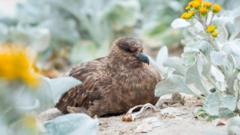
The buffer has officially vanished. For years, Australia stood as the last major landmass on earth untouched by the highly pathogenic H5N1 bird flu strain that has decimated wildlife across the globe. That era of isolation ended when federal authorities confirmed that a dead migratory bird found on a beach in Western Australia tested positive for the exact strain scientists have been dreading.
The news shouldn't shock anyone who follows global ecology, but it hits hard. Federal Agriculture Minister Julie Collins confirmed that samples taken from a brown skua found at Cape Le Grand National Park near Esperance proved positive for the lethal H5N1 lineage. The bird was discovered sick on June 14, 2026, and died shortly after. A second bird, a giant petrel found nearby, is currently isolated and undergoing tests.
This single dead seabird changes the entire map of global biosecurity. The virus has now officially established a foothold on every single continent. It is a massive wake-up call for farmers, conservationists, and everyday citizens who assumed Australia's strict geographic isolation would shield it forever.
The Real Story Behind the Western Australian Detection
A lot of the initial coverage treats this like a sudden breakout in a chicken coop, but the reality is much more nuanced. This case happened in a remote, rugged stretch of the southern coast, over 700 kilometers southeast of Perth. State Agriculture Minister Jackie Jarvis pointed out that it is highly unusual to see a brown skua on the south coast of Western Australia. These are sub-Antarctic birds. They spend their lives flying over freezing open oceans.
When wild birds get deeply sick, they lose their navigational accuracy. Strong winds easily blow them off course, which explains how this specific skua ended up dying on a public beach. Biosecurity officers acted quickly to isolate the animal and run the initial laboratory work. The samples were then rushed to the CSIRO Australian Centre for Disease Preparedness in Geelong for final confirmation.
The immediate silver lining is that this is not an active agricultural outbreak yet. Minister Collins emphasized that there is no evidence of mass wildlife mortality in the area right now, nor is there any sign that the virus has breached commercial poultry operations. The system caught the case early. However, catching one sick bird on a massive coastline means others have likely arrived undetected.
Why This Specific Strain Is Different
Australia has dealt with avian influenza before, which leads to a lot of confusion. Just a couple of years ago, back in 2024, egg farms across Victoria and New South Wales faced severe outbreaks that forced farmers to cull hundreds of thousands of chickens. Supermarket shelves went empty, and egg rationing became common.
Those 2024 outbreaks were caused by completely different strains—specifically the H7N3, H7N9, and H7N8 variants. While those viruses were highly pathogenic to poultry, they were localized problems that mutated from wild birds already native to the Australian continent.
The H5N1 strain that just arrived is an entirely different beast. It belongs to a specific branch called clade 2.3.4.4b, which began ripping through Europe and the Americas around 2020 and 2021. This specific branch has a terrifying capacity to jump from wild waterfowl into mammals. It doesn't just kill chickens. It destroys ecosystems.
The Massive Ecological Threat to Unique Species
The true danger of H5N1 in Australia lies in its unique wildlife populations. Black swans, unique shorebirds, and concentrated colonies of marine mammals have zero natural immunity to this lineage.
We already have a dark blueprint of what this looks like from sub-Antarctic territories. Scientists tracking the virus confirmed that through late 2025 and early 2026, thousands of southern elephant seal pups and hundreds of adult king penguins died from H5N1 on Heard Island, a remote Australian territory thousands of kilometers flocking south of the mainland. The virus moves like wildfire through dense animal colonies where individuals huddle closely for warmth or breeding.
If the virus moves from coastal seabirds into inland waterways, Australia's native species face an existential crisis. Black swans are known to be incredibly susceptible to influenza strains. A widespread outbreak in places like the Murray-Darling Basin could trigger ecological collapse across wetlands. Dr. Carol Booth from the Invasive Species Council warned that this detection is deeply alarming because of how violently the virus behaves once it gets into vulnerable, naive populations.
Assessing the Actual Risk to Humans
Let's clear up the panic around human transmission. The World Health Organization and local health authorities consistently maintain that the risk to the general public remains low. H5N1 doesn't spread easily between humans. Almost every single human case recorded globally has involved someone who had direct, unprotected contact with heavily infected live poultry or heavily contaminated environments.
Australia actually recorded its first-ever human case of H5N1 back in May 2024. A two-and-a-half-year-old child returned to Victoria after traveling to Kolkata, India, where she caught the virus. She became severely ill, required intensive care in a Melbourne hospital, and thankfully made a full recovery. That case involved an entirely different South Asian branch of the virus (clade 2.3.2.1a) and didn't spread to a single other person in Australia.
The risk increases when people get careless around dead wildlife. If a beachgoer spots a dead pelican or a sick seal and decides to poke it, move it, or let their dog sniff it, they are creating a point of exposure. The virus shed in feces and saliva stays active in cold, damp coastal environments for a surprisingly long time.
How the Government Is Preparing
The arrival of H5N1 did not take biosecurity teams by surprise. Because the virus took years to make its way down the migratory pathways to mainland Australia, the federal government had a massive head start to prepare.
Canberra previously carved out 113 million Australian dollars in specialized funding specifically to brace for this exact scenario. This money went toward building rapid testing capacity, training field staff, setting up the Highly Pathogenic Avian Influenza Preparedness Taskforce, and running mock scenarios to practice how agencies would contain a sudden outbreak on a commercial farm.
The interim Australian Centre for Disease Control has also been heavily involved, synchronizing efforts between agricultural departments and human public health units. This unified approach matters because tracking an animal pandemic requires analyzing ecological data alongside medical readiness.
Practical Steps to Take Right Now
You don't need to panic, but you absolutely need to change how you interact with nature along the coast. Passive observation is the gold standard for protecting both yourself and local wildlife.
If you are walking along a beach, hiking a coastal trail, or visiting a national park anywhere in Australia, keep your distance from any animal that looks unwell or is dead. Look out for signs like a lack of coordination, tilted heads, respiratory distress, or unusual clusters of dead birds in one area.
Never touch the animal. Keep your pets on a leash so they don't ingest or roll in contaminated carcasses. Instead, memorize the official reporting options. You can call the Emergency Animal Disease Hotline at 1800 675 888. Alternatively, you can log the details directly at birdflu.gov.au. Prompt reporting allows biosecurity teams to clear the area, test the specimens, and track the movement of the virus before it hits commercial farms or endangered ecological zones.
For small-scale backyard chicken keepers, now is the time to audit your setups. Prevent wild birds from accessing your flock’s feed and water bowls by using solid roofing or fine netting. Small biosecurity habits at home can prevent a local wildlife tragedy from turning into an agricultural disaster.