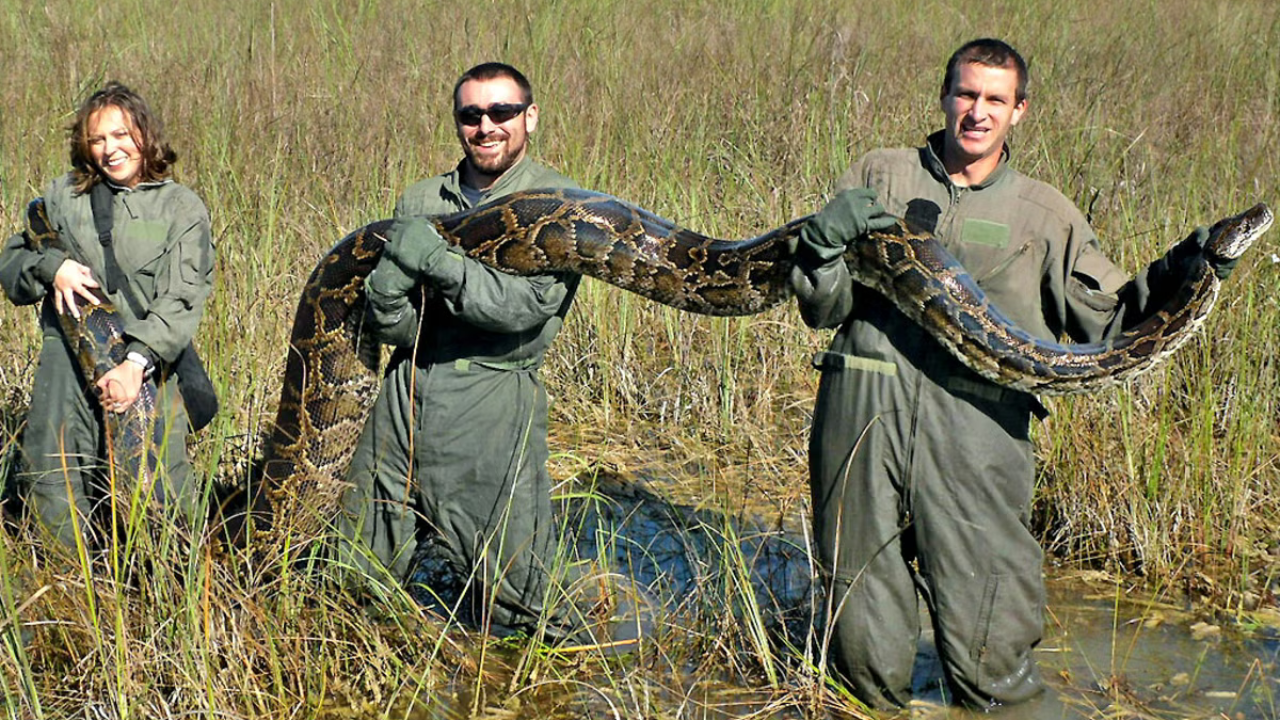
Everyone knows the basic nightmare of the Florida Everglades. Giant Burmese pythons slither through the sawgrass, swallowing everything in sight. They gulp down adult deer, snatch alligators, and clear out entire populations of small mammals. It is a straight-up ecological disaster.
But a ground-breaking study published in the Journal of Zoology reveals a bizarre new twist. These massive predators are doing something much more subtle than eating the locals. They are planting gardens.
Scientists recently discovered that Burmese pythons act as accidental delivery vehicles for plant seeds. By eating fruit-loving birds and mammals, the snakes carry plant seeds deep into new territories. It is an unexpected ecosystem shift that turns our entire understanding of South Florida invasive species upside down.
The Hidden Gardening Habit of South Florida Apex Predators
For decades, biologists viewed the python problem through a single lens. Total destruction. The snakes arrived through the exotic pet trade, escaped or got released, and found an absolute paradise. Since they have no natural predators in Florida, they ate their way through the food chain.
Then came the research team. Biologists from the University of Florida, the US Geological Survey, and the Conservancy of Southwest Florida teamed up to look closer at what resides inside these snakes. They examined the digestive tracts of pythons captured during routine management efforts.
They found seeds. Lots of them.
The researchers identified 25 distinct types of plant seeds inside the python tracts. The list included common native Florida plants like the cabbage palm and creeping cucumber. The snakes do not eat fruit. They are strict carnivores. So how did the seeds get there?
The answer comes down to a process called secondary seed dispersal, or diploendozoochory.
A raccoon or a marsh rabbit eats some berries. Before those berries can pass through the mammal, a giant python hits the mammal. The snake swallows the prey whole. The prey digests, but the seeds do not. They ride along inside the snake until it poops them out miles away.
Survival of the Fittest Seeds
You might think a python stomach would destroy a seed. Snake digestive juices are notoriously strong. They dissolve bones, fur, and teeth.
The study tested this directly. Scientists ran germination experiments on the seeds recovered from the snakes. The results surprised everyone.
Nearly 40 percent of the cabbage palm seeds survived the trip through the python gut. Not only did they survive, they sprouted successfully.
This means the seeds are completely viable. The snakes are actively dispersing living plants across the wetlands.
The Trophic Cascade Nobody Expected
To truly grasp why this matters, you have to look at what the Everglades used to look like. Twenty years ago, the marshes rustled with furry activity. Raccoons, opossums, bobcats, and rabbits filled the brush.
Those animals were the original caretakers of the forest. They ate fruit, walked around, and deposited seeds. They kept the plant community moving and healthy.
Then the pythons hit.
Populations of marsh rabbits completely vanished from many areas. Opossum and raccoon sightings dropped by roughly 99 percent in the southern reaches of Everglades National Park. The original seed movers were wiped out.
Replacing the Workforce They Destroyed
The ecosystem faced a massive job vacancy. Plants had no way to move their offspring.
Now, it turns out the pythons stepped into the vacancy. They took over the ecological function of the very animals they wiped out.
But do not mistake this for a happy ending. A native raccoon behaves very differently from an invasive constrictor. Raccoons stay in specific territories, follow predictable trails, and have specific bowel habits. Pythons move differently, live in different micro-habitats, and hold food in their guts for much longer periods.
This changes where plants grow. The entire geography of the Everglades is shifting under the radar.
Double Agents in the Grass
The study did not just look at pythons. Researchers also tracked the Argentine black and white tegu. This is another massive invasive reptile tearing up South Florida.
While the python is a carnivore acting as an accidental carrier, the tegu is an omnivore. Tegus love fruit. They eat it directly.
The research team found 73 different seed types inside tegu digestive tracts. Between the two reptiles, they touched 38 different plant families. This includes native species, endangered plants, and highly destructive invasive weeds.
The Network is Adapting
Ecologists use interaction networks to map how species rely on each other. When they plugged the python and tegu data into these models, they discovered something alarming.
The invasive reptiles show high levels of integration into the local network. They are fitting right into the ecosystem jigsaw puzzle.
When an invasive species integrates this deeply, eradication becomes even trickier. They are no longer just external invaders. They are part of the plumbing. They are reshaping the botanical future of the state.
Unpredictable Consequences for Conservation
This finding complicates the work for land managers. Florida spends millions of dollars every year trying to eliminate pythons. Contractors cruise the levees at night, tracking down giant snakes to remove them from the wild.
Now, removing a snake might mean altering how a specific plant moves.
Even worse, the snakes can carry invasive weeds. If a python eats a bird that just gorged on an invasive Brazilian pepper seed, that python might drop the seed in a pristine, untouched corner of the swamp. They act as rapid transit systems for environmental degradation.
Moving Beyond Simple Biology
For years, the public narrative focused entirely on the shock factor. Giant snakes eating family pets or fighting alligators. That makes for great headlines, but it misses the bigger picture.
Invasive species do not just subtract things from an ecosystem. They rewrite the rules.
They bring new parasites. They alter how diseases spread. For instance, because pythons ate all the large mammals, local mosquitoes now feed almost exclusively on cotton rats. Cotton rats carry the Everglades virus. As a result, the virus spreads much faster now.
Now, we know they also design the forest layout.
Next Steps for Everglades Management
If you care about conservation, the playbook has to change. We cannot just count dead snakes anymore.
Biologists must map where these snakes travel to predict where new plant communities will pop up.
Keep supporting local removal efforts like the annual Python Challenge, but realize the goal is no longer just protecting native wildlife. It is about saving the very physical structure of the wetlands. Pay attention to the botanical surveys coming out of South Florida over the next few years. The trees growing out there tomorrow are being decided by the predators slithering through the brush today.