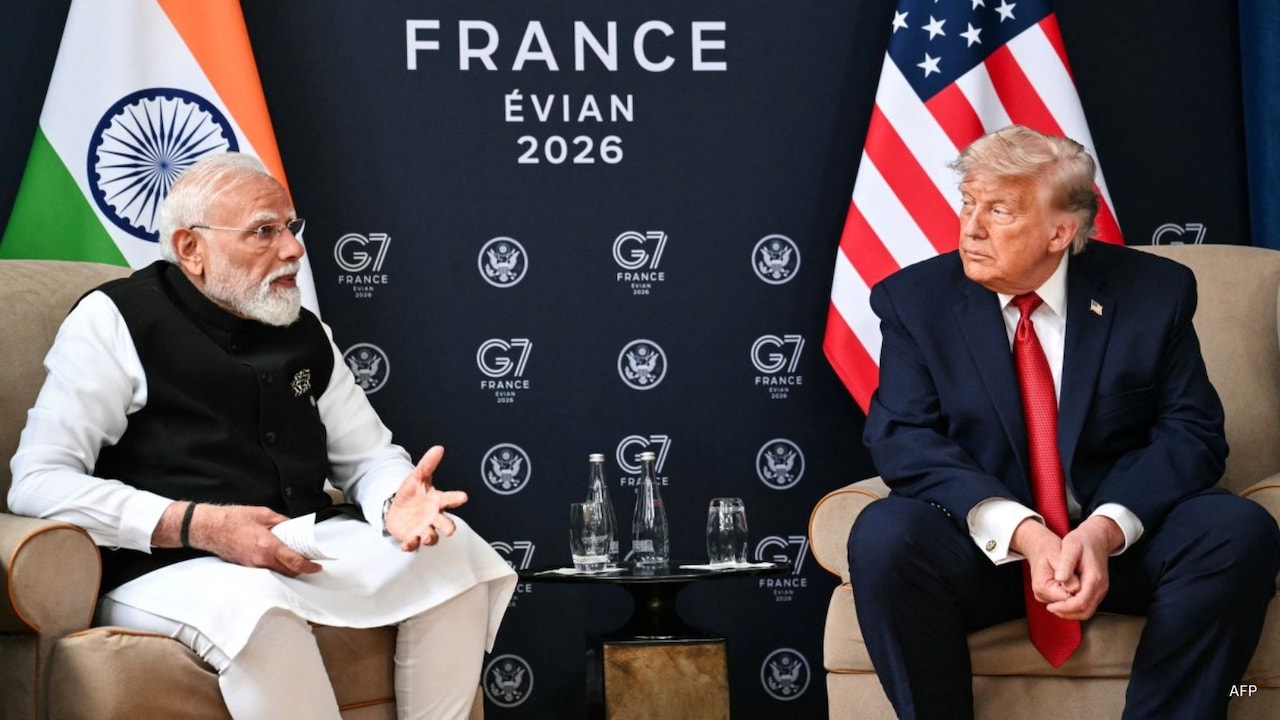
Donald Trump just put Narendra Modi at the absolute top of his global leaderboard, and the reason why should make everyone rethink how modern foreign policy actually works.
During an interview on "The Axios Show" following a high-stakes G7 summit in France, Trump laid out exactly why he respects the Indian Prime Minister. While standard diplomatic speak usually revolves around shared democratic values or vague partnership goals, Trump cut straight to a practical reality. He pointed out that Modi manages a nation of 1.5 billion people and, crucially, stays out of wars. Trump called that strategy smart. For an alternative view, see: this related article.
The Art of Staying Out of Other Peoples Conficts
Most Western commentators spent years criticizing New Delhi for its refusal to pick a definitive side in global conflicts. Whether dealing with European tensions or Middle Eastern flare-ups, India stubbornly maintained its strategic autonomy. Trump, historically skeptical of long-term foreign military entanglements himself, sees this restraint as a masterclass in leadership rather than a sign of weakness. Further analysis on the subject has been published by Al Jazeera.
Managing a massive economy and lifting millions into the middle class requires stability. Getting dragged into expensive, draining regional proxy battles ruins domestic growth. Trump praised this balance, highlighting that Modi maintains a public calmness that hides a remarkably tough interior character.
Trump remarked that if you tried to cast a movie about leaders like Modi or Chinese President Xi Jinping, you would not be able to find anyone commanding enough in Hollywood. He noted that Modi is a very tough cookie who has broken the old cycle of political volatility in India, where prime ministers used to cycle out every six to twelve months. Modi has held steady for over 12 years, providing a predictable anchor for international trade and security.
What Happened Behind Closed Doors at the G7
The public praise followed intense, behind-the-scenes negotiations at the G7 summit in Évian-les-Bains. The relationship between Washington and New Delhi faced significant friction over the prior year, primarily driven by trade imbalances and tariffs.
Trump openly admitted that India used to take advantage of American trade policies under previous US administrations. He blamed older generations of American politicians for allowing bad deals to slip through. Things changed because the current administration pushed for tighter, more balanced agreements. Even though Indian negotiators are not thrilled about losing their old advantages, Trump respects the fact that Modi acts as a fierce negotiator for his own people.
The two nations are now working on massive trade deals where India is actively spending billions of dollars within the United States, creating American jobs while securing its own industrial supply lines.
The Straight of Hormuz Friction
The summit was not just a collection of easy photo opportunities. Serious issues came to the table. Modi directly confronted global leaders, including Trump, over a US military strike that resulted in the tragic deaths of Indian seafarers. Thousands of Indian sailors work on maritime trade routes globally, and their safety remains a non-negotiable priority for New Delhi.
Modi made it clear that freedom of navigation must be secured without turning commercial shipping lanes into active combat zones. Trump responded with genuine sympathy for the families of those sailors and used the moment to offer a massive security assurance.
He stated plainly that if India were ever attacked while Modi is in office, the United States would step in to help. This goes far beyond standard diplomatic boilerplate. It signals a deeply personal, leader-to-leader security guarantee that reshapes security dynamics across Asia.
Why Multi Alignment Beats Traditional Alliances
Traditional foreign policy experts love neat, tidy alliances like NATO. They want nations to sign on the dotted line, pledge total loyalty, and inherit all of Washington's enemies. India completely rejects this old framework.
New Delhi practices multi-alignment. This means India builds a tight defense partnership with the US through the Quad, buys military equipment from legacy suppliers, and signs independent energy deals whenever it serves national interests. It is an unvarnished, pragmatic approach to survival.
| Strategy Component | Old Alliance Model | Indias Multi-Alignment Model |
|---|---|---|
| Primary Goal | Ideological bloc unity | National interest maximization |
| Military Role | Automatic deployment in allied wars | Strict defense of sovereign borders |
| Trade Policy | Restrictive economic blocs | Direct, transactional bilateral deals |
| Conflict Stance | Picking a side immediately | De-escalation and safe commercial transit |
This approach infuriates ideological purists, but it achieves results. By refusing to tie its fortunes blindly to any single global superpower, India ensures that it never becomes collateral damage in a conflict it did not start. Trump recognizes this calculated self-interest because it mirrors his own transactional approach to international relations.
The Myth of the Soft Diplomat
People looking at photos of world leaders often mistake courtly manners and diplomatic protocol for softness. Trump warned against making that mistake with Modi. He described the Indian leader as looking incredibly nice, almost like an angel on the surface, but operating with absolute, cold-blooded toughness underneath.
This internal steel shows up in how India handles its immediate neighborhood. New Delhi has quietly strengthened its border infrastructure, expanded its naval footprint across the Indian Ocean, and built up a domestic defense manufacturing base. India stays out of global wars because it chooses to, not because it lacks the capacity to project power.
It preserves its strength for real threats along its own frontiers while ignoring distracting global sideshows. For an American administration focused heavily on domestic economic renewal and avoiding endless foreign interventions, this brand of nationalist realism is highly respectable.
Real Next Steps for Global Businesses and Analysts
Faced with this evolving geopolitical reality, corporate strategists and policy analysts cannot rely on outdated assumptions about global alliances. If you want to navigate this environment effectively, apply these concrete steps immediately.
First, stop evaluating Indian policy through a pro-Western or anti-Western lens. Evaluate every major policy shift out of New Delhi strictly by asking how it serves India's domestic economic security. If a trade deal protects local manufacturing or secures affordable resources, India will sign it regardless of external political pressure.
Second, prepare for a more transactional trade environment. The days of open-ended, preferential trade status are over. Future deals will require clear, reciprocal benefits. Ensure your cross-border operations emphasize direct investments and job creation inside both markets to survive regulatory changes.
Third, factor direct leader-to-leader relationships into your long-term risk assessments. Formal treaties still matter, but personal assurances between strong executives are driving rapid shifts in defense and economic policy. Watch the direct communications between Washington and New Delhi rather than relying solely on official ministerial communiqués.