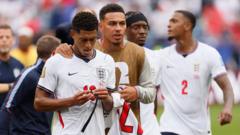
Possession doesn't win football matches. If it did, England would have walked out of Boston Stadium with a historic victory instead of a frustrating 0-0 draw against Ghana. Keeping 78.8% of the ball sets a new, albeit unwanted, World Cup record for the highest possession percentage by a team failing to score. It also exposed structural flaws that Thomas Tuchel must address immediately if this tournament run isn't going to end in early heartbreak.
Fans and pundits are quickly pointing fingers at individual players. Some blame Harry Kane for looking sluggish. Others look at Anthony Gordon or Djed Spence. While individual player ratings tell a story, they don't give you the whole picture. England didn't draw because one or two players had an off night. They drew because they walked face-first into Carlos Queiroz’s defensive yellow wall and lacked the collective intelligence to move it aside.
The real question isn't just about who failed to make an impact. The real question is why Tuchel’s tactical system made it so difficult for these world-class individuals to thrive.
The Reality Behind the Stagnant Possession in Boston
Let's look at the numbers before jumping into the individual assessments. England had 18 shots but managed only three on target. Ghana sat back in a rigid 5-4-1 defensive block, surrendered the pitch, and registered just a single shot the entire game. It was a masterclass in defensive resilience from the Black Stars, but it was heavily aided by England’s lateral, predictable passing.
John Stones spent the half-time break walking on the pitch to talk to Marc Guéhi. His advice was clear. Speed up the distribution. Move the ball before the defensive line can shift. England didn't listen. The passing remained slow, safe, and entirely unthreatening.
Defending the Goal with Mixed Results
Jordan Pickford
He was a total spectator for the first 45 minutes. Then came the second half, and he nearly threw the game away. Pickford rushed out wildly and brought down Prince Adu. He was incredibly lucky to escape a red card or a late penalty. A performance that required concentration instead delivered a moment of pure panic.
Rating: 5/10
Reece James
He started with plenty of energy and overlapping intent. However, a heavy challenge from Jordan Ayew required lengthy medical treatment and completely sucked the life out of his game. He faded badly in the second half, offering very little of his usual attacking quality.
Rating: 6/10
Ezri Konsa
He produced one genuinely superb last-ditch tackle to deny Antoine Semenyo in a dangerous goal-scoring position. On the flip side, his clumsy challenge on Prince Adu inside the area could easily have resulted in a tournament-altering penalty. He survived by the skin of his teeth.
Rating: 5/10
Marc Guéhi
Replacing John Stones in the starting lineup is a heavy burden. Guéhi did well enough with his defensive duties and read the game cleanly. His passing range is respectable, but he didn't move the ball forward into the midfield pockets quickly enough to disrupt Ghana’s static shape.
Rating: 6/10
Djed Spence
This was the most baffling tactical selection from Thomas Tuchel. Starting the Tottenham fullback out of position at left-back completely robbed England of natural width and attacking adventure. Spence didn't do anything to justify his selection and looked uncomfortable trying to cut inside onto his stronger foot.
Rating: 5/10
Midfield Engine Stalls Against the Yellow Wall
Declan Rice
Rice was back to his marauding best during the opening twenty minutes of the contest. He won his duels and tried to drive the team forward from deep. Sadly, his performance dipped along with the rest of the squad as the game ground to a halt. His set-piece delivery in Boston was way below his usual high standards, wasting several crucial corner opportunities.
Rating: 7/10
Elliot Anderson
A night to forget for the young midfielder. Anderson was far too slow in possession, consistently taking three or four touches when a single first-time pass was needed. Playing against a low block requires proactive, daring forward passing. Anderson chose the safe option almost every single time.
Rating: 5/10
Attackers Isolated and Starved of Service
Noni Madueke
Madueke certainly didn't lack effort or directness. He caused Gideon Mensah some early headaches by running straight at him. The problem lies with his final ball. He repeatedly worked himself into excellent positions on the right flank only to overhit his crosses or pick out a Ghanaian shirt.
Rating: 6/10
Jude Bellingham
Earning your 50th cap at a World Cup should be a joyous occasion. Instead, Bellingham found out just how difficult life can be when an opponent completely suffocates your space. He worked tirelessly, but he couldn't replicate the magic or cutting edge he showed in the 4-2 opening win against Croatia. Thomas Partey shadowed his every move.
Rating: 6/10
Anthony Gordon
An incredibly anonymous display from the winger. Aside from a clever dummy in the opening minutes to jumpstart a brief attacking sequence, Gordon did almost nothing of substance. He looked devoid of ideas on the left wing and his starting spot against Panama is now under severe pressure.
Rating: 4/10
Harry Kane
Eight touches. That is all England’s captain and talisman managed in an excruciatingly quiet first half. Kane explained after the match that Partey man-marked him out of the game, preventing him from dropping deep to pick up the ball. When his golden opportunity finally arrived late in the game, blasting a rebound high over the bar after Nico O'Reilly hit the woodwork, he blinked.
Rating: 6/10
Impact of the Finishers Off the Bench
Tuchel loves to talk about his finishers rather than his substitutes. The changes did inject some life into an otherwise turgid performance, but it wasn't quite enough to break the deadlock.
Bukayo Saka replaced Gordon after 66 minutes and instantly brought much-needed urgency to the pitch. He tested Ghana keeper Benjamin Asare with a sharp, low drive and looked like the only forward capable of making something happen. He should have started.
Nico O'Reilly came on for Spence at the same time and nearly became the hero. He was desperately unlucky to see his late header strike the top of the post. Leaving him on the bench in favor of Spence was a clear error in judgment by the manager.
Morgan Rogers and Eberechi Eze both entered the fray with 14 minutes remaining. Rogers provided a few driving runs that unsettled the tired Ghanaian defense, while Eze looked slightly uncomfortable in a deeper midfield role, nearly getting punished for a loose giveaway. Marcus Rashford was thrown on in the 83rd minute but cut a frustrated figure on the left wing with little time to impact the flow.
Tactical Failings That Must Be Fixed Before Panama
Blaming individual attackers for a lack of goals misses the broader tactical issue. This performance was down to structural problems rather than individual talent. Tuchel’s setup failed to anticipate just how deep and compact Ghana would play.
Leaving out creative passers who can fizz ball through tight lines left England looking creatively bankrupt. The decision to sacrifice width on the left flank by playing Spence out of position meant Ghana could simply choke the middle of the pitch. They knew England had no way around them.
The tournament format might strip away some group-stage jeopardy, but England cannot afford to coast. Failing to win this group means a potential nightmare matchup against a top-tier knockout opponent.
To fix this before Saturday, Tuchel needs to make three immediate adjustments. First, return natural width to the left side by starting O'Reilly or a true left-sided player. Second, demand faster distribution from the center-backs to prevent the defensive block from setting its shape. Third, give Saka the starting nod to reintroduce direct, vertical pressure from the opening whistle. Safe passing won't bring home a World Cup trophy. Daring football will.