Pakistan is facing an existential crisis that goes way beyond standard political drama in Islamabad. For decades, outsiders viewed the country through the lens of military coups, debt bailouts, and tension with India. That perspective misses the real threat eating away at the state from within. The map itself is fracturing.
Look at what happened earlier this year. In late January and early February 2026, coordinated armed assaults and suicide bombings paralyzed Balochistan under what Baloch rebels called Operation Herof 2.0. Then, just weeks later in June, massive civil unrest erupted across Pakistan-occupied Kashmir, commonly called PoK. When both a heavily militarized border zone and a mineral-rich province reject the federal government simultaneously, it isn't just a temporary policy problem. It's a fundamental breakdown of state authority. Also making headlines recently: What Most People Get Wrong About The Birthright Citizenship Ruling.
Many international analysts shrug this off as routine friction. They're wrong. The current wave of dissent points to a deeper, systemic unraveling that makes the old model of central governance obsolete.
The Burning Core of the Baloch Insurgency
Balochistan has always been a thorn in the side of the central government, but the early 2026 offensives proved that the Baloch rebels have evolved. The Baloch Liberation Army, known as the BLA, launched simultaneous strikes across multiple districts, targeting police stations, military outposts, and a high-security prison in Quetta. Additional details into this topic are detailed by USA Today.
This wasn't a ragged band of hit-and-run guerillas. It was a highly organized force using sophisticated weaponry and tactical coordination. They held positions, blocked major highways like the coastal highway, and broadcasted messages through local mosques urging residents to rebel. Law enforcement operations killed over 200 militants, but the cost was devastating, claiming dozens of security personnel and civilian lives.
The anger driving this violence isn't a secret. Islamabad treats Balochistan like a corporate resource colony. The province holds vast natural gas reserves and copper mines, yet its people remain among the poorest in the country. To make matters worse, the multi-billion-dollar China-Pakistan Economic Corridor, or CPEC, runs right through the province. Local populations see Gwadar port and CPEC infrastructure as a foreign occupation that steals their resources while giving nothing back.
When local communities get zero benefits from mega-projects on their own soil, rebellion stops being a choice. It becomes an inevitability. The state responds with forced disappearances, arbitrary detentions, and military crackdowns. That brutality just feeds the insurgent recruitment pipeline.
Why PoK Protesters Are Turning Their Backs on Islamabad
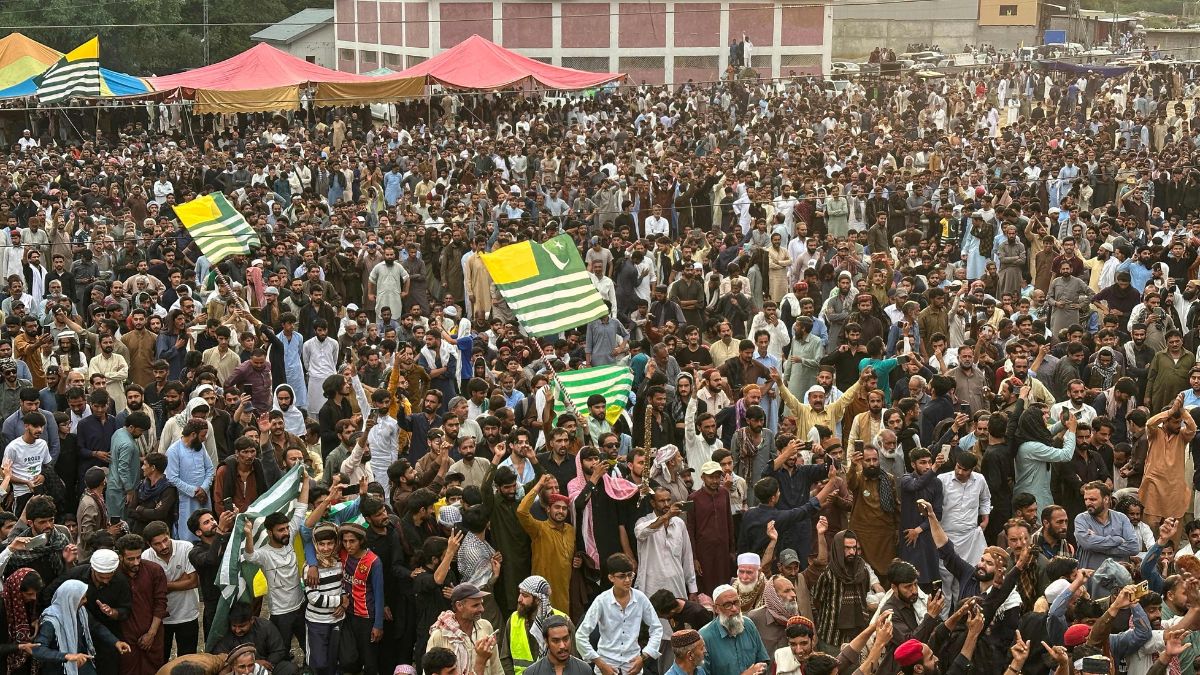
While Balochistan fights with guns, PoK is fighting through a massive, unprecedented civilian shutdown. Throughout June 2026, the region witnessed a near-total rebellion. The Joint Awami Action Committee, or JAAC, led a movement that brought thousands of traders, professionals, and regular citizens onto the streets of Muzaffarabad, Rawalakot, and Poonch.
The immediate trigger seemed bureaucratic, but it carries explosive political weight. The protests focused on a controversial legal structure reserving 12 seats in the 53-member PoK Assembly for Jammu and Kashmir refugees living outside the region in parts of Pakistan like Punjab and Sindh.
Local residents are furious about this setup. They argue that Islamabad uses these 12 seats to pack the local legislature with federal loyalists who have no actual connection to Kashmir. Even worse, the salaries and expenses of these centrally controlled politicians are billed directly to the local PoK budget. It's a classic case of exploitation without representation.
The economic pain runs deep. Residents live right next to massive hydropower installations like the Mangla Dam, yet they face skyrocketing power tariffs and severe energy shortages. Subsidized wheat has vanished. When the JAAC called for an indefinite strike, the Pakistani government didn't try to negotiate fairly. They banned the JAAC under anti-terror laws, cut off internet and mobile networks, and sent in federal paramilitary forces.
More than a dozen people died in violent clashes in Rawalakot alone. By branding a grassroots civil rights group as a terrorist entity and sealing off the area from international journalists, Islamabad exposed its own desperation.
The Parallel Nightmare in Gilgit Baltistan
You can't look at the PoK crisis without looking at Gilgit-Baltistan. The two regions share the same fundamental grievance against federal high-handedness. Islamabad denies full political rights to Gilgit-Baltistan to keep its options open for an international plebiscite over the broader Kashmir dispute.
This leaves the local populace in a constitutional vacuum. They don't have provincial status, they don't have proper representation in Islamabad, but they still get their resources stripped. The local tourism and mining potential gets swallowed by federal agencies, leaving locals with crumbling infrastructure and food insecurity.
The common thread linking Quetta, Muzaffarabad, and Gilgit is a total rejection of the Pakistani state's colonial style of governance. People are tired of being treated as strategic buffers or cash cows for the elite in Rawalpindi and Lahore.
The Blame Game That Doesn't Work Anymore
Every time a bomb goes off or a protest shuts down a city, the federal government reaches for a familiar script. They blame external actors. Following the January attacks, Interior Minister Mohsin Raza Naqvi quickly pointed fingers at India, claiming the BLA operates with foreign funding and cross-border help.
India's Ministry of External Affairs rejected those claims, calling them a lazy tactic to deflect attention from internal failures. The reality is that external actors don't need to create instability when the Pakistani state is doing such a thorough job of it.
You don't need foreign funding to make a local trader march in the streets when he can't afford electricity because of federal taxes. You don't need an external conspiracy to make a young Baloch pick up a rifle when his brother disappeared into a military detention center without trial. The issues are entirely homemade.
Understanding the Illusion of Control
The biggest mistake global observers make is assuming the Pakistani military can always squash these movements through sheer force. That strategy worked in the past, but the ground realities shifted.
The military is fighting on too many fronts. They're dealing with a revived Pakistani Taliban, the TTP, along the northwestern border with Afghanistan. They're managing a broken economy kept alive only by emergency loans. Now, they're forced to deploy paramilitary assets to secure local governance assemblies in Kashmir while fighting full-scale guerrilla warfare in the southwest.
The state is running out of cash and running out of bullets. Using counter-terrorism laws against peaceful civil rights organizers in PoK shows a regime that has lost the ability to govern through consent. When a government relies entirely on fear, it loses its legitimacy.
What Lies Ahead for the Region
The old status quo is dead. Pakistan isn't going to wake up tomorrow and find these regional movements gone. If you want to understand where this situation is heading, look at these concrete tracking indicators over the next few months.
First, keep a close eye on the scheduled local legislative elections in PoK. If the federal government pushes through its loyalists using those 12 reserved seats despite the body count on the streets, the civil movement will likely transform from an economic protest into an open independence movement.
Second, track the security expenditures around CPEC infrastructure. If the BLA continues to disrupt the coastal highway and launch simultaneous urban operations, Chinese state enterprises will likely pause their investments. Beijing has already shown immense frustration with Pakistan's inability to protect its workers. Without Chinese financial backing, the economic house of cards falls apart.
Finally, look at the legal system. The misuse of electronic crimes laws and anti-terror acts to lock up local journalists and activists is backfiring. It's driving dissent underground, making it harder for the state to negotiate even if it wanted to.
The central government needs to realize that military might cannot replace actual governance. Until people in the peripheral regions get real representation and a fair share of their own resources, the borders of Pakistan will remain on the verge of an explosion.