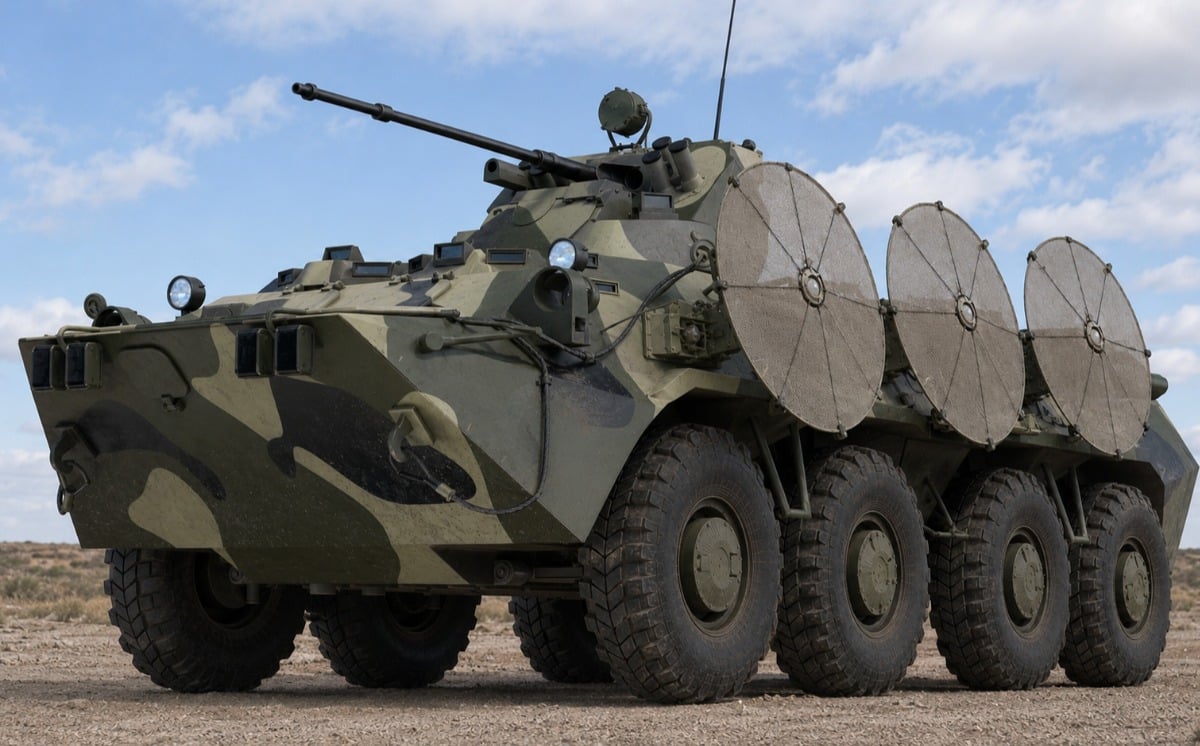
You have probably seen the ridiculous "turtle tanks" clanking around Ukraine. Those makeshift metal sheds welded onto heavy armor look desperate, but they exist for a reason. First Person View (FPV) kamikaze drones are completely destroying multi-million dollar armored vehicles. The frantic race to survive has led to some bizarre engineering ideas, and Russia just patented the latest one: a spinning, motorized mechanical umbrella.
The patent drawings look wild. Instead of passive steel cages or heavy mesh nets, this new system relies on high-speed kinetic motion. It is essentially a central mast mounted on top of an armored vehicle with layered cables or rigid blades extending outward. When an FPV drone dives in for a top-attack strike, these blades spin rapidly to bat the drone away, rip its propellers off, or force an early detonation before it touches the main hull.
It sounds like clever sci-fi. In reality, it is a logistical nightmare waiting to jam.
The Problem With Dynamic Armor
Static cages—often called "cope cages"—are heavy and ugly, but they don't require electricity. They don't have gears. They don't break down when covered in mud.
This spinning umbrella system relies entirely on a dedicated electric motor and transmission tied directly into the vehicle's power supply. Think about the average environment for an infantry fighting vehicle or a main battle tank. You are dealing with thick mud, heavy dust, constant vibrations from rough terrain, and flying shrapnel.
What happens when a single tree branch jams the spinning mechanism? The motor burns out. What happens when artillery shrapnel dents the central mast? The system locks up. Suddenly, your high-tech drone shield is just a useless, heavy pole sitting on your roof.
The designers claim that the system spins up to 600 RPM. They argue that a drone operator looking through a grainy headset camera won't even see the spinning blades until it's too late. While that might be true for the pilot, it ignores how brutal combat environments are on moving parts.
A Design Stolen From the Frontlines
This isn't Russia's first weird anti-drone patent, and it points to a much bigger trend. Russian military engineering academies have spent the last couple of years essentially legalizing battlefield modifications—and copying Ukrainian designs.
Last year, the Karbyshev Military Engineering Academy patented a folding mesh screen called the "hood." It was a direct copy of a lightweight, collapsible mesh system that Ukrainian crews used successfully on their own tanks. The Russian version claimed to be 1.5 times more effective than older cages, but field reports showed a massive flaw: the way they mounted it to vehicles like the BMP-2 blocked the vehicle's turret from rotating. You got drone protection, but you couldn't aim your main gun.
Now they are testing this spinning cable concept. Early prototypes have reportedly been spotted on small ground robotic platforms in occupied areas like the Zaporizhzhia region. Using cables instead of rigid metal blades makes the system slightly lighter, and cables don't snap as easily when they hit a tree. But the internal space required for the motors and spinning hubs cuts into the vehicle's utility.
The Active Shield Arms Race
Russia isn't the only military trying this. The Indian Army actually filed a very similar patent recently for a counter-rotating blade shield to protect its T-72 and T-90 fleets. The global defense community knows that static armor screens add too much weight and ruin a tank's power-to-weight ratio. Everyone wants a dynamic solution.
But wanting it doesn't mean it works. To make a spinning mechanical umbrella viable, you have to solve three massive issues:
- Power Draw: Armored vehicles are already packed with radios, thermal sights, electronic warfare jammers, and turret motors. Tapping into the electrical grid for a high-RPM mechanical spinner risks draining the system.
- Sensor Blockage: Modern armor relies on optics, laser warning receivers, and radar. A blur of spinning metal cables right above the turret can easily interfere with your own active defense sensors and cameras.
- Crew Evacuation: If the vehicle catches fire, the crew needs to scramble out of the hatches instantly. A massive, spinning metal fan directly over the hatch makes a quick escape terrifyingly dangerous unless there is an instant automatic cutoff that works 100% of the time.
What Happens Next
Don't expect to see every Russian tank rolling out with a giant propeller anytime soon. Moving a concept from a patent office blueprint to mass factory production is incredibly difficult, especially under heavy economic sanctions.
If you are tracking modern military tech, skip the hype surrounding these patent filings. Instead, watch the real-world field modifications coming out of actual conflict zones. Watch the development of short-range electronic jammers and hard-kill automated shotguns. Those are the systems that actually scale. Heavy mechanical fans are flashy on paper, but the mud always wins.