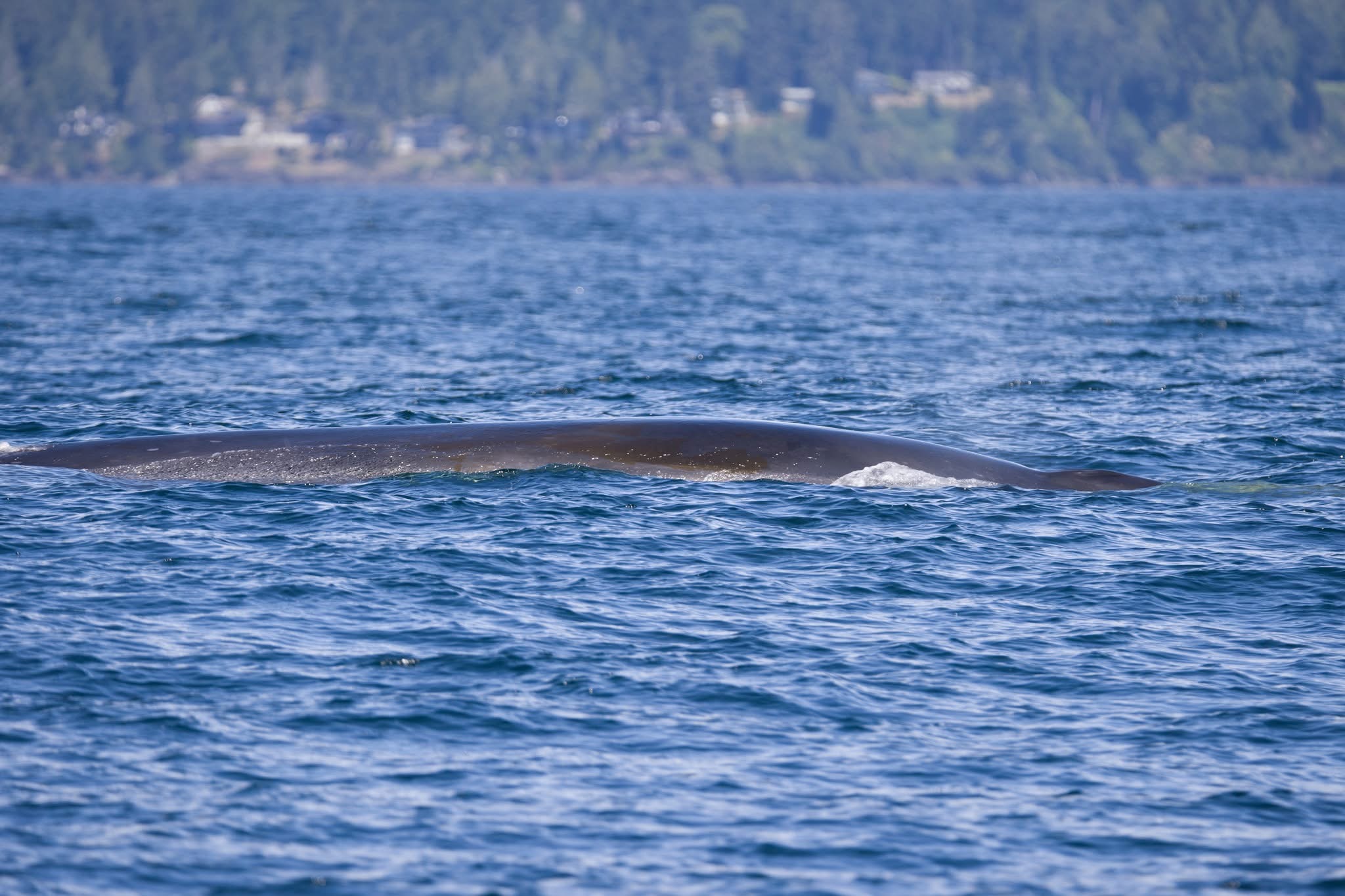
You don't expect to see a seven-story building swimming past your boat.
When a 70-foot fin whale surfaced in the shallow waters of the Salish Sea near Race Rocks, seasoned naturalists on Vancouver Island lost their minds. For context, captain Mollie Cameron has spent a decade taking people out on these waters. She routinely tells guests that spotting a gray or minke whale is rare enough to justify buying a lottery ticket.
Seeing a fin whale? That's entirely different. It's only the sixth time this species has been documented in the Salish Sea since 2015.
The encounter happened just west of Victoria, and it tells us something fascinating—and a bit worrying—about the changing state of our coastal oceans.
The Greyhound of the Sea Comes Inshore
Fin whales are the second-largest animals on Earth, eclipsed only by the blue whale. They can weigh up to 72 tonnes, live for 90 years, and slice through the water at 40 kilometers per hour. That insane speed earned them the nickname "greyhounds of the sea".
But here is the thing: they aren't supposed to be here.
Fin whales are deep-ocean creatures. They usually stick to the continental slope, hunting krill in massive, deep offshore trenches. Seeing one in the narrow Strait of Juan de Fuca is like finding a safari elephant wandering through a city park.
This specific 70-foot behemoth wasn't just passing through, either. Naturalists watched it lunge-feeding, which means the area is teeming with baitfish or krill right now. Valerie Shore, a senior naturalist with Eagle Wing Tours, believes this could be a younger whale exploring new territory. Humpback whales have already learned that the Strait of Juan de Fuca is an absolute buffet in the summer. It looks like the fin whales are starting to notice.
Spotting the Signs of Trouble
While the whale looked healthy and active, up-close photos revealed a dark side to its journey. Shore noticed a small hole in its dorsal fin, likely left by Pennella, a massive parasitic copepod that burrows straight into a whale's blubber to drink its blood.
It sounds horrific, but parasites are natural. Humans are the real threat.
During the encounter, multiple massive cruise ships blasted right through the area. One didn't even slow down.
Fin whales are the most common victims of ship strikes globally. Their speed and feeding habits make them oblivious to hulls. Just recently, a cruise ship docked in Alaska with a dead, pregnant fin whale pinned to its bow after leaving Vancouver. Earlier this spring, a 61-foot fin whale washed up dead on Samish Island in Washington after getting tangled in nets and attacked by orcas.
The Real Story Behind the Return
This sighting isn't just a lucky break for tourists; it's a direct result of decades of conservation. Commercial whaling completely wiped out these giants in local waters during the 20th century. They are still listed as threatened under Canada's Species at Risk Act.
The fact that they are dipping their toes back into the Salish Sea means populations are slowly bumping up. But our waters are louder and more crowded than they were a century ago.
If you are out on the water around Vancouver Island, you have a job to do. Don't rely on the whale seeing you.
- Watch for the blow: A fin whale's exhale shoots 20 feet into the air and sounds like a freight train.
- Slow down immediately: If you see large splashes, flocks of diving seabirds, or a cluster of whale-watching boats, drop your speed below 7 knots.
- Give them space: Legally and ethically, you need to maintain a massive boundary. Don't cut across their path.
If you happen to spot an entangled, injured, or unusually close whale in British Columbia waters, call the Fisheries and Oceans Canada marine mammal incident reporting line immediately at 1-800-465-4336. Keep your eyes on the horizon, report your sightings to the WhaleReport app, and give these giants the room they need to survive.