Academics and business owners don't speak the same language.
Spend five minutes at a corporate tourism conference and you will hear intense debates about quarterly KPIs, booking conversion funnels, and immediate revenue targets. Spend five minutes at a university hospitality faculty and you will hear about ontological frameworks, destination image constructs, and multi-layered empirical studies.
They are looking at the exact same human behaviors. Yet, they live in parallel universes.
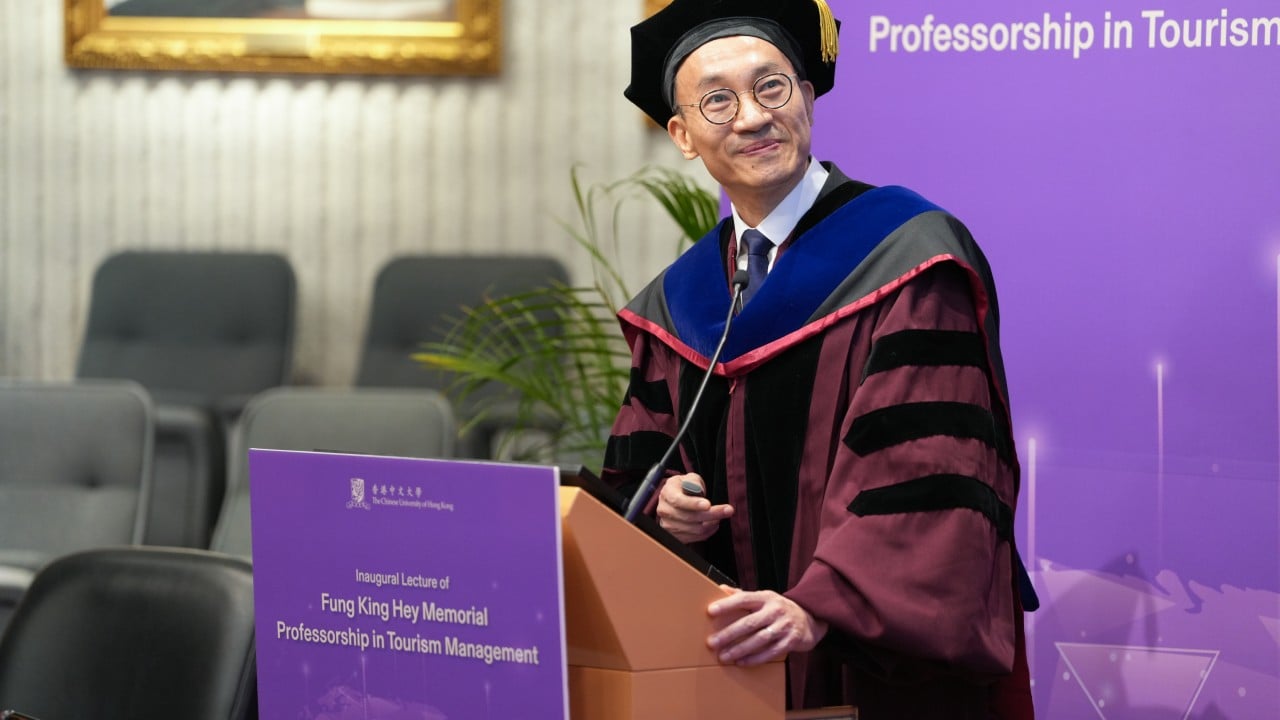
When Professor Robert Li moved to the Chinese University of Hong Kong (CUHK) Business School as the Fung King Hey Memorial Professor of Tourism Management, he brought an operating model designed to smash those two worlds together. He calls it the "compleat scholar" approach. It is an intentional strategy to stop universities from chasing insular, theoretical metrics and start giving the experience economy something it can actually use.
The Broken Pipeline Between Theory and Practice
The standard academic track rewards volume and obscurity. You write a highly technical paper, lock it behind a massive journal paywall, and hope three other professors cite it so you get tenure. The people running actual travel boards, hotels, and airlines never see it. If they do, they can't understand it because it is buried under layers of academic jargon.
Professor Li started his career on the corporate side at the Nanjing Municipal Tourism Bureau. He was tasked with building travel campaigns, managing promotions, and creating destination videos. He ran into a frustrating wall: nobody could actually define why certain marketing campaigns worked or how a city's public image truly formed in a traveler's mind. Corporate metrics measured the what but never the why.
When he moved into academia to solve those problems, he realized the institutional incentives were backward. Academics were studying what was "theoretically interesting" to get published. Industry leaders were chasing immediate vanity metrics.
To bridge this gap, you have to build continuous research programs rather than one-off papers. Instead of writing a single isolated report on a niche trend, a research program is a long-term, multi-year thematic pipeline. It brings together experts from computer science, psychology, public health, and linguistics to study a single core business problem from every angle over a decade.
Turning Jargon into Mainstream Business Strategies
The tourism sector is no longer just a vocational trade about booking beds and selling flight tickets. It has evolved into a massive, interconnected experience economy. Today, retail, sports, culture, healthcare, and entertainment are bleeding into one another.
[Traditional Tourism Track: Hotels -> Flights -> Tour Guides]
                     vs.
[Modern Experience Economy: Culture + Retail + Wellbeing + Hospitality]
Because of this shift, traditional business training fails. It is better to view hospitality as a testing ground where core general business rules converge. Li champions what he labels "gen business" subjects. These take overarching business logic—like consumer psychology or data analytics—and tailor them directly to the experience economy.
Consider employee burnout and corporate vacation culture. For years, HR departments viewed vacation time as a simple benefit checklist item. By treating tourism and leisure through a public health and psychological lens, long-term research programs provided actual data showing how structured time off directly impacts workforce productivity and retention. Suddenly, a soft human resources topic becomes a hard financial metric that C-suite executives care about.
Smashing the Journal Paywall
The biggest structural failure in modern research is distribution. Even when a professor discovers a brilliant insight that could save a company millions, it usually stays trapped in English-language, Western academic journals. If your target audience consists of operators, regional tourism boards, and local business owners across Asia, that distribution model is totally useless.
To fix this, Li's team launched a dedicated initiative on WeChat. They took top-tier, complex academic studies and stripped out the academic posturing. They rewrote the data into short, punchy, narrative-driven stories that a business owner could read on their phone during a morning commute.
It turns out corporate managers actually want data-driven insights. They just refuse to read a 40-page paper written in passive voice to get them.
How to Build a Multi-Dimensional Career Architecture
If you want your work to matter outside your specific silo, you have to consciously abandon the single-track mindset. The concept of the "compleat scholar" means building a multi-faceted career where your roles build on each other instead of competing for your time.
You can apply this exact framework whether you are climbing the corporate ladder or working in a lab:
- Build collaborative programs, not tasks: Stop looking at your projects as isolated assignments. Connect them under a single, long-term theme that builds compounding value over five to ten years.
- Force cross-disciplinary experiments: If you work in marketing, bring a data scientist and a psychologist into your planning sessions. Innovation lives at the messy borders between different departments.
- Translate your value constantly: If you cannot explain your complex project to a colleague from an entirely different department in under two minutes, you do not understand its real-world value yet. Strip away the corporate speak.
- Own the distribution channel: Do not wait for people to discover your work. Re-package your insights for the platforms where your target audience already spends their time.
The future belongs to generalists who can navigate deep technical spaces and translate them into immediate business value. Stop staying inside your professional lane. Find the parallel universe next to yours and start building a bridge.