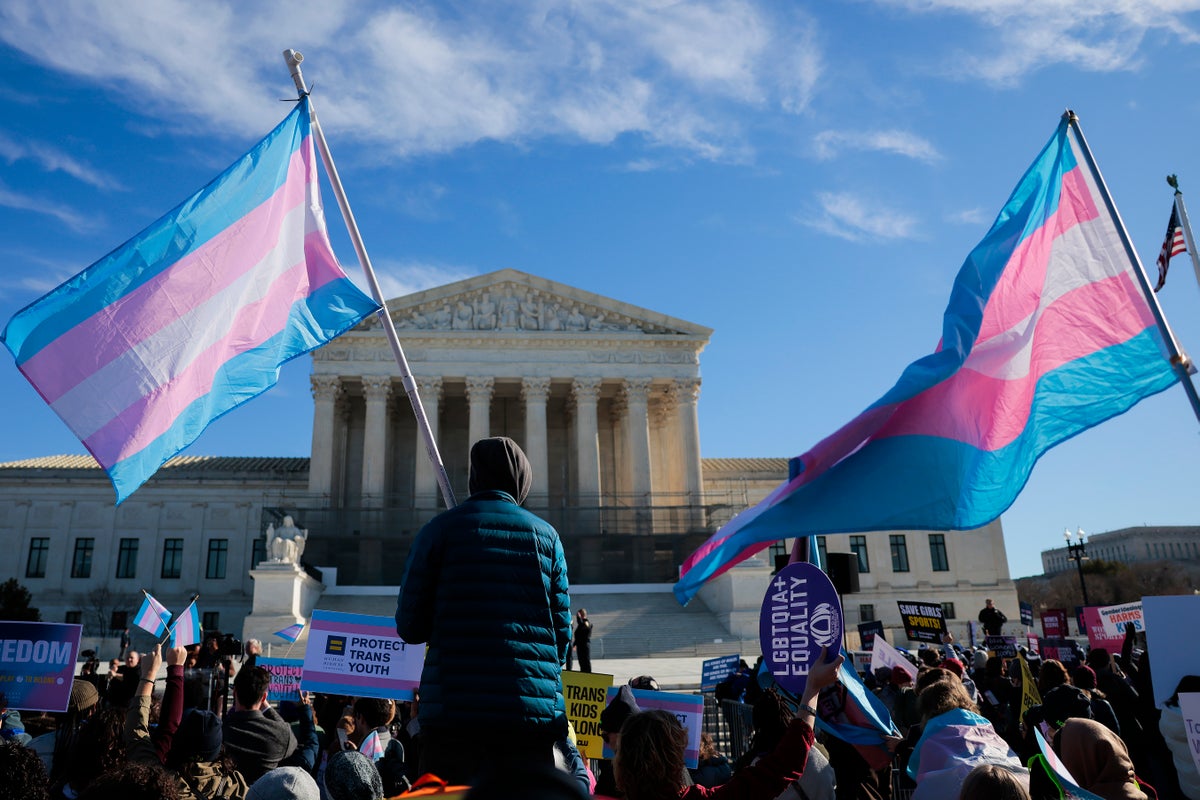
Donald Trump didn’t waste any time taking a victory lap on Truth Social. Within minutes of the Supreme Court dropping its final decisions for the term, he was typing in all caps, calling a 6-3 ruling that upholds state bans on transgender female athletes a "BIG WIN." He claimed it takes a "ridiculous situation off the table."
If you only read the headlines, you'd think this was just another standard chapter in the political culture wars. It's not. Look past the political posturing and you'll see a massive legal shift that will rewrite the rules for student athletics across the country.
The high court looked at two specific laws: Idaho’s Fairness in Women’s Sports Act and West Virginia’s Save Women’s Sports Act. Both laws require public school and university athletic teams to be designated strictly by biological sex at birth. By upholding them, the conservative majority didn't just hand a symbolic win to the white house. They gave a permanent green light to at least 25 other states with similar bans on the books, effectively ending a years-long legal stalemate.
The Legal Shift Underneath the Noise
For years, the battle over transgender sports participation hinged on a single word: sex. Opponents of these bans argued that Title IX, the 1972 law prohibiting sex discrimination in education, should protect a student’s gender identity. They pointed to a landmark 2020 Supreme Court case, Bostock v. Clayton County, which explicitly stated that workplace discrimination laws cover transgender individuals.
But Justice Brett Kavanaugh, writing for the majority, drew a sharp line between the workplace and the playing field.
Kavanaugh, who has frequently pointed out his own background coaching youth girls' basketball, argued that Title IX actually permits—and always intended to permit—schools to separate athletic competition based on biological sex. He wrote that states have a legitimate interest in maintaining women's and girls' sports for biological females to address safety and competitive fairness. According to the majority, the Constitution and Title IX don't require an overhaul of how America organizes sports.
In a sharp dissent from the bench, Justice Sonia Sotomayor tore into that logic. She focused heavily on the human toll, pointing directly to the case of Becky Pepper-Jackson, a 15-year-old high school student from West Virginia who challenged the law. Sotomayor argued that the majority was flat wrong to dismiss the equal-protection claims of a teenager who had undergone early gender-affirming care, never experienced male puberty, and simply wanted to run track with her peers.
The Collapse of the Middle Ground
What makes this decision so definitive is how it treats the physiological arguments. In the lead-up to this case, groups like the NCAA tried to find a middle ground. For nearly 15 years, college sports relied on a compromise policy: transgender women could compete if they completed one calendar year of testosterone suppression therapy.
That middle ground is completely gone now.
Following intense pressure and threats of losing federal funds from the Trump administration, the NCAA had already scrapped that policy in 2024. The Supreme Court's ruling locks that door shut. The conservative justices showed zero appetite for creating complex, case-by-case rules based on hormone levels or the age when someone transitioned. Instead, they opted for a blunt, uniform standard based entirely on sex assigned at birth.
The real-world impact of the relentless litigation showed up clearly in the companion case from Idaho. Lindsay Hecox, a college student at Boise State University who originally filed the lawsuit against Idaho’s first-in-the-nation 2020 ban, quietly walked away from the legal fight. Her lawyers revealed she stopped participating in sports entirely and tried to dismiss the case due to overwhelming public scrutiny, fear of harassment, and an increasingly hostile climate.
Where the Real Battle Lines Move Next
Don't assume this means the entire issue is settled. The Supreme Court's ruling allows states to ban transgender athletes, but it doesn't force them to do it.
We are about to see a stark, geographical fracturing of youth sports in America. Currently, 23 states—including California and Connecticut—explicitly allow transgender student-athletes to play on teams that align with their gender identity. Local advocacy groups in those states are already digging in. Tony Hoang, the head of Equality California, quickly issued a statement noting that inclusive policies have worked for years without incident and will continue under state protection.
Because the Supreme Court left unresolved the lawsuits challenging those inclusive state laws, the legal battlefield is merely shifting. Blue states will continue to protect trans athletes, while red states will enforce total bans. If you're a student-athlete, your right to play now depends entirely on the state line you live behind.
Your Practical Next Steps
If you're a parent, coach, or school administrator trying to navigate this new landscape, you can't rely on old policy handbooks. Here is what you need to do right now:
- Audit your state's current athletic association guidelines: With the federal cloud lifted, states with suspended bans will immediately begin enforcing them for the upcoming school year.
- Review local Title IX compliance: If you operate in a state with an active ban, work with legal counsel to update school athletic charters. Ensure they reflect biological sex definitions without violating unrelated privacy protections.
- Establish clear mental health supports: The intense public spotlight on youth sports isn't going away. School districts need to ensure that vulnerable students—regardless of what side of the line they fall on—have access to counseling resources to insulate them from the broader political noise.