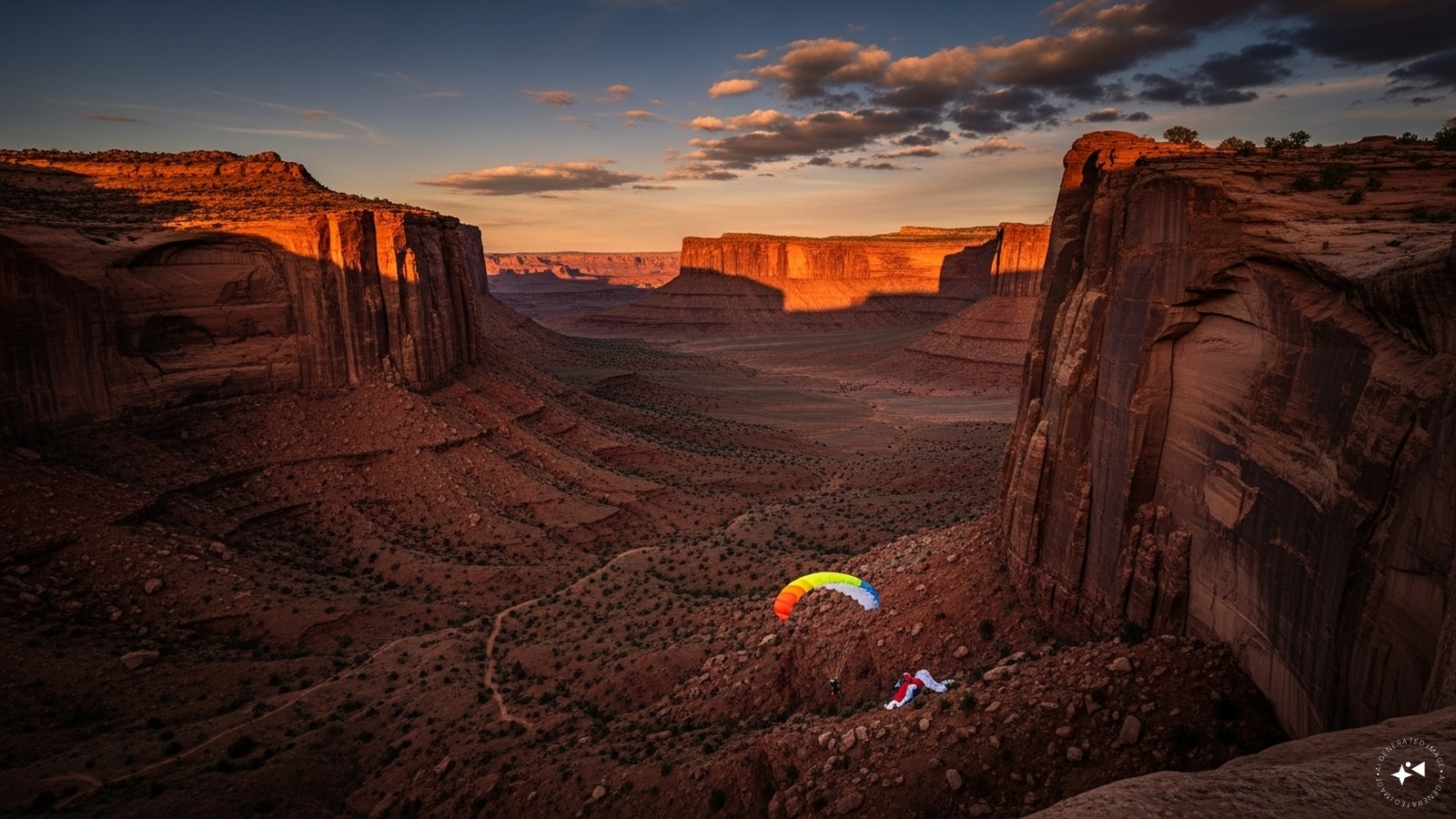
You think you understand risk until you look over a desert cliff in Moab. The air is completely still. The drop is sheer, hundreds of feet of red rock plunging into empty space. For most people, it's a view to take in from behind a safety railing. For Andy Lewis, it was just another day at the office.
But gravity doesn't care how many world championships you've won, or whether you shared a stage with Madonna. For a different perspective, consider: this related article.
The extreme sports community is reeling after a weekend tandem BASE jumping accident at Mineral Bottom, a remote canyon area near the Utah-Colorado border. Two men are dead. One was a 68-year-old grandfather looking for an unforgettable experience. The other was Andy "Sketchy Andy" Lewis, a pioneer of modern tricklining and an elite figure in the BASE world.
The tragedy cuts straight to a massive debate tearing through the extreme sports community. Should commercial operations be taking inexperienced tourists on tandem BASE jumps? Similar coverage on the subject has been shared by The Washington Post.
What Happened at Mineral Bottom
On Sunday, emergency responders from the Grand County Sheriff's Office rushed to the rugged desert terrain of Mineral Bottom. The report was grim: a severe accident during a jump.
Andy Lewis, 39, and his passenger, 68-year-old business owner Danny Joe Kregle, died at the scene. They were harnessed together in a tandem configuration. Lewis ran BASE Jump Moab, a commercial enterprise that offered everyday thrill-seekers the chance to step off a giant canyon wall with an expert strapped to their back.
While skydiving tandem jumps are widely accepted and heavily regulated, tandem BASE jumping is a completely different animal. You don't have thousands of feet to recover from a bad exit or a twisted line. You have seconds.
People who knew Lewis weren't surprised he was the one pushing this business model. He built his entire life on razor-thin margins of safety. John McEvoy, a veteran BASE jumping instructor who frequently jumped with Lewis, noted that Lewis possessed unparalleled athleticism but routinely chose to accept extreme levels of danger. He jumped into tighter gaps and pulled his canopy later than almost anyone else in the game.
From the Super Bowl to the Canyon Floor
If you don't know Andy Lewis from the desert, you probably know him from the biggest stage in the world. Back in 2012, Lewis became an overnight pop culture phenomenon during Madonna’s Super Bowl XLVI halftime show.
Dressed in a Roman toga, he bounced, flipped, and performed jaw-dropping acrobatics on a slackline stretched across the stage while the pop icon performed right behind him. It brought the niche world of tricklining—where athletes treat an inch-wide piece of webbing like a trampoline—into the mainstream. His performance was so wild that his phone literally rang itself to death with media requests for days afterward.
Before the fame, Lewis dominated the sport, capturing four consecutive world slacklining championships from 2008 to 2011. He held a Guinness World Record for slackline surfing above China's Diaoshuilou waterfall and once walked a line suspended between two hot air balloons over 4,000 feet in the air.
He was fully aware of the math behind his choices. In a documentary interview filmed last year, Lewis admitted how bizarre it felt that losing friends to the sport had simply become a normal part of his existence.
The Big Controversy Surrounding Tandem BASE Jumps
You won't find consensus on tandem BASE jumping inside the community. It's a massive point of friction.
A standard skydive gives you a massive cushion of time. If something goes wrong, you can cut away your main parachute and deploy a reserve. In a canyon environment like Moab, you're jumping from a fixed earth structure. There's no time for a reserve parachute to save you if the main system fails or opens facing the rock wall.
- The Industry Pushback: Many traditionalists believe BASE jumping requires years of skydiving experience, rigorous mental preparation, and deep technical knowledge. Passing that experience off to a paying customer who just signs a waiver feels incredibly irresponsible to a large faction of jumpers.
- The Commercial Argument: Proponents of companies like BASE Jump Moab argue that under the strict control of a master instructor, the risks can be managed. They believe it democratizes an incredible human experience for people who would otherwise never feel the rush of a human flight from a cliffside.
Statistically, BASE jumping is already estimated to be five to eight times more lethal than traditional skydiving. When you strap an inexperienced, potentially panicking passenger to your chest, you add a massive variable to an already fragile equation.
The Second Victim
While the media spotlight naturally gravitates toward Lewis because of his celebrity ties, the loss of Danny Joe Kregle hits just as hard.
Kregle wasn't a reckless daredevil. He was a successful businessman, a father, and a grandfather known for his sense of humor. His family shared that one of his greatest passions was performing magic tricks to make his granddaughter laugh. He went into the desert looking for an adventure of a lifetime and trusted a world-renowned athlete to get him down safely.
What Happens Next for Action Sports Tourism
If you're looking to book an extreme adventure trip, this incident changes the calculus for operators in Utah. Local authorities and federal land managers will undoubtedly scrutinize the legality and insurance structures of commercial tandem operations launching from public lands.
Don't expect extreme sports to vanish from Moab. The red rocks will always draw people who want to live on the edge. But if you're a tourist looking for an adrenaline fix, you need to understand that some lines can't be uncrossed.
Before you sign up for any high-risk commercial activity, do your homework:
- Check the regulations: Understand if the activity is permitted by the local Bureau of Land Management (BLM) or National Park Service.
- Evaluate the rescue logistics: Remote canyon rescues can take hours. Know the emergency plan of your guiding company.
- Acknowledge the worst-case scenario: No matter how famous your guide is, equipment can fail, and wind conditions can change in a heartbeat. Never jump off a cliff unless you're truly prepared for the absolute finality of what can happen if the canopy doesn't open.