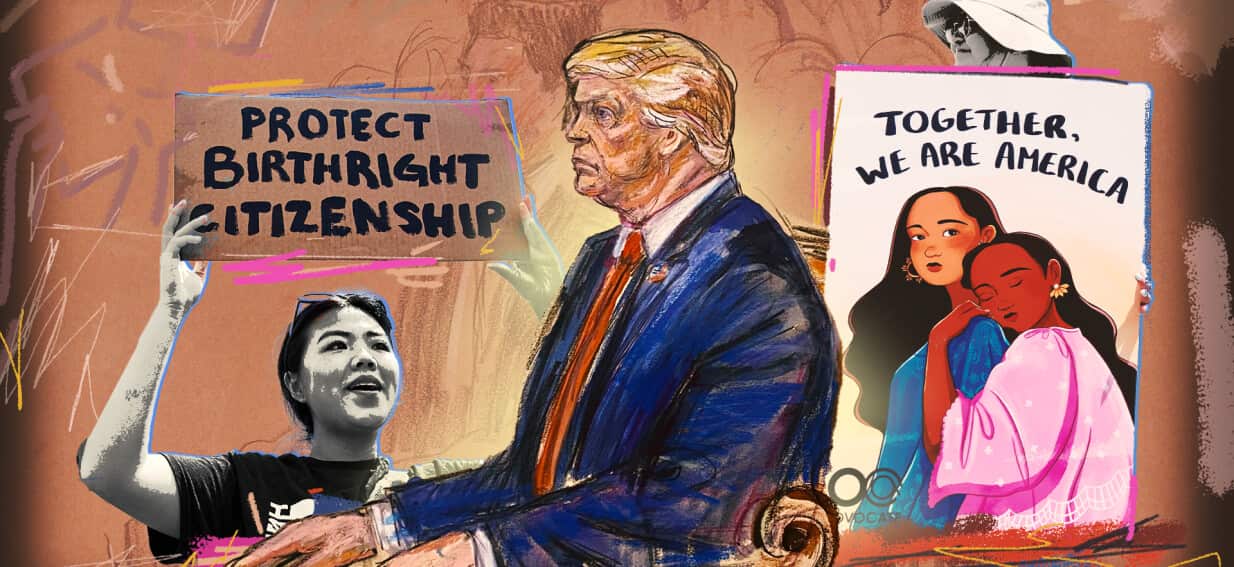
The executive pen has its limits. Donald Trump found that out the hard way when the Supreme Court delivered a crushing blow to his signature immigration agenda. By a 6-3 vote, the highest court in the land completely dismantled his Day 1 executive order that aimed to end birthright citizenship for children born to undocumented immigrants and temporary visa holders.
It's a massive defeat for the administration. For months, the White House argued that a president could simply override more than a century of settled legal tradition with a single stroke of a pen. The justices didn't buy it. Instead, they reaffirmed a fundamental American rule. If you're born on U.S. soil, you're an American citizen. Period.
The legal showdown in Trump v. Barbara wasn't just a dry debate over constitutional text. It was a high-stakes battle over the very definition of American identity, affecting hundreds of thousands of families nationwide. By keeping the status quo, the court stopped what advocates warned would be immediate chaos inside hospitals, vital records offices, and immigrant communities.
Why the Law Protects Birthright Citizenship
The administration's legal strategy rested on a highly creative interpretation of the Fourteenth Amendment. Ratified in 1868 during the Reconstruction era, the amendment states that all persons born or naturalized in the United States, and "subject to the jurisdiction thereof," are citizens.
Government lawyers tried to argue that children of undocumented immigrants or tourists aren't truly subject to U.S. jurisdiction. Their logic? Because their parents owe political allegiance to a foreign nation, the children shouldn't get automatic citizenship.
It's an argument that completely ignores history.
Chief Justice John Roberts dismantled this theory in the majority opinion. He rooted the ruling deeply in English common law, which relied on the concept of jus soli—the right of the soil. When the framers of the Fourteenth Amendment drafted that language, they were explicitly trying to overturn the horrific 1807 Dred Scott decision. Dred Scott had wrongfully declared that citizenship depended on bloodlines rather than geography.
The Fourteenth Amendment flipped that script. It made geography the ultimate equalizer.
We've actually been through this exact fight before. In 1898, the Supreme Court ruled on United States v. Wong Kim Ark. That landmark case involved a man born in San Francisco to Chinese immigrant parents who were permanent residents. The court ruled back then that he was a citizen at birth. The Trump administration tried to claim the Wong Kim Ark case only applied because his parents were permanent residents, not temporary visitors or undocumented workers. The court saw right through that distinction. The term "domicile" isn't in the amendment. The text is plain, clear, and absolute.
The Unexpected Judicial Alliance That Sunk the Order
If the White House expected its judicial appointees to fall in line, it miscalculated badly. The voting breakdown shows a fascinating dynamic within the court's conservative wing.
Chief Justice Roberts led the majority. He was joined on constitutional grounds by the three liberal justices—Sonia Sotomayor, Elena Kagan, and Ketanji Brown Jackson—along side conservative Justice Amy Coney Barrett. That made five votes explicitly declaring the executive order unconstitutional under the Fourteenth Amendment.
Justice Brett Kavanaugh provided the crucial sixth vote to strike down the order, though he took a slightly different path. Kavanaugh didn't want to rule directly on the constitutional question. Instead, he concluded that the executive order directly violated a 1940 federal statute where Congress explicitly codified birthright citizenship into immigration law.
Kavanaugh wrote that regardless of what the Constitution allows, a president cannot run roughshod over laws passed by Congress. If the law says these children are citizens, the president must enforce it. He cannot rewrite federal statutes by decree.
Only Justices Clarence Thomas, Samuel Alito, and Neil Gorsuch dissented. They favored a much narrower view of jurisdiction, arguing the court should have allowed the administration's policy to take effect while a longer legislative debate played out. But their view was soundly defeated. The cross-ideological majority proved that on fundamental constitutional guardrails, institutional rules still trump partisan loyalty.
The Massive Human Toll Left in the Wake of the Fight
Let's look at what would have happened if Trump had won this case. The implications are staggering.
Data from the Migration Policy Institute reveals that roughly 255,000 children are born each year in the U.S. to non-citizen parents. Under the administration's proposed rule, these babies would have been stripped of legal status the moment they drew their first breath.
Think about the immediate practical nightmare that creates.
- Statelessness: Many of these children would not automatically qualify for citizenship in their parents' home countries. They would effectively belong nowhere. They would have no passports, no legal identity, and no state protection anywhere on Earth.
- The Documentation Trap: How do you prove your newborn is a citizen if a standard hospital birth certificate is no longer enough? Older Americans would suddenly face insane bureaucratic hurdles just to prove their own status, forcing regular working people to hunt down decades-old parental immigration records just to get a passport or a driver's license.
- Healthcare and Economic Shock: Denying citizenship means denying access to basic pediatric care, early-life nutrition programs, and public school enrollment down the line. It would have created a massive, permanent underclass of residents living completely in the shadows.
For over a year, immigrant families lived under a cloud of intense anxiety. The American Civil Liberties Union and a broad coalition of civil rights groups filed a massive nationwide class-action lawsuit, Barbara v. Donald J. Trump, right after a messy legal battle in 2025 over localized court injunctions. That class-action suit is what kept the policy blocked nationwide until the Supreme Court could finally put a permanent stake through its heart.
The Fight Shifts to Capitol Hill
Don't expect the administration to just give up and move on. Within minutes of the decision being handed down, Trump took to his Truth Social platform to vent his frustration. He labeled the decision "too bad" but immediately pointed toward his next battleground.
He's now calling on Congress to pass legislation to end birthright citizenship.
This shifts the entire battlefield from executive overreach to legislative warfare. Because Justice Kavanaugh noted that Congress has the power to alter the federal citizenship statutes, conservative lawmakers are already drafting bills to test that exact theory.
Taking this route will be an uphill battle. Passing a law through a deeply divided Congress is vastly more difficult than signing an executive order in the Oval Office. It requires building majorities, surviving filibusters, and horse-trading votes. Even if a future Congress did manage to pass a law restricting citizenship for children of undocumented immigrants, it would immediately trigger a brand-new round of constitutional challenges. The court's majority today strongly hinted that the Fourteenth Amendment itself protects these children, meaning even a congressional law might face the exact same fate.
To completely rewrite the rules of American citizenship, opponents would likely need a full constitutional amendment. That requires a two-thirds majority vote in both the House and the Senate, followed by ratification from 38 states. In today's hyper-polarized political environment, achieving that level of consensus is virtually impossible.
Your Next Steps in a Changing Legal Landscape
The Supreme Court cleared the air, but navigating immigration policy remains incredibly complicated. If you or your family are trying to secure status or understand how these shifting legal winds affect your household, standing on the sidelines isn't an option.
First, ensure all birth records and vital statistics for your children are perfectly documented and filed with your local state registrar. A U.S. birth certificate remains the gold-standard proof of citizenship.
Second, don't rely on social media rumors or political speeches for legal advice. Talk to a licensed immigration attorney who understands the fallout of the Trump v. Barbara ruling.
Finally, keep a close eye on Congress. The executive order is dead, but the legislative fight is just beginning. Stay informed, know your rights, and make sure your paperwork is completely ironclad.