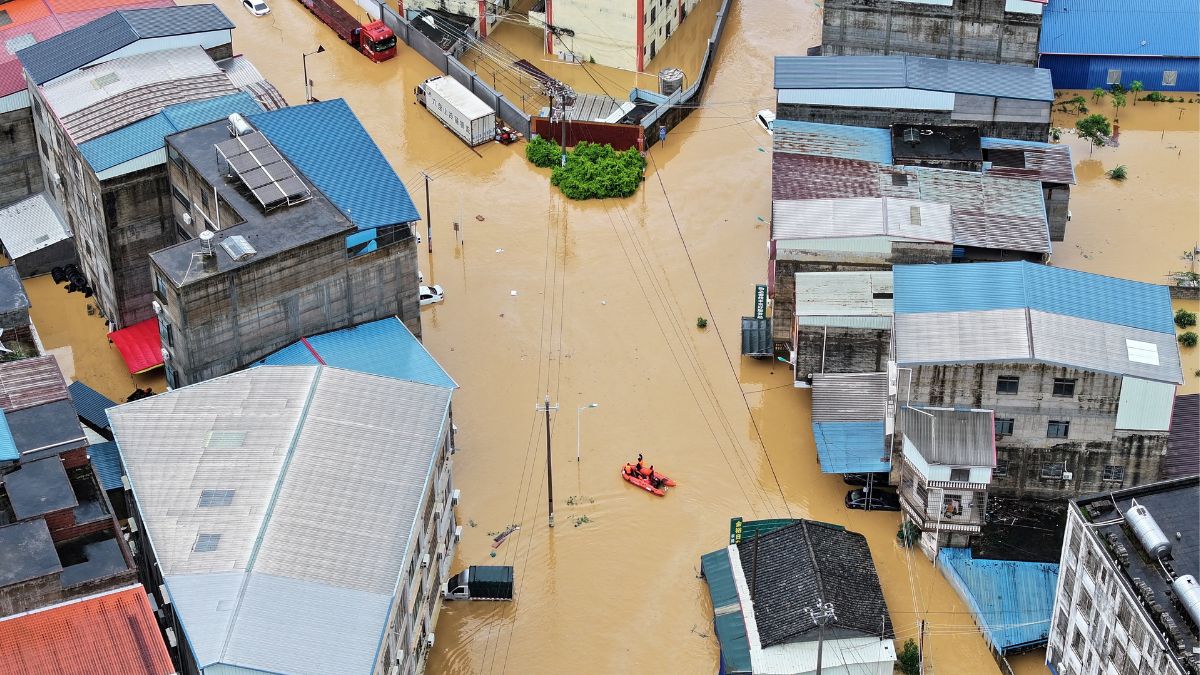
Typhoon Maysak didn't just bring rain. It brought a wall of water that shattered infrastructure, collapsed ancient and modern dams, and left a trail of destruction that caught authorities entirely off guard. Over fifteen people are confirmed dead, with thousands displaced as torrential floods continue to rip through towns and cities across southern and central China.
The storm made landfall first in Hainan before crossing into Vietnam and turning inward toward the Guangxi Zhuang Autonomous Region. By the time it transitioned into a tropical depression, it had sucked up massive volumes of water from the South China Sea. It dumped that payload directly over major population centers, causing unprecedented emergencies. For an alternative view, see: this related article.
The real story isn't just the wind speed or the rainfall totals. It's the sudden, cascading failure of critical water infrastructure that turned a predictable weather event into a humanitarian crisis.
The Night the Infrastructure Broke
When Maysak moved inland, the sheer volume of precipitation overwhelmed systems that had already been softened by seasonal rains. In Guangxi's capital city, Nanning, officials quickly upgraded their flood emergency response to Level I. It didn't take long to see why. Further coverage on this trend has been published by Reuters.
The Liulan Reservoir in Hengzhou, a mid-sized reservoir built back in 1960 that holds over 95 million cubic meters of water, suffered a massive structural failure. The water level surged to 111.2 meters, nearly a full meter above its maximum designed flood limit. The pressure created a massive 50-meter gap in the dam wall.
A wall of brown, muddy water tore down the valley, swallowing telephone poles, submerging entire villages, and forcing residents onto rooftops to await rescue. It wasn't an isolated incident. The Yunbiao Reservoir overtopped simultaneously, creating a multi-front emergency that left local rescue teams scrambling.
Further north in central China's Hubei Province, the storm system collided with local atmospheric conditions to produce brutal, convective weather. Thunderstorms, heavy gales, and actual tornadoes ripped through the cities of Huanggang, Huangshi, Ezhou, and Xianning. Eight people lost their lives in Hubei in a matter of hours as structures collapsed and flash floods swept through urban streets.
The Cities Swallowed by the Torrent
In Guigang, about 170 miles from Nanning, the Yujiang River rose to terrifying heights. The local hydrological station recorded water levels hitting 42 meters, eventually forecast to peak well above the official warning threshold by more than six meters.
Videos shared by locals on platforms like Douyin showed standard multi-lane city streets transformed into rushing, brown rivers. Cars were fully submerged, with torrents cascading down hillsides into active building construction sites.
In coastal Fangchenggang, the situation was identical. Drivers abandoned their vehicles as floodwaters rose to steering-wheel height. Local residents noted that they hadn't seen water levels this high in over twenty years.
Beyond the Immediate Devastation
While southern and central regions drown, northern China is fighting its own battle against volatile weather. Flash floods in Inner Mongolia and heavy downpours in Liaoning province have already claimed five lives, proving that the country's climate pressures are hitting multiple fronts simultaneously.
Worse, the ground across Guangxi and Guangdong is completely saturated. There's nowhere for any additional water to go. This makes the upcoming forecast incredibly dangerous, as meteorologists track Super Typhoon Bavi moving across the Pacific toward eastern China.
Survival Steps for Flooded Zones
If you're currently in or near the affected provinces, the danger doesn't pass when the rain stops. Saturated soil means landslide risks remain critical for days.
- Avoid standing water entirely. Floodwaters in urban areas are heavily contaminated with industrial runoff, raw sewage, and hidden electrical hazards from downed lines.
- Prep for mold immediately. Saturated walls and floors will breed toxic mold within 24 to 48 hours. When returning to properties, use protective gloves and KN95 masks to clear out wet drywall, carpets, and insulation.
- Track the secondary systems. Don't assume the weather is clearing. Monitor local bulletins for updates on Super Typhoon Bavi, which is expected to impact eastern regions later this week.