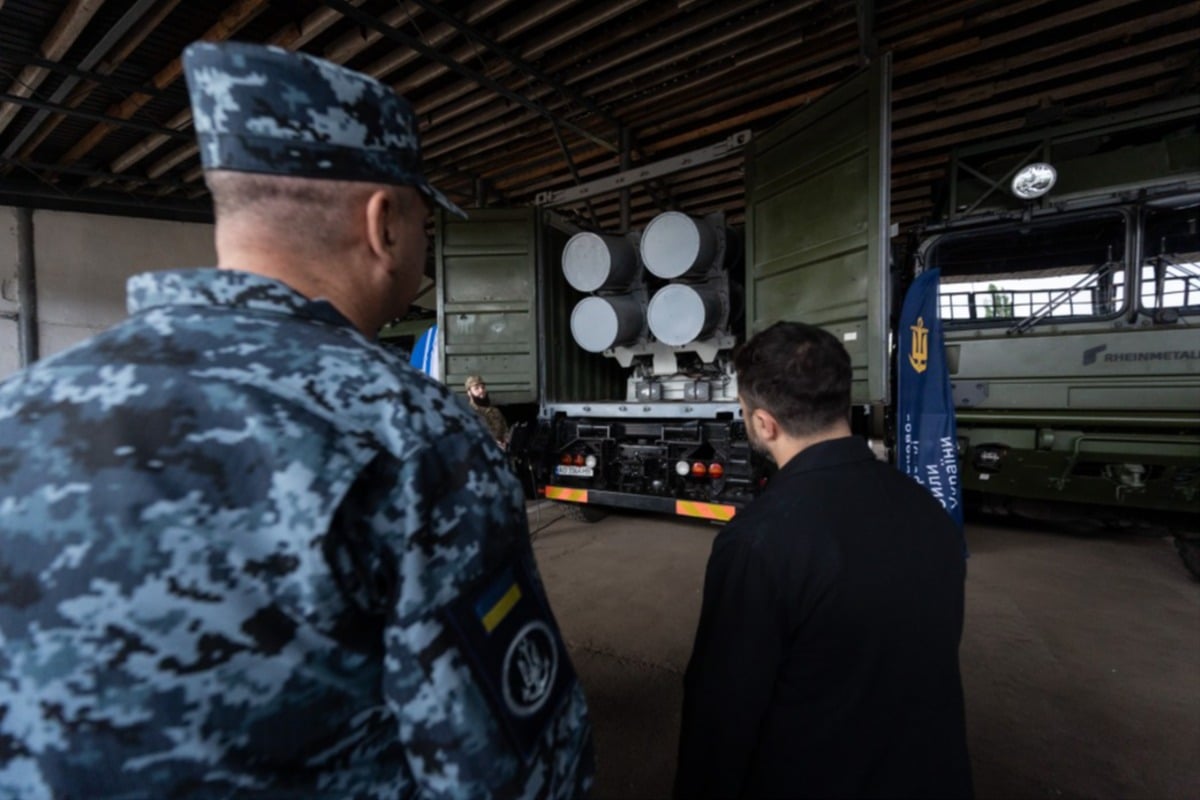
Military secrets usually decay quickly in modern warfare. Persistent drone surveillance and satellite constellations mean you can rarely park a multi-million dollar asset anywhere without someone noticing. Yet, the Ukrainian Navy managed to pull off a masterclass in operational security, hiding a Western-supplied mobile coastal defense platform right under the Kremlin's nose for years.
During a presidential visit to the Odesa region, official photographs finally confirmed what naval analysts had whispered about for months. Parked alongside Ukraine's domestic Neptune launchers stood a mobile launcher for the Naval Strike Missile (NSM), a stealthy fifth-generation anti-ship weapon developed by Norway's Kongsberg Defence & Aerospace. Don't forget to check out our earlier article on this related article.
The internet immediately started buzzing, but the real story isn't just that Ukraine has the missile. It's how they modified it, how they hid it, and why they chose this exact moment to let the world see it.
The Secret Deliveries Nobody Addressed
Back in mid-2022, rumors circulated that Washington was looking into sending either Harpoon or NSM platforms to break the Russian blockade in the Black Sea. Later, Polish media dropped hints that Kyiv was negotiating to buy components of Poland's own coastal missile units. To read more about the context here, The Guardian offers an in-depth summary.
Then, total silence.
The assumption was that the talks fell through or that the hardware never arrived. Instead, the newly released images show a weapon system that has been integrated quietly into Ukraine's coastal defense network.
The giveaway is the launcher's configuration. Unlike the Polish military's version, which rides on a specialized, heavily camouflaged Jelcz chassis, the Ukrainian variant is painted a flat, solid military green. Even more telling, it's mounted on a standard commercial-style truck fitted with a multilift hook-lift system.
This choice isn't accidental. By putting a high-end Western strike asset on a generic logistics chassis, Ukraine didn't just save money; they built a system that looks identical to a standard supply truck from an overhead drone feed.
Why the NSM Changes the Black Sea Dynamic
The R-360 Neptune missile earned its place in history by sending the Russian cruiser Moskva to the bottom of the sea. But the Neptune is a legacy subsonic design derived from Soviet architecture. The NSM is a completely different beast.
Weighing just over 400 kilograms with a 120-kilogram penetrating warhead, the NSM is explicitly designed to bypass modern air defense networks.
$$Range \approx 185\text{ km } (100\text{ nautical miles})$$
It hits target ships by sea-skimming at high subsonic speeds. What makes it terrifying for ship captains isn't raw speed—it's the guidance system. While older anti-ship missiles turn on a bright, loud active radar seeker that screams "incoming" to an enemy's electronic warfare suite, the NSM stays completely passive.
During its final run, the missile uses an Imaging Infrared (IIR) seeker. It looks at the target visually, comparing the ship's thermal signature against an onboard database. It doesn't just aim for the middle of the ship; it autonomously selects the most vulnerable spot—like the command bridge or the ammunition magazine—and strikes with pinpoint precision.
The Strategic Shift Behind the Reveal
Why show the weapon now after keeping it dark for so long?
The Russian Navy's Black Sea Fleet has already been largely forced out of Sevastopol, retreating eastward to Novorossiysk after sustaining relentless losses from Ukrainian sea drones and cruise missiles. By publicly displaying the NSM capability alongside the extended-range "Long Neptune" variants, Ukraine sends a clear message to Moscow: any attempt by Russian surface vessels to creep back into the western Black Sea will face a lethal, multi-layered gauntlet.
Furthermore, the NSM has a built-in land-attack mode. Using GPS updates and terrain reference navigation, these hidden mobile trucks can target coastal radar stations, electronic warfare nodes, or fortified positions along the Crimean coastline.
Your Next Steps for Tracking the Naval War
If you want to keep tabs on how this development alters the naval balance in Eastern Europe, skip the generalized mainstream news cycles.
- Monitor independent open-source intelligence (OSINT) platforms like Militarnyi and Covert Shores for satellite imagery showing changes in Russian naval deployments around Novorossiysk.
- Watch for official updates from Kongsberg Defence & Aerospace or the Ukrainian Ministry of Defense regarding further Western parts integration.
- Track naval exercises in neighboring Romania and Bulgaria to see how NATO's regional coastal defense infrastructure aligns with Ukraine's newly revealed capabilities.