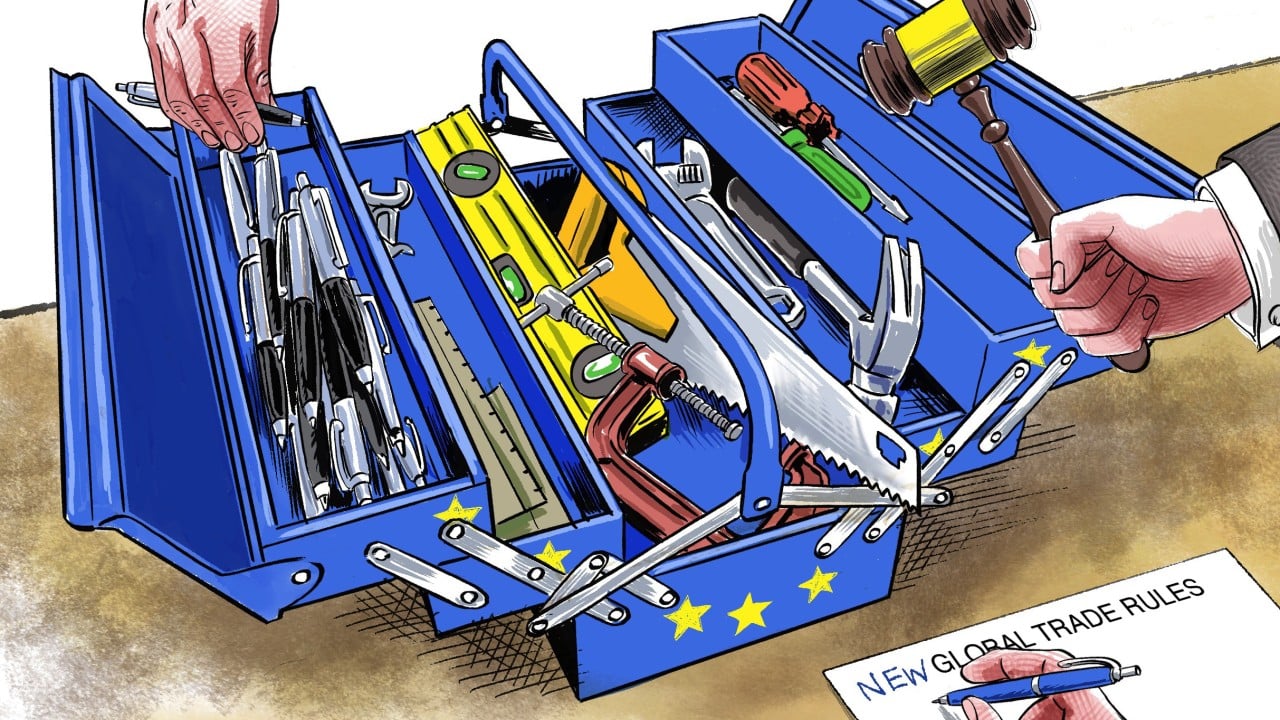
The old rules of global trade are dead, and the Western nations that wrote them are the ones holding the smoking gun. For decades, Washington and Brussels preached the gospel of free markets, open borders, and the borderless efficiency of the World Trade Organization. They told developing economies that state intervention was a relic of the past.
Then China won the game using a different rulebook.
Now, an anxious coalition of Western governments is trying to tear up the old agreement and draft a replacement. They call it de-risking, friend-shoring, and protecting economic security. Strip away the diplomatic jargon, though, and it's a desperate scramble to erect trade barriers fast enough to stop Chinese industrial dominance from wiping out domestic manufacturing. You see it in the 100% tariffs Washington slapped on Chinese electric vehicles. You see it in the European Union's aggressive anti-subsidy probes and carbon border taxes.
The Western world is discovering that rewriting the rules of global commerce is far harder than running a protectionist playbook. Trade flows don't change overnight just because a politician signs an executive order. The infrastructure of global production is too deeply entrenched.
The Sudden Shift Away From Free Markets
For thirty years, the global economic consensus was simple. Build your factories wherever labor is cheapest, ship components across continents without friction, and let consumers enjoy cheap goods. Western corporate headquarters focused on design, marketing, and software, while outsourcing the messy, capital-intensive work of actual manufacturing to Asia. This worked brilliantly for corporate profit margins. It worked less well for Western industrial towns, which watched their economic foundations hollow out.
China didn't just become a giant sweatshop for cheap plastic toys. Beijing treated manufacturing as a core national security priority. Through decades of coordinated state investment, cheap land grants, state-directed bank loans, and massive infrastructure spending, China built an unassailable ecosystem of suppliers.
When the West suddenly realized that China controlled over 70% of global lithium-ion battery production, 80% of solar manufacturing steps, and a massive chunk of the world's refined critical minerals, the panic set in. The response wasn't to out-compete China on factory efficiency. It was to change what counts as fair play.
The United States led the charge by effectively crippling the World Trade Organization's appellate body, refusing to appoint new judges. Without a functioning court, the global trade referee became toothless. This wasn't an accident. It allowed Washington to unilaterally deploy Section 301 tariffs and massive domestic subsidies like the Inflation Reduction Act without worrying about international legal blowback. The EU followed suit, deploying its Foreign Subsidies Regulation to investigate Chinese companies bidding on European infrastructure projects.
The irony is thick enough to choke on. The very nations that built the rules-based international order now view those rules as a geopolitical straitjacket.
Why Tariffs Alone Failed to Stop the Factory of the World
If you look at the raw trade data, the Western attempt to wall off China looks like a massive success on paper. Direct imports of Chinese goods into the US fell significantly after the tariff waves of the late 2010s and early 2020s. Mexican and Vietnamese exports to the US surged to fill the gap. Politicians gave victory speeches, claiming they were bringing supply chains back home or at least to friendly neighbors.
It was mostly an illusion.
What actually happened wasn't a decoupling of supply chains, but a lengthening of them. Chinese component manufacturers didn't go out of business. They simply shipped their parts to Vietnam, Malaysia, or Mexico, where workers did the final assembly before sending the finished product to Western ports. Economists call this transshipment, but you can think of it as commercial laundering.
A study by the Bank for International Settlements tracked these shifting trade networks. They found that even though the US bought fewer direct goods from China, the supply chains became more complex, more expensive, and ultimately remained reliant on Chinese inputs. A Mexican auto part factory supplying Detroit still buys its steel, its electronic components, and its specialized machinery from Chinese vendors.
By adding extra links to the chain, Western trade policies didn't break the reliance on Chinese industry. They just made the final products more expensive for ordinary consumers. You're paying a premium for the exact same supply chain, just routed through a third country to dodge a tariff code.
The National Security Excuse and the New Economic Bloc
To justify this retreat from free trade, Western policymakers had to invent a new vocabulary. The primary tool is the weaponization of national security. Under classic trade rules, you could only restrict imports during wartime or severe geopolitical crises. Today, everything from legacy microchips in a washing machine to the battery cells in an electric delivery van is classified as a critical security threat.
Washington's export controls on advanced semiconductors are a prime example. By cutting off Chinese firms from Dutch lithography machines and American software, the US sought to freeze China's domestic technology sector in place. The argument is that these chips power the next generation of military hardware and artificial intelligence.
This strategy ignores the reality of retaliatory economics. Beijing didn't capitulate. Instead, the Chinese government poured hundreds of billions of dollars into its own domestic semiconductor supply chain. Firms like Huawei and SMIC developed workarounds, engineering their way through limitations to produce competitive hardware.
Meanwhile, China turned around and restricted its own exports of critical materials like gallium, germanium, and graphite. These aren't household names, but you can't build defense systems, radar equipment, or high-performance electric vehicle batteries without them. The West lacks the refining capacity to replace these inputs quickly. Setting up a new rare earth processing facility takes a decade of environmental permits, capital expenditure, and technical training. You can't fix a twenty-year structural deficit with a press release.
What Happens Next for Global Supply Chains
The dream of a clean economic break between the West and China is a fantasy. Corporate boards know this, even if politicians refuse to admit it publicly. If your company relies on global manufacturing, navigating this messy transition requires a cold, unsentimental strategy.
First, stop treating friend-shoring as a magic bullet. Moving your final assembly line to India or Poland doesn't insulate you from geopolitical risk if your Tier 2 and Tier 3 suppliers are still based in Shenzhen. You need deep visibility into your supply network. Trace every sub-component back to the raw material stage. If a critical component relies on a single Chinese processing plant, you're exposed, regardless of where your final warehouse sits.
Second, prepare for a bifurcated global market. We're heading toward a world with two separate technological and industrial ecosystems. One will serve the US, Europe, and their immediate allies, built on higher-cost, heavily subsidized local supply chains. The other will serve China, Southeast Asia, Africa, and Latin America, utilizing highly optimized, cheaper Chinese components. Companies will have to choose whether to run parallel supply chains—one for the West and one for the rest of the world—or accept lower margins to comply with Western protectionism.
Third, factor the cost of compliance directly into your product development cycles. The EU's Carbon Border Adjustment Mechanism is a preview of the future. It forces companies importing steel, aluminum, and electricity into Europe to pay a tax equivalent to the carbon cost of domestic production. It's a tariff wrapped in green tissue paper. Managing these regulatory hurdles is going to require as much engineering talent as building the actual products.
Get used to the friction. The era of frictionless, hyper-efficient global trade isn't coming back. The West is going to keep changing the rules of the game every time it loses a round, and businesses that fail to build resilience into their core operations are going to get caught in the crossfire.