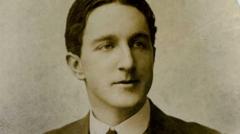
When a soldier dies in captivity, a family expects their body to return intact, or at least to rest with dignity under a headstone. You don't expect their organs to be quietly harvested by enemy scientists, turned into laboratory slides, and used for medical research for the next seven decades.
Yet that is exactly what happened to Private Donald Macrae and at least four other British servicemen.
For nearly 85 years, the family of Donald Macrae believed he was resting peacefully in a military cemetery in Berlin. He was a young Scottish soldier who died in 1941 while being held as a prisoner of war. But back home in the UK, his relatives had no idea that a dark piece of wartime medical exploitation had left his body incomplete.
The truth came out only recently because of deep archival digging by historians. German researchers didn't just bury these men; they took their brains and spinal cords, sliced them into thin sections, and kept using them for scientific papers well into the 21st century.
Anatomy of a Wartime Crime
Between March and December of 1941, five British prisoners of war lost their lives in German captivity. Their names were Donald Macrae, Patrick O'Connell, Donald McPhail, Joseph Elston, and William Lancaster.
They died in prisoner-of-war camp hospitals. Under Article 76 of the 1929 Geneva Convention, which Germany had signed, prisoners who died in captivity were supposed to receive an honorable burial. Their graves were supposed to be respected and properly marked.
The Nazi medical machine didn't care about the Geneva Convention.
When these five men died, German military pathologists performed autopsies under the guise of investigating "unusual deaths". Instead of just determining a cause of death, they removed the men's brains and spinal cords. These organs weren't studied briefly and buried. They were packed up and shipped directly to elite neuropathological research institutes in Munich and Berlin.
The institutions involved weren't rogue back-alley operations. They were the Kaiser Wilhelm Institutes, the highly prestigious predecessors to modern Germany's Max Planck Institutes.
The Neurologists Who Exploited the Dead
The tissue samples landed on the desks of Julius Hallervorden and Hugo Spatz, two of the most prominent neuropathologists of the era.
[Historical Context Note]
Hallervorden and Spatz are infamous in medical history. They built their careers heavily on analyzing the brains of victims murdered under the Nazi regime's euthanasia programs, which targeted disabled and sick individuals.
When Allied soldiers died in captivity, these doctors saw a fresh supply of research material. They estimated that around 2,000 brains taken from victims of the Nazi regime passed through their research networks. The British prisoners were simply absorbed into this massive, unethical testing engine.
The scientists turned Donald Macrae's nervous system into microscopic slides. They wanted to study the physical trauma of war, blast injuries, and neurological conditions. They did so without anyone's consent, violating every standard of medical ethics.
The Decades of Cover-Ups
You might think that after Germany fell in 1945, these samples were discovered, flagged, and buried with the soldiers. They weren't.
The slides remained in German scientific collections for decades after the war ended. They became part of the standard research infrastructure of post-war West Germany. Generations of scientists looked through microscopes at the brains of dead British soldiers without questioning where they came from or who they belonged to.
By the 1980s and 1990s, a wave of historical reckoning hit German institutions. Activists and ethical committees began looking into the origins of human tissue collections. The discovery of thousands of brain slides from the Nazi era caused massive panic inside the scientific community.
Instead of carefully identifying the victims and contacting their nations or families, some institutions panicked. They chose a fast, quiet exit.
Thousands of historic glass slides containing human brain tissue were quietly rounded up and buried en masse in anonymous plots. It was an unethical purge designed to sweep a historical scandal under the rug, leaving thousands of victims forever nameless.
But Donald Macrae's slides survived that purge.
Because his samples were deemed to have "special scientific interest," researchers kept them out of the mass graves. They preserved his brain and spinal cord tissue for active use. Shockingly, scientists at the Max Planck Institute continued to use the remains of this World War Two soldier for research until 2015.
How the Truth Came Out
The silence finally broke because of the work of Paul Weindling, a professor of medical history at Oxford Brookes University. Weindling and his team spent years painstakingly cross-referencing old German laboratory logs, patient records, and military archives.
They managed to match the anonymous scientific serial numbers on the glass slides back to the real names of the British soldiers.
In 2020, Weindling made a phone call to Libby Macrae, Donald’s niece. She knew her uncle had died during the war, but she had absolutely no idea about the macabre journey his remains had taken.
The revelation forced a direct confrontation with the Max Planck Institute. The institute co-operated, acknowledging the dark heritage of the samples. The Commonwealth War Graves Commission stepped in to handle the delicate logistics of repatriation and reburial.
Reassembling a Soldier 85 Years Later
Now, 85 years after his death, Donald Macrae's brain and spinal cord samples are finally leaving the laboratory drawers of Germany.
The Commonwealth War Graves Commission has taken custody of the surviving slides from the Max Planck Institute. They are transporting them to the Berlin South-Western Cemetery, where Private Macrae's body was laid to rest decades ago.
This isn't a typical military funeral. It's a somber, highly unusual act of biological restitution. The pieces of his body used for science are being placed into the earth to join the rest of his remains, finally making his grave whole.
The case exposes a massive flaw in how we think about wartime casualties. We track dog tags, we log names on stone walls, and we build monuments. But we rarely look inside the medical archives to see if our soldiers were truly laid to rest, or if pieces of them are still cataloged in foreign filing cabinets.
The investigation into these collections isn't finished. Thousands of slides from various nationalities remain unaccounted for in archives across Europe. For the families of Patrick O'Connell, Donald McPhail, Joseph Elston, and William Lancaster, the push for clarity continues as historians trace what remains of their loved ones.
If you want to know what happened to these men, listen to the full investigation on the BBC Radio 4 documentary Shadow of War: A Tainted Anatomy, presented by Professor Lady Sue Black, which blows the lid clean off this hidden chapter of military and medical history.

