Ankara is a pressure cooker right now. The ongoing NATO summit in Turkey is not just another scripted photo-op for world leaders to smile and nod. It is a desperate, high-stakes collision between a Ukrainian president running out of ammunition and an unpredictable American president who thinks he can end a four-year war with a single phone call.
Volodymyr Zelensky arrived in Turkey with a brutal reality check for the alliance. Kyiv is defenseless against Russian ballistic missiles because American stockpiles are empty. This is not hyperbole. It is the direct consequence of Washington shifting its military focus to the Middle East earlier this spring. Read more on a connected subject: this related article.
The main issue here is pretty simple. Zelensky needs air defense interceptors immediately. Donald Trump wants a quick diplomatic exit. The two men are scheduled to sit down on Wednesday afternoon for a high-stakes meeting that could decide the trajectory of European security for the next decade. If you want to understand what is actually happening behind the closed doors in Ankara, you have to look at the math, the missiles, and the domestic politics driving both sides.
The Empty Stockpile Crisis
On Monday morning, Russia fired 23 ballistic missiles straight into the heart of Kyiv. Fifteen people died. Residential blocks shattered into dust. The most horrifying part of this attack was that Ukraine basically could not fight back. Their American-supplied Patriot batteries sat completely silent because they had no missiles left to load. More journalism by TIME explores related views on the subject.
How did a superpower ally run out of ammo? Look at Washington. The American military spent the spring of 2026 burning through its own interceptor stockpiles during the brief, intense war with Iran. Pentagon officials quietly redirected shipments of Patriot PAC-3 missiles away from Eastern Europe to protect American bases and naval assets in the Middle East.
Ukraine is paying the price for that pivot. Zelensky is being blunt about it. He told the summit crowd that it is painful to watch empty launchers while Russian missiles rain down. He is right.
Western defense production lines are simply too slow. The United States cannot protect its own interests in the Gulf and supply a massive land war in Europe at the same time. This supply crunch has exposed a massive vulnerability that Moscow is exploiting every single day.
What Trump Gets Wrong About the Deal
Trump is telling everyone who will listen that a peace deal is just around the corner. He spent nearly 90 minutes on the phone with Vladimir Putin just days ago. He emerged from that call claiming that both sides are exhausted and ready to sign a contract.
"I think we're getting much closer than people realize," Trump told reporters in the Oval Office right before flying to Turkey.
That view is dangerous. It assumes Putin is operating in good faith. It also ignores the reality on the ground. Russia launched over 8,300 munitions at Ukrainian targets in May alone. That is not the behavior of a government looking for an off-ramp. Putin is pressing his advantage because he knows the Western political will is fracturing.
Trump wants a quick win to satisfy his base and cut American spending. His advisors, including Defense Secretary Pete Hegseth, are already ordering a top-to-bottom review of American troop deployments across Europe. They are openly scolding NATO allies for failing to back the U.S. during the Iran crisis. Trump is treating European security like a bad business deal where the U.S. gets ripped off.
Zelensky knows this. His strategy for the Wednesday meeting is not to beg for charity. He is trying to frame Ukraine as a necessary asset for the West, not a financial burden.
The Strategic Rear Is Dead
To convince Trump that Ukraine is worth the investment, Zelensky is showing off Kyiv's own long-range military successes. Ukraine is no longer just a passive recipient of hardware. They have built an incredibly efficient domestic drone industry completely independent of Western restrictions.
Just this week, Ukrainian long-range strike drones flew 1,680 miles deep into Russian territory to blow up a massive oil refinery in Omsk, Siberia. Think about that distance. That is roughly the distance from New York to Denver.
Kyiv has effectively crippled about 20 percent of Russia's total oil-refining capacity. They have neutralized the traditional advantage of Russian geography.
"We have completely eliminated the very idea of Russia having a strategic rear," Zelensky announced at the NATO defense industry forum.
The military reality has shifted dramatically. While Ukraine can knock out 90 percent of incoming Iranian-designed Shahed drones using cheap, domestic tech, they are still utterly dependent on the West for high-altitude anti-ballistic defenses. Zelensky is trying to show Trump that Ukraine is doing the heavy lifting on the ground, but they need the American umbrella to keep the lights on while they do it.
Europe Needs to Grow Up
The real audience for Zelensky's anger might actually be Berlin, Paris, and London rather than Washington. The reliance on American defense manufacturing is a glaring flaw in European security. European leaders have spent decades outsourcing their defense production to American factories. Now that America is distracted by its own geopolitical fires, Europe is caught flat-footed.
Zelensky issued a direct challenge to the European continent. He stated that Europe urgently needs its own autonomous factories to build anti-ballistic missile systems from scratch. Relying on Washington for every single Patriot interceptor is a losing strategy when the American electorate is turning inward.
NATO's new Secretary General, Mark Rutte, tried to put a positive spin on things by announcing a $40 billion investment in counter-drone tech and high-altitude surveillance planes like the SAAB GlobalEye. Alliance members are also talking about guaranteeing a €70 billion annual military fund for Ukraine through 2027.
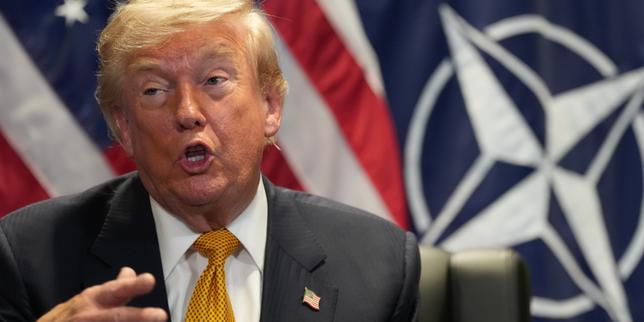
But promises on paper do not stop a ballistic missile today. Trump remains intensely skeptical of these multi-billion dollar plans. He openly told reporters in Ankara that he is still deeply disappointed by NATO's lack of cooperation during recent American operations. He even muttered that he might not have shown up to the summit at all if his ally, Turkish President Recep Tayyip Erdogan, had not been the host.
The Real Cost of Indecision
The current policy of slow-walking advanced weapons while debating peace terms is causing real catastrophe. The Western alliance is caught between two bad choices. They can either fully arm Ukraine to match Russian ballistic capabilities, or they can force Zelensky into a premature ceasefire that leaves Moscow holding vast swaths of captured territory.
Trump thinks he can split the difference. He believes his personal chemistry with both leaders can forge a magical middle ground. But a frozen conflict just gives Putin time to rebuild his conventional forces, learn from his tactical mistakes, and prepare for the next offensive.
If Europe wants to survive the Trump presidency without losing its eastern flank, it has to stop waiting for permission from the White House. European nations must instantly shift their industrial sectors into a wartime footing. They need to fund domestic anti-ballistic missile development right now. Zelensky's warning in Ankara should serve as a wake-up call for every capital from Warsaw to Madrid. The American security blanket is officially fraying, and the sky is still falling.
European defense ministers must take immediate action. Bypass the slow bureaucracy of joint NATO committees. Sign direct bilateral production contracts with defense tech firms to manufacture interceptor alternatives on European soil immediately. Allocate the newly agreed 3.5% GDP defense spending targets directly to missile assembly lines rather than long-term research projects. Open immediate logistical corridors to transfer any remaining active European air defense systems directly to the Ukrainian border before the winter bombardment begins.
Zelensky and NATO Chief Address Press
This video provides a direct, unedited look at the joint press briefing in Ankara where the immediate military needs of Ukraine and the defense spending friction with the U.S. administration were laid out in detail.